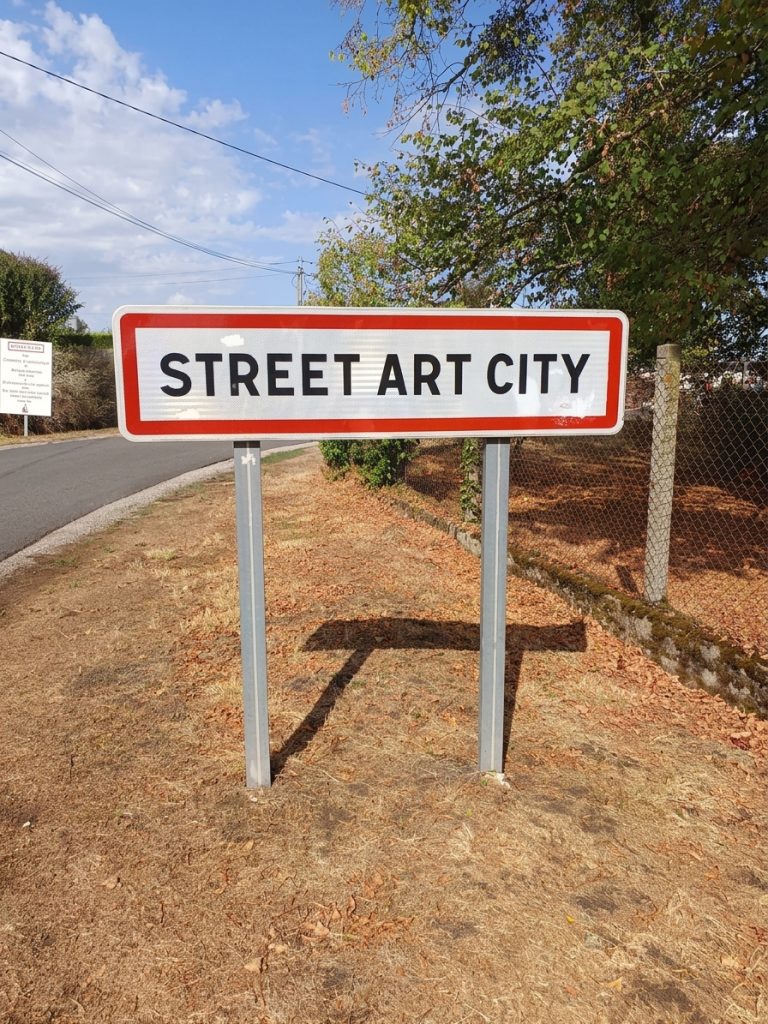
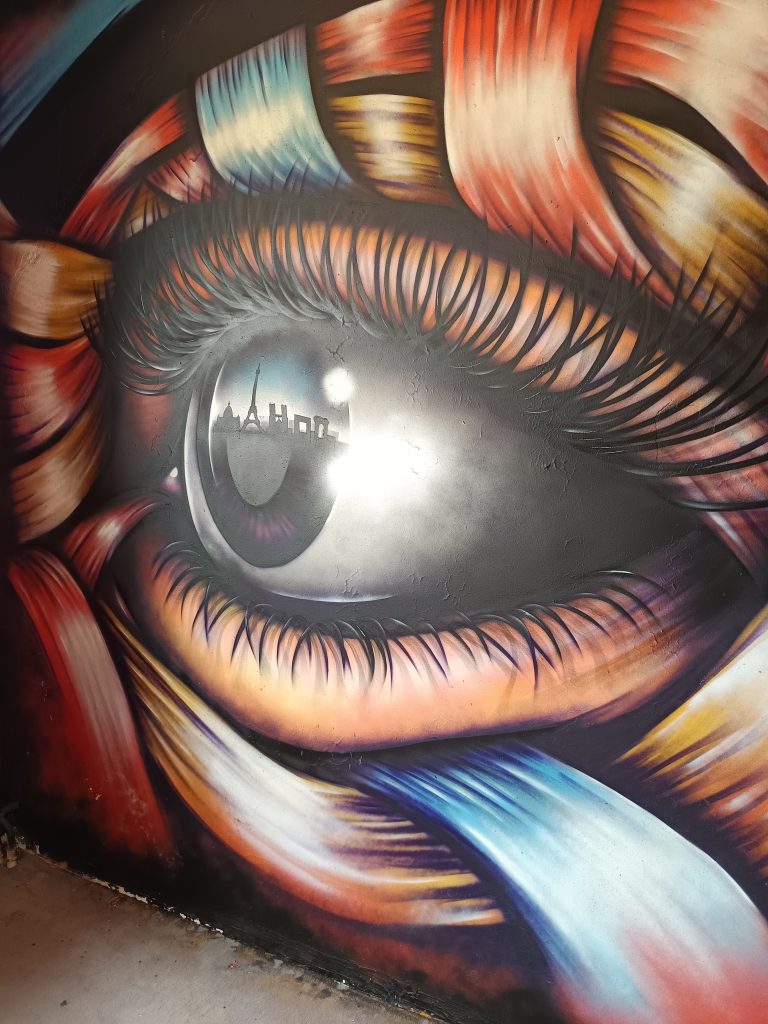
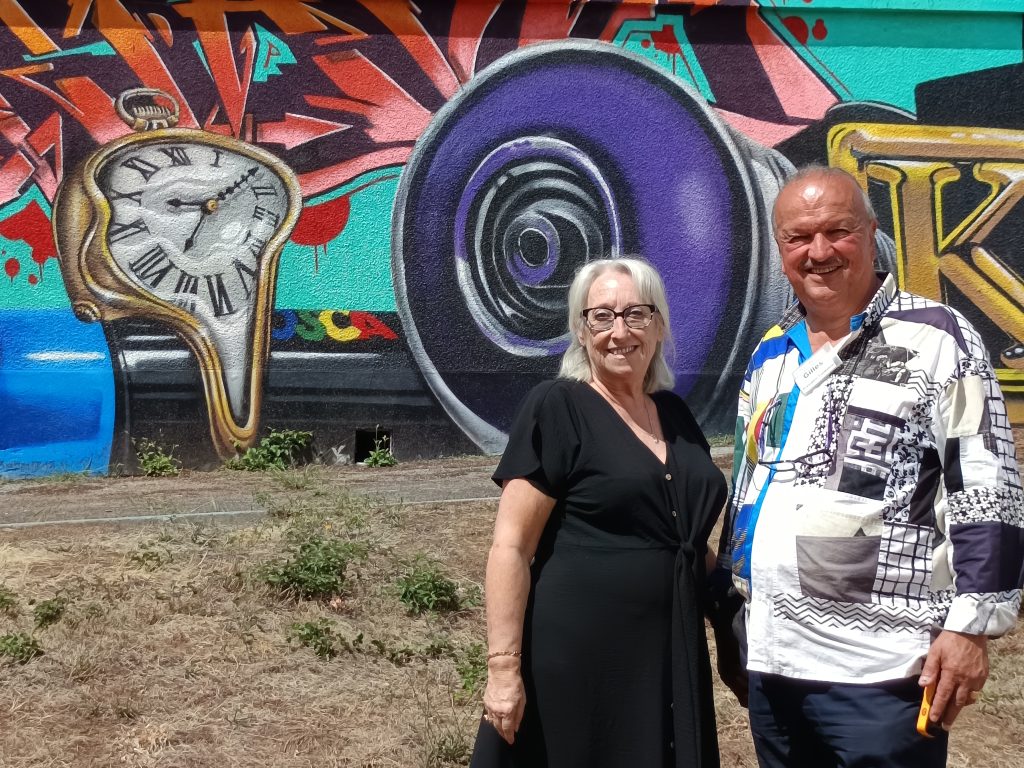
Ten hectares of concrete in Lurcy-Lévis, in the north of the Allier department, lay dormant for twenty years. The site was formerly a PTT training centre, opened in 1982 and closed in 1992. In 2003, Sylvie and Gilles Iniesta bought it from France Télécom. For over a decade, the couple wondered what they might do with it. Then one morning in January 2015, they had their answer: to transform this derelict site into a place entirely dedicated to street art. Today, the façades showcase works by artists from 71 countries. “There was no artist residency for street art. We decided we’d create one.’
WeAreKollectors Magazine
On 22 January 2015, Sylvie Iniesta walked through the abandoned site with her little dog, Bijou. All around her were scrub and grey façades of thirteen derelict buildings. Nothing, or almost nothing, gave any hint of what the place would become. Then she looked at the walls in a different light. She went home, opened her computer, and typed in a word she barely knew: ‘graffiti’. Over the next ten days, the couple spent hours discovering a world about which they knew almost nothing.
Until then, Gilles Iniesta had regarded graffiti as mindless vandalism of little interest. He now speaks of that former view with the irony of someone whose assumptions have since been thoroughly disproved by reality. As they researched the subject, the novice couple realised above all what the movement was lacking: a permanent home. At that time, street art mainly existed on derelict sites earmarked for demolition, at festivals lasting just a few days and through public commissions. The works and venues were ephemeral.
But what if this fragility was precisely the reason to create a place where artists could take their time?
WeAreKollectors Magazine
Music has its venues. So do dance, theatre, sculpture and writing. However, street art has long been developed elsewhere, in the streets and on available walls, often on the fringes of institutions. Its history did not encourage artists to seek out studios. They simply took whatever space they could find. Gilles and Sylvie Iniesta do not see this as an obstacle. They see ten hectares of available land.
In May 2015, a graffiti artist from Clermont-Ferrand accepted their invitation and arrived with four friends. Five artists, crates of spray cans, and their first wall. The founders watched and listened, and realised that something was taking shape.
Street Art City was officially launched in March 2016 and opened to the public in April 2017. The venue was presented as the world’s first permanent residence dedicated to urban arts. Since then, other initiatives have emerged, but none replicate this combination of an artists’ residence, an open-air exhibition space and ten hectares dedicated entirely to street art.
WeAreKollectors Magazine
At a festival, painting stops when the programme draws to a close. The spray cans are put away, the artist leaves and the mural is left as it is. In Lurcy-Lévis, however, the schedule adapts to the artwork. “If an artist needs an extra two days to finish their mural, we reschedule their train. They’ll leave later and finish their mural,” explains Gilles Iniesta. The difference may seem minor. Yet it changes everything. Time is no longer a constraint imposed on the artist; it becomes an integral part of their work.
Up to ten artists can stay on site at the same time. The association and its eleven staff members provide them with accommodation, meals, materials and support. The rest is up to the artists: they decide on the use of the aerial platform, the façade and the scale of the wall, as well as the time needed to see their idea through to the end. Perhaps this is where Street Art City’s uniqueness lies: offering artists what the street often denies them – the chance to let a work evolve without racing against the clock.
It has four floors, long corridors and numbered doors. The building once housed trainees from the PTT. Today, it is home to one of Street Art City’s most unique experiences: Hotel 128.
One hundred and twenty-eight rooms, each around ten square metres in size, are entirely entrusted to a single artist – from floor to ceiling. The result: three canvases created on site. Visitors push open a door, close it behind them, and find themselves alone in a setting entirely conceived by the artist. There’s no distance between you and the artwork here: you step right into it. Some artists have even hidden objects in cupboards or the room’s nooks and crannies, for those who take the time to look. A head torch can then become just as important a tool for exploration as your own eyes.
Just three seasons (2017, 2018 and 2019) were needed to fill the building, with an art book resulting from each season. Exploring Hôtel 128 takes two to three hours, or longer if certain doors catch your attention. For artists accustomed to monumental façades, these ten square metres nevertheless present a unique challenge: how to scale down without sacrificing immersion.
WeAreKollectors Magazine
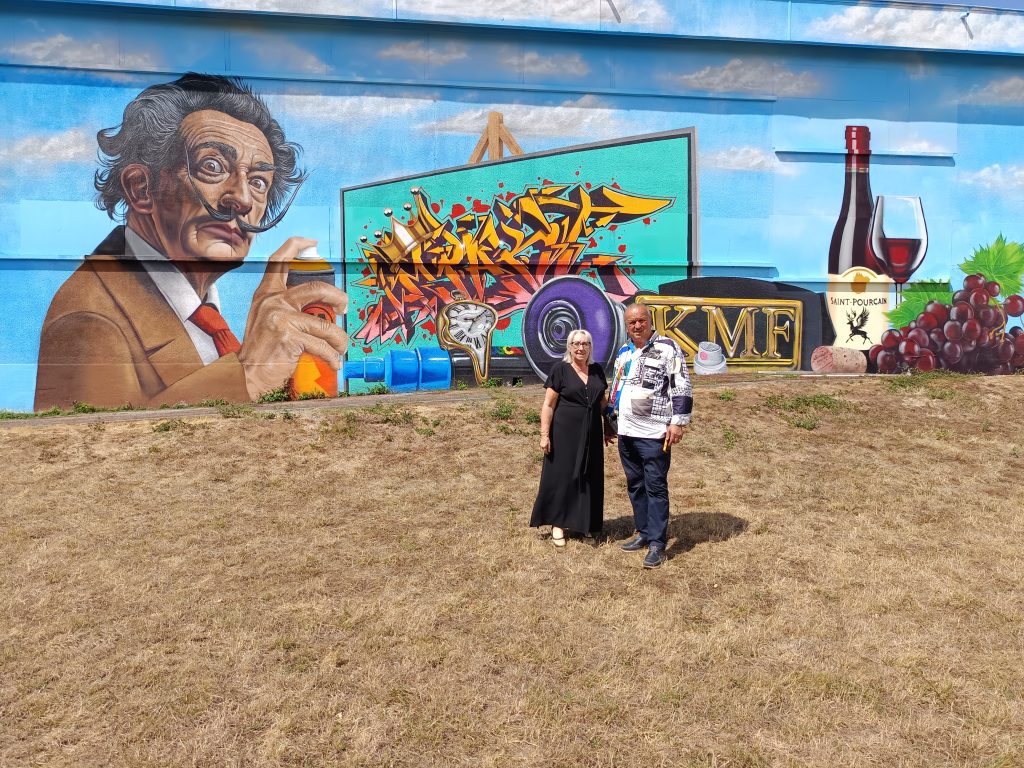
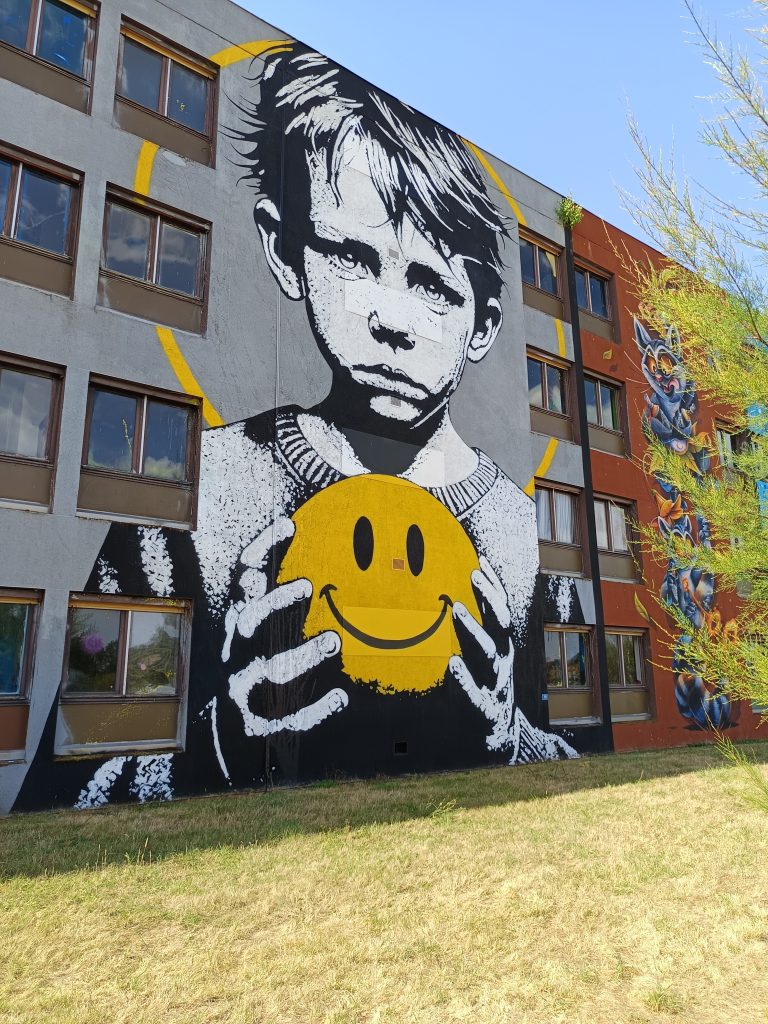
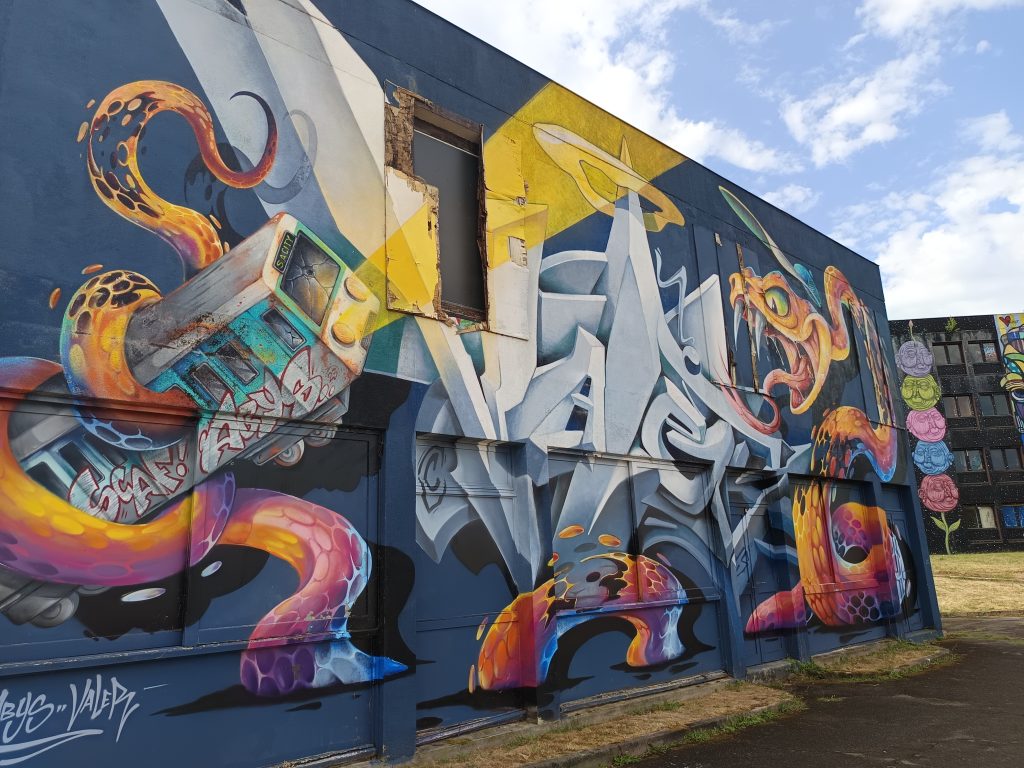
Outside, the concrete has taken on a new role. Twenty-two thousand five hundred square metres of painted walls now comprise a landscape that bears little resemblance to that of 2015. As the seasons change, the aerial platforms move from building to building, transforming the façades. One guiding principle remains: to achieve the greatest possible diversity. Graffiti, muralism, lettering, photorealism, hyperrealism, stencils and sculpture are all represented, and Street Art City refuses to reduce urban art to a single aesthetic. C215’s cats greet visitors as soon as they enter. Further on, a winged stag appears to emerge from the Bourbonnais region, while a metro carriage cuts across a façade. Nothing is ever quite finished.
The murals age, some disappear and others take their place. The site is constantly renewed with each new residency, like an exhibition whose curation is perpetually in flux.
“Street art isn’t just three vulgar words on a motorway bridge,” says Gilles Iniesta. In Lurcy-Lévis, all you need to do is look up to understand.
Gilles et Sylvie Iniesta ; WeAreKollectors Magazine
The other transformation is less visible: the one taking place within the visitors themselves. In 2025, 34 per cent of visitors came from abroad, from twelve European countries and beyond. Television crews from Vietnam, Australia, New Zealand, and the US came to film this unlikely spot in northern Allier. However, some visitors have been coming back since the very beginning. One such visitor is a man from Lorient who will turn 86 this year and returns every spring with his wife. This autumn, he plans to bring 37 books on street art that he has collected during his travels. He would rather donate them to the site than risk losing them after he is gone.
Schoolchildren also visit the site during school hours. Sometimes, a child leaves with more than just a souvenir of their visit — they leave with the desire to draw. Parents say they have seen their children’s outlooks change and start creating, and then, a few weeks later, they ask to return for another family visit. For the founders, these stories are just as important as visitor numbers. They reveal what a cultural venue can achieve beyond its walls: a sense of curiosity that is passed on.
Street Art City
As of 1 July 2026, there were 1,272 artists from around the world on the waiting list. The standard of applications is rising with each passing season, driven in particular by artists who discover the work being done here and wish to have access to this space and time, too. However, after dedicating more than a decade to keeping Street Art City alive, the founders are now faced with the question of how to pass on the legacy.
The venue attracts companies for their seminars, and new partnership opportunities are being explored to expand its activities. However, beyond the business model, Sylvie and Gilles Iniesta are already considering the future. As they have no children to naturally take up the torch, they are looking for ways to pass on what they have built. This has become almost as important as the artistic programme.
“Street art is the artistic movement of the 21st century; it is through this that we are shaping our identity,” says Gilles Iniesta.
In Lurcy-Lévis, this development is far from abstract. It can be seen in the size of the walls, the height of the façades, the doors of the Hôtel 128, and the number of returning visitors.
It took twenty years of silence for the derelict site to find its voice. Since 2015, it has been speaking in colours.

Février, 2026
Créer avec l’existant, penser avec l’histoire
De l’architecture au design, cette édition explore comment lieux, savoir-faire et matières héritées deviennent terrains de création actuelle.
Janvier, 2026
Le luxe se réinvente.
Finis les logos clignotants, place à une sobriété raffinée, à l’immersion personnelle, à l’excellence artisanale, à la durabilité sensible.
Décembre, 2025
Héritages, gestes contemporains et plaisirs essentiels
Parce que la fête n’est jamais qu’apparence : elle reflète notre manière d’habiter le monde, de transmettre, de fabriquer des souvenirs durables.
ÉDITION #3
Upcycling et kintsugi transforment l’objet contemporain, faisant de la trace, de la réparation et de la matière un langage esthétique.
ÉDITION #3
Artisans et designers donnent une seconde vie aux matériaux anciens, entre création contemporaine, patrimoine et réemploi.
ÉDITION #3
Bunkers, wagons et kiosques renaissent grâce à la création, révélant comment l’art redonne sens aux lieux délaissés.
ÉDITION #2
Un regard transversal sur le quiet luxury à travers des lieux, des objets et des figures qui expriment l’élégance.
ÉDITION #1
Une sélection de marques, architectures, objets et escapades qui donnent corps au sens de la fête.
ÉDITION #3
Usines et gares délaissées deviennent lieux culturels ouverts, où mémoire industrielle et usages contemporains redessinent la ville.
ÉDITION #3
L’audacieuse métamorphose d’un palace parisien
ÉDITION #3
Au cœur du Marais, un lieu discret révèle comment archives, architecture et recherche font dialoguer l’œuvre de Picasso.
ÉDITION #2
Une expérience shopping unique dans un magasin emblématique.
ÉDITION #2
Voyage culinaire et architectural au cœur de la Seine
ÉDITION #2
Dans le 9e arrondissement, un établissement qui invite au quiet luxury
ÉDITION #1
Chante! vient d’ouvrir ses portes. Une invitation à vibrer !
ÉDITION #3
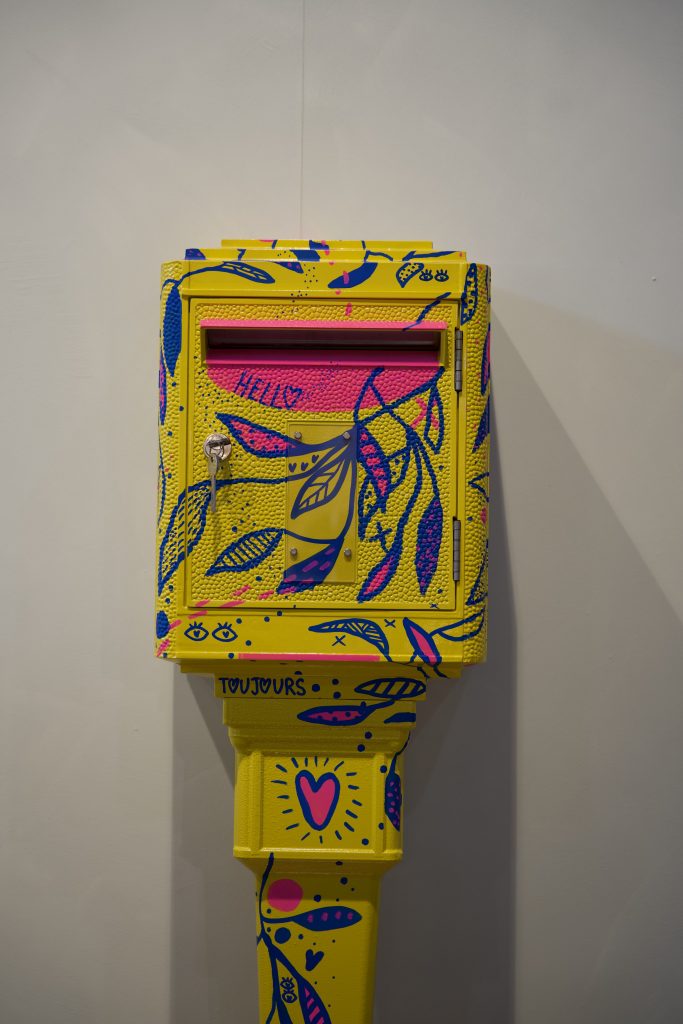
Icône du paysage français, la boîte jaune change de statut et s’invite dans l’univers du design.
ÉDITION #3
L’édition 2026 affirme une vision où artisanat, design et mémoire façonnent l’habitat contemporain, international actuel.
ÉDITION #3
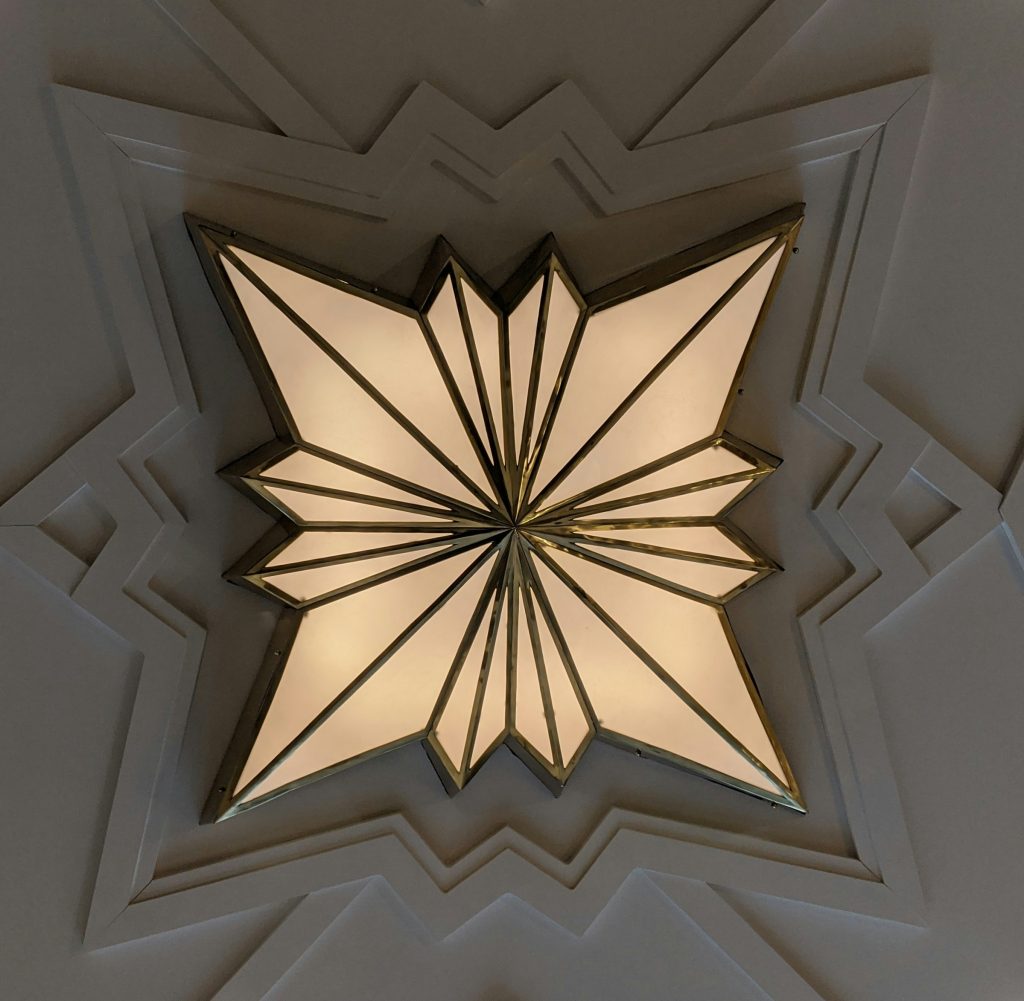
Cent ans après 1925, l’Art déco revient dans nos villes et intérieurs avec géométrie, audace, optimisme.
ÉDITION #3
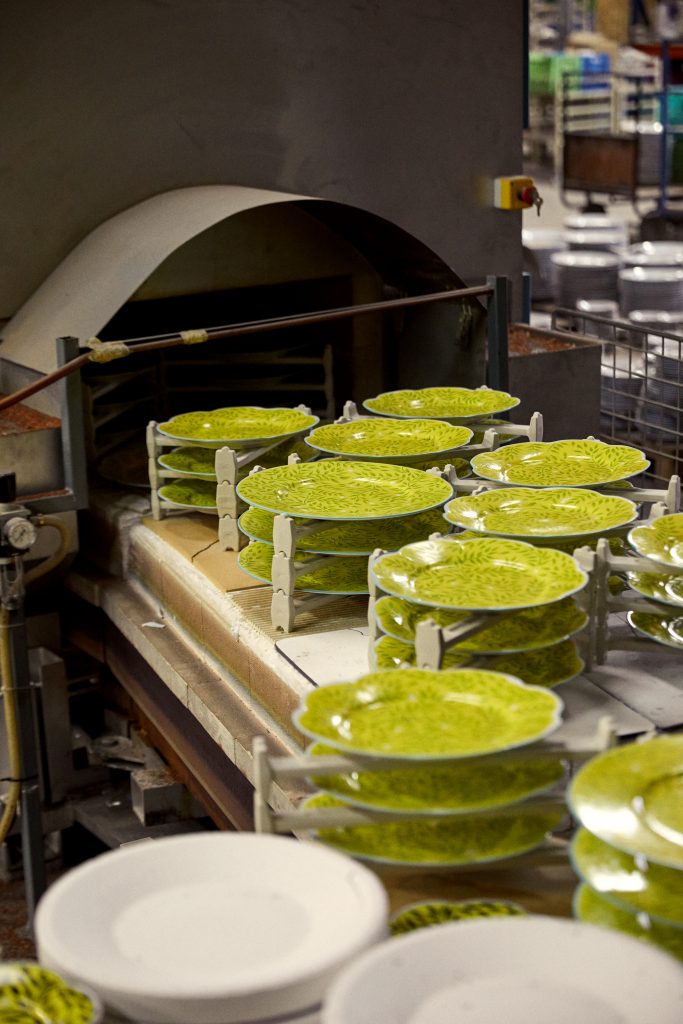
Depuis plus de deux cents ans, Royal Limoges conjugue porcelaine, savoir-faire industriel et création contemporaine.
ÉDITION #3
Des terrains de sport aux podiums, la sneaker raconte un siècle de mutations culturelles, techniques et stylistiques.
ÉDITION #2
Design, mode, artisanat : des créations où la forme et la matière se répondent avec justesse, loin de tout effet de mode.
ÉDITION #1
Décorations artisanales, calendriers ultra-luxe et pièces de collection pour s’enivrer de joie avant l’heure.
ÉDITION #3
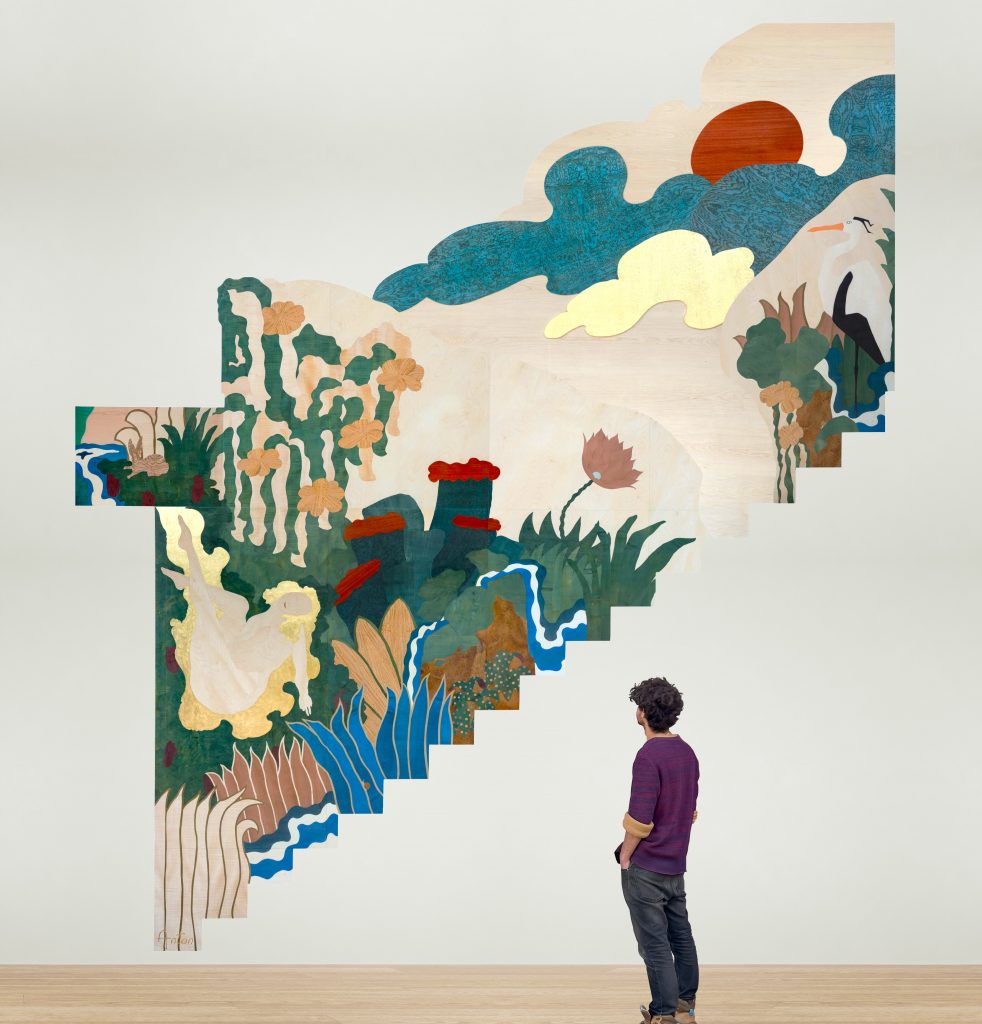
Entre marqueterie monumentale et jungle symbolique, Anton Laborde transforme le bois en récit contemporain poétique engagé.
ÉDITION #3
À Maison & Objet, Thierry Laudren présente des meubles sculptés où fonction, matière et lenteur façonnent une présence.
ÉDITION #3
Jean Nouvel conçoit une architecture attentive aux contextes, où lumière, histoire et usages façonnent chaque projet.
ÉDITION #3
À Lyon, Sophie Morel rénove des lieux historiques en alliant respect du bâti et écriture contemporaine.
ÉDITION #3
Au Centre d’Études Picasso, l’architecte compose une architecture où lumière, géométrie et héritage dialoguent avec précision.
ÉDITION #2
Entretien avec le fondateur d’EDO (European Design Office)
ÉDITION #2
Portrait d’un visionnaire qui transforme l’art de recevoir en expérience totale.
ÉDITION #1
Personnalités, artisans et créateurs qui donnent à la fête sa profondeur humaine.
ÉDITION #3
De Bordeaux au Bassin, art, vignobles et bien-être composent une échappée élégante au cœur de la Gironde.
ÉDITION #2
Vers une région de l’Italie habitée par le temps, où paysages, culture et usages s’accordent dans une continuité rare.
ÉDITION #1
Destinations et rituels qui réinventent la fête, du soleil tropical aux marchés d’hiver.