Pascal Rieu, vitrailliste et peintre de lumière

Pascal Rieu, stained-glass artist and painter of light

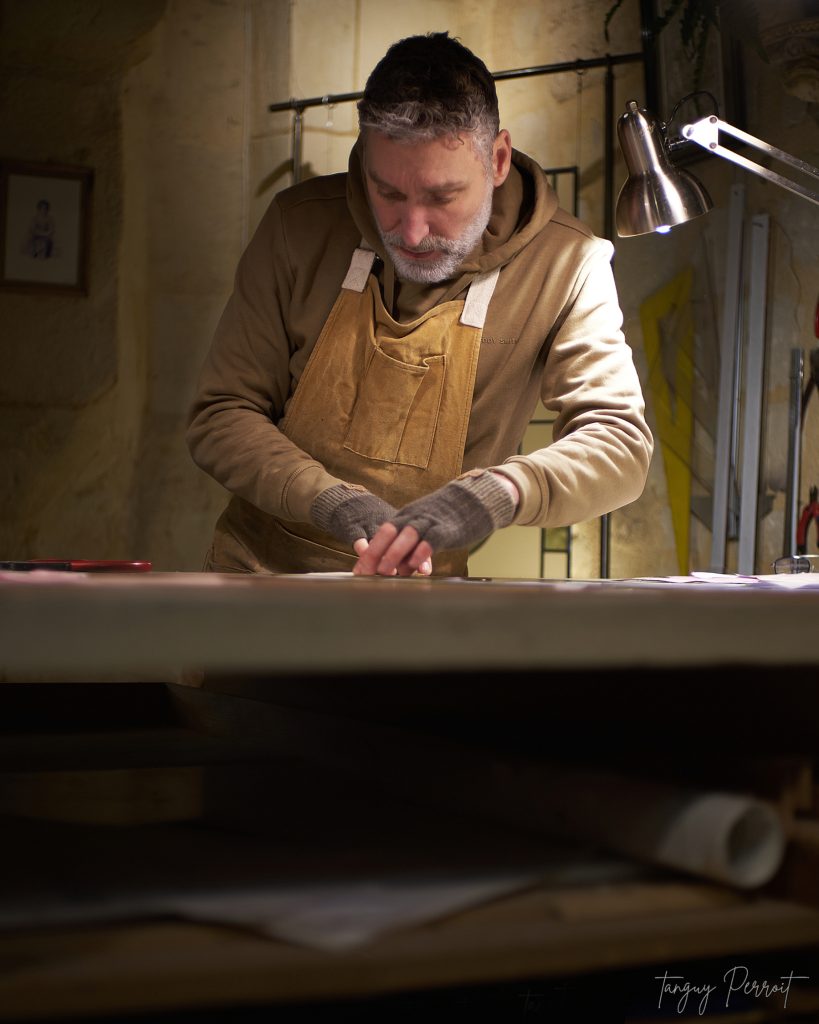
In his picturesque studio at 28 Rue Eugène-Sue in the Old Town of Tours, Pascal Rieu sketches, cuts, paints and sets glass. Having trained under the master glassmaker Marc Grossriether, he worked as a graphic designer for twenty years before becoming a Master Craftsman. He now creates stained-glass windows for private homes and looks after those in castles. “For anyone who loves images, the connection is obvious: a stained-glass window is an image.”

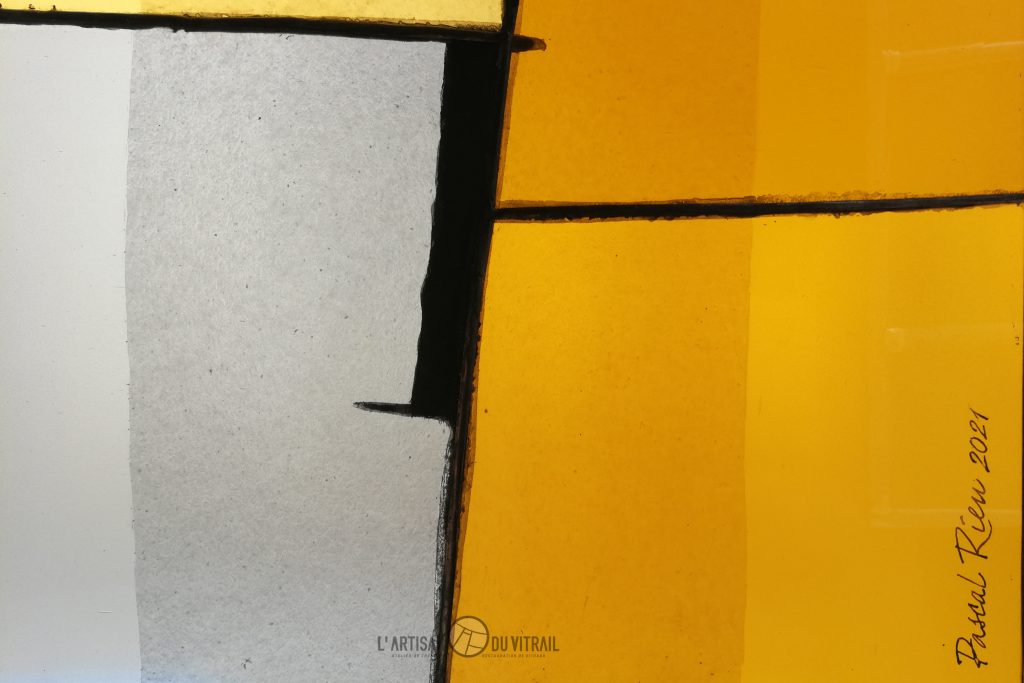
Glass spans the centuries. Every piece leaving the workshop bears a discreet mark of this: Pascal Rieu’s signature and the year of its creation. Between this final touch and the initial sketch lies a whole craft, taken up at the age of forty with the fervour of a long-considered decision.

Twenty years of images

Tetris; Pascal Rieu; L’Artisan du Vitrail

Tetris; Pascal Rieu; L’Artisan du Vitrail

Pascal Rieu’s first career was spent in front of a screen. For ten years, he worked for two communications agencies, before choosing to go freelance and be his own boss. As a freelance graphic designer, he created DVD covers, menus, and all the promotional material for the release of French films published by small labels. It was here that he honed his skills in understated layouts, colour choices and balanced compositions. Then came video-on-demand and the digital revolution. The pace quickened and, in his view, the work lost its sense of fulfilment. Around the age of forty, the graphic designer sought a craft combining manual skill and intellectual engagement, preferably a traditional one involving drawing, colour and creativity. Mosaics, ornamental stone carving and ceramics were all considered. Ultimately, stained glass won him over for reasons that would be obvious to any graphic designer: it offers images through which light passes.

Ten months with a master

Restauration de vitraux; Pascal Rieu, L’Artisan du Vitrail

Stained-glass restoration; Pascal Rieu, L’Artisan du Vitrail

At the time, Pascal was living in Paris’s 20th arrondissement and scouting out workshops across the capital. He settled on Marc Grossriether’s Mise au Verre workshop near Pigalle, in a neighbourhood he particularly liked. The man was affable and his creations were accessible, so they hit it off. He felt that the choice of master was just as important as the choice of craft for a training programme lasting several months. Over the course of ten months, he learnt the fundamentals and obtained his CAP in Glass Arts and Techniques, specialising in stained glass. It was a gamble: the Île-de-France region funded part of the training, while Pascal covered the rest of the costs, including the purchase of his first kiln, with his savings. In October 2013, he founded L’Artisan du Vitrail in Paris. Recognition soon followed in the form of the Tremplin Prize at the Artisanales de Chartres in 2014 and the Young Talent Prize at the Carrousel des Métiers d’Art et de la Création in 2015. To those seeking a career change who now come through his door, he offers the same advice: think carefully about the trade, and then devote yourself to it wholeheartedly. The rest will follow gradually.

Listening before drawing

Pascal Rieu; L’Artisan du Vitrail

Pascal Rieu; L’Artisan du Vitrail

Every project begins with a conversation. Pascal Rieu asks plenty of questions, meets with his clients several times, observes their interiors and asks about their favourite colours and the countries they have travelled to. The stained-glass window must harmonise with the home in which it will be installed, and this dialogue enables the craftsman to gain an understanding of the lives of those who commission it. He produces two or three designs: one that faithfully reflects the initial request and one or two that are open to unexpected possibilities. Eight times out of ten, the commission leans towards abstraction and Art Deco, whose geometric elegance transcends passing fashions. The other proposals offer clients a surprise and give the craftsman the pleasure of experimenting with different techniques and styles. His ideal project can be summed up in two words spoken by a client: carte blanche. One client once burst into tears while the work was being installed. ‘I was simply overwhelmed with emotion,’ she confided afterwards.
From La Ligérienne to Tetris

Vitrail La Ligérienne; Pascal Rieu, L’Artisan du Vitrail

Vitrail La Ligérienne; Pascal Rieu, L’Artisan du Vitrail

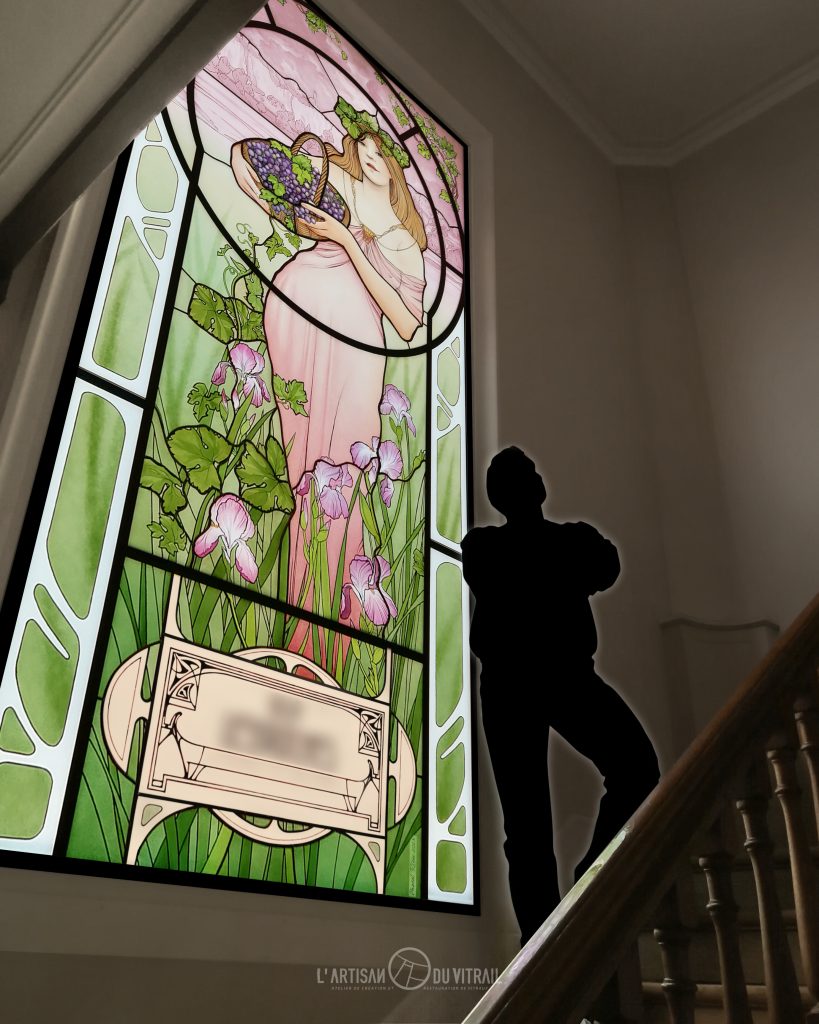
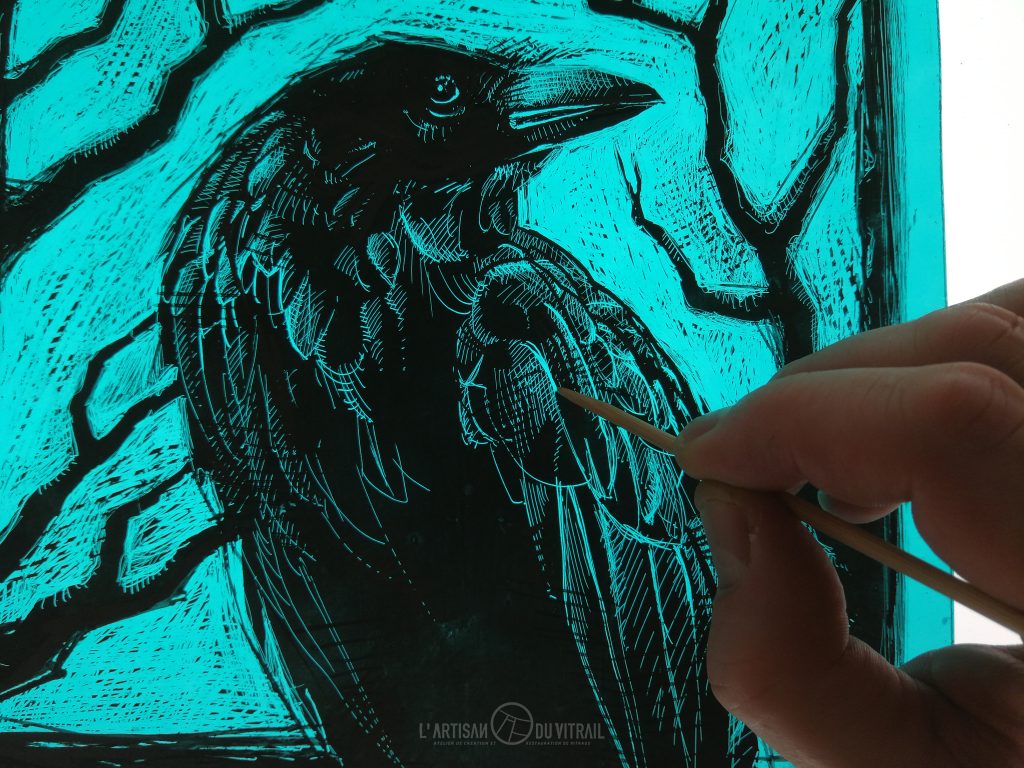
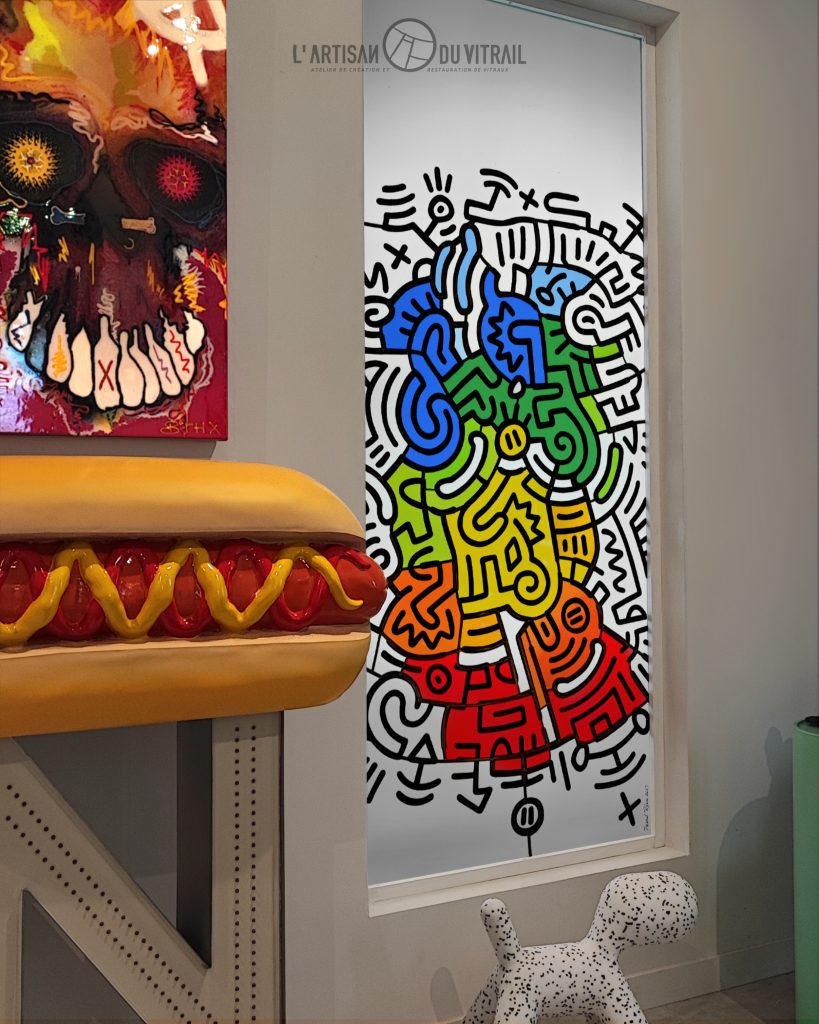
His largest stained-glass window is approximately 3.5 metres high and 1.4 metres wide. Named La Ligérienne, it illuminates a grand residence on the banks of the Loire, near Tours. The owners dreamt of a Mucha. Pascal Rieu sets out his approach: he does not produce copies of the work of other artists, whether famous or unknown. However, he may draw inspiration from the masters to create his own work. Following extensive research into illustrations and documentation devoted to the Czech poster artist, an original Art Nouveau composition emerged – the piece that demanded the most energy and time from him. For the manor house, he was given carte blanche to create two stained-glass windows, including Le Corbeau. Elsewhere, Keith 2025 pays homage to the colourful energy of Keith Haring; Tetris combines blue, yellow and orange and overlooks an inner courtyard; and 1935 brings together painted glass and two sandblasted panels in an orange-coloured partition wall. The same aim prevails from one room to the next: to juggle styles to best suit each space.

Lead, grisaille and light

Vitrail Art Déco - Le Corbeau; Pascal Rieu; L’Artisan du Vitrail

Art Deco Stained Glass – Le Corbeau; Pascal Rieu; L’Artisan du Vitrail

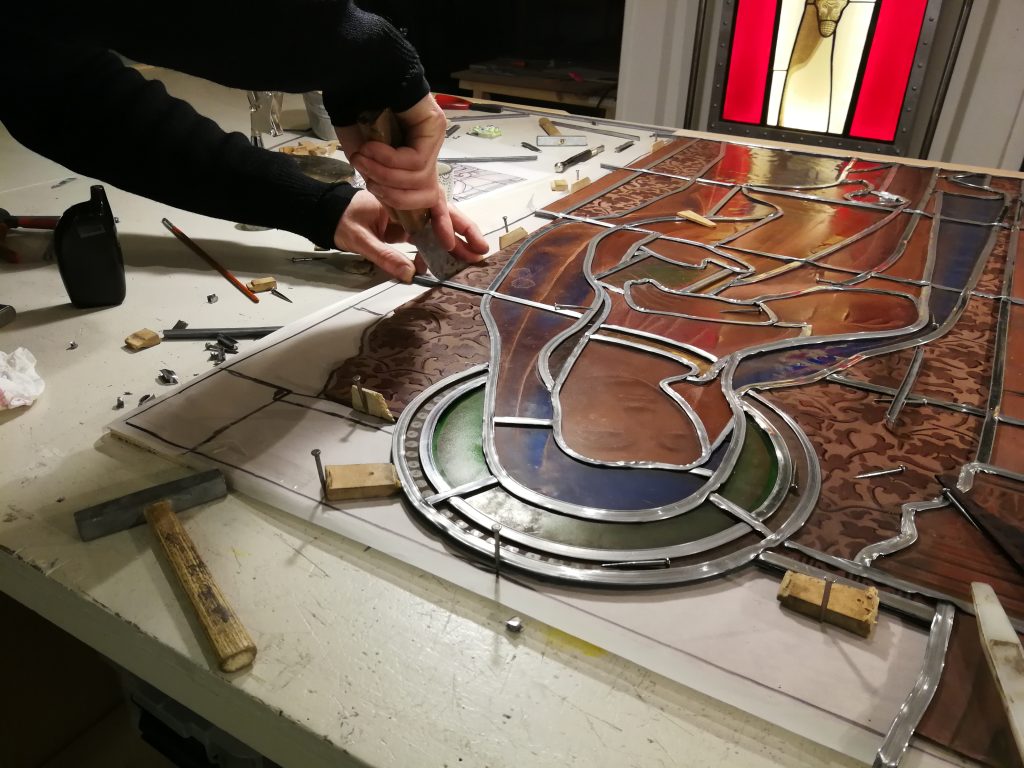
Over the centuries, little has changed in terms of the craft and technique. In the traditional technique inherited from the Middle Ages, each piece of glass is cut by hand and set into lead profiles. Then, each junction is soldered on both sides before installation. Only the cutting tools have evolved. In the early 20th century, Louis Comfort Tiffany popularised an alternative approach that allowed for three-dimensional stained glass, giving rise to his famous lamps. This was followed by cement-bonded glass panels, which adorned churches rebuilt after the Second World War, and then gemmail. Pascal Rieu works with both lead came and the Tiffany method, placing great emphasis on painting, enamels, and grisaille. He has also recently started using sandblasting to engrave the glass. “Light passes through the glass. Depending on the season and time of day, the stained-glass window comes to life. It is a magical material, much like precious stones.”

Restoring and passing on the tradition

Keith; Pascal Rieu; L’Artisan du Vitrail

Keith; Pascal Rieu; L’Artisan du Vitrail

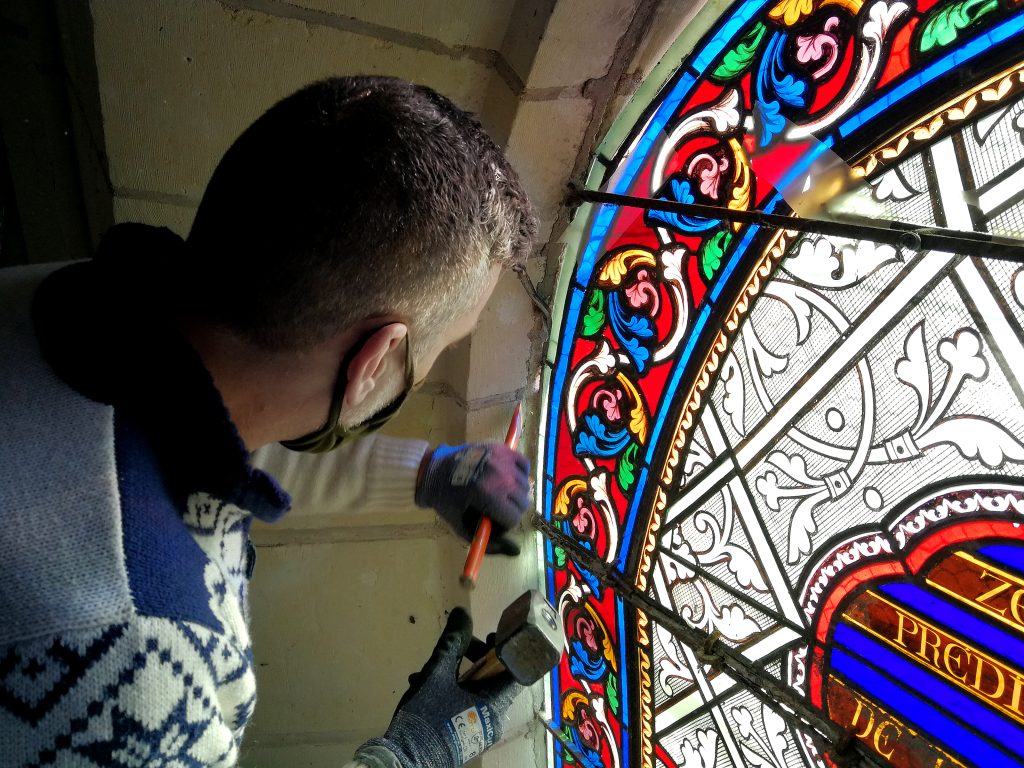
Pascal Rieu moved to Tours in 2020 after spending three years in Montélimar, in his native Rhône Valley. The region boasts a rich heritage, and restoration is playing an increasingly important role there. Private individuals entrust him with the stained-glass windows they wish to preserve, while local councils entrust him with those in their churches. A couple from Canada, who are restoring a local château and sharing their work on social media, appointed him as the property’s stained-glass artist, and other château owners have followed suit. Since setting up his workshop, Pascal has also opened its doors every spring for the European Days of Artistic Crafts, featuring demonstrations of tools and techniques. At Azay-le-Rideau Castle, a partnership renewed for the third time brings two school classes to the castle every year to discover the heritage and the crafts that bring it to life. He is proud to be an artisan: the commission provides a framework within which he has found his freedom.

Signed, dated, for centuries to come

Each of his creations bears his signature and the year. This approach is exemplified in one of his recent pieces: a small stained-glass window for a funeral chapel, created through an extended dialogue with his client. Pascal Rieu sees it as a work destined to endure, much like the Roman pottery that the earth reveals centuries later. ‘This stained-glass window will outlast eras, decades, perhaps even centuries.’ Light, however, remains his guiding light.

From 29 October to 1 November 2026, the International Cultural Heritage Fair at the Carrousel du Louvre will be themed ‘Heritage in Light’. Pascal Rieu will unveil a brand-new creation there: a free-form, backlit sign drawing on his influences and playful references where LED lighting will cause the glass to pulse in time to rhythmic beats.

Continue exploring

Raphaël Barrois: shaping light in glass
Anne Paccard: the perfect harmony of song and bells
Mr Popart, the street artist with a quirky twist
Bagage Collection: vintage trunks that tell a story
Tom Waugh, stone sculptor, the long life of disposable things
Adeline Giffon, interior designer: volume, light and materials

Février, 2026

Édition 3 : Patrimoine et création

Créer avec l’existant, penser avec l’histoire

De l’architecture au design, cette édition explore comment lieux, savoir-faire et matières héritées deviennent terrains de création actuelle.

Janvier, 2026

Édition 2 : Quiet luxury

Le luxe se réinvente.

Finis les logos clignotants, place à une sobriété raffinée, à l’immersion personnelle, à l’excellence artisanale, à la durabilité sensible.

Décembre, 2025

Édition 1 : Le sens de la fête

Héritages, gestes contemporains et plaisirs essentiels

Parce que la fête n’est jamais qu’apparence : elle reflète notre manière d’habiter le monde, de transmettre, de fabriquer des souvenirs durables.

ÉDITION #3

Révéler la beauté
‎

Upcycling et kintsugi transforment l’objet contemporain, faisant de la trace, de la réparation et de la matière un langage esthétique.

ÉDITION #3

Les nouveaux artisans du patrimoine

Artisans et designers donnent une seconde vie aux matériaux anciens, entre création contemporaine, patrimoine et réemploi.

ÉDITION #3

L'art à la rescousse des friches et lieux oubliés

Bunkers, wagons et kiosques renaissent grâce à la création, révélant comment l’art redonne sens aux lieux délaissés.

ÉDITION #2

Le murmure du beau
‎

Un regard transversal sur le quiet luxury à travers des lieux, des objets et des figures qui expriment l’élégance.

ÉDITION #1

Lieux, maisons et matières en éclats

Une sélection de marques, architectures, objets et escapades qui donnent corps au sens de la fête.

ÉDITION #3

La création au secours des bâtiments promis à l’oubli

Usines et gares délaissées deviennent lieux culturels ouverts, où mémoire industrielle et usages contemporains redessinent la ville.

ÉDITION #3

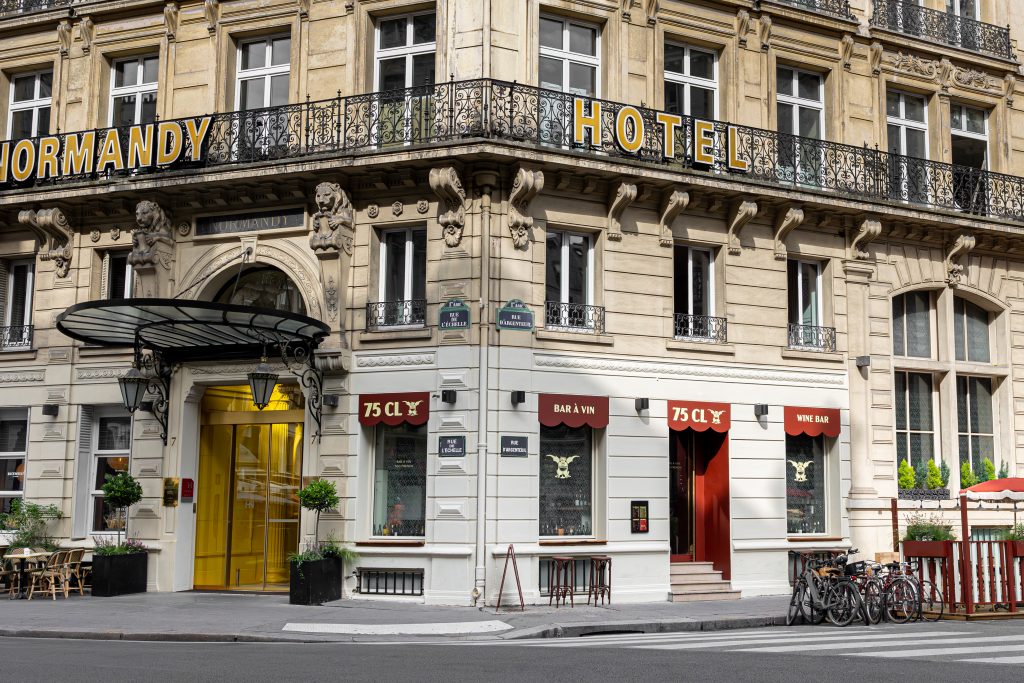
Normandy Hotel Paris Saint-Honoré

L’audacieuse métamorphose d’un palace parisien

ÉDITION #3

Dans les coulisses du Centre d'Études Picasso à Paris

Au cœur du Marais, un lieu discret révèle comment archives, architecture et recherche font dialoguer l’œuvre de Picasso.

ÉDITION #2

Shopping iconique dans un décor Tudor

Une expérience shopping unique dans un magasin emblématique.

ÉDITION #2

Gastronomie et architecture

Voyage culinaire et architectural au cœur de la Seine

ÉDITION #2

L'art de l'hospitalité parisienne

Dans le 9e arrondissement, un établissement qui invite au quiet luxury

ÉDITION #1

Chante!

Chante! vient d’ouvrir ses portes. Une invitation à vibrer !

ÉDITION #3

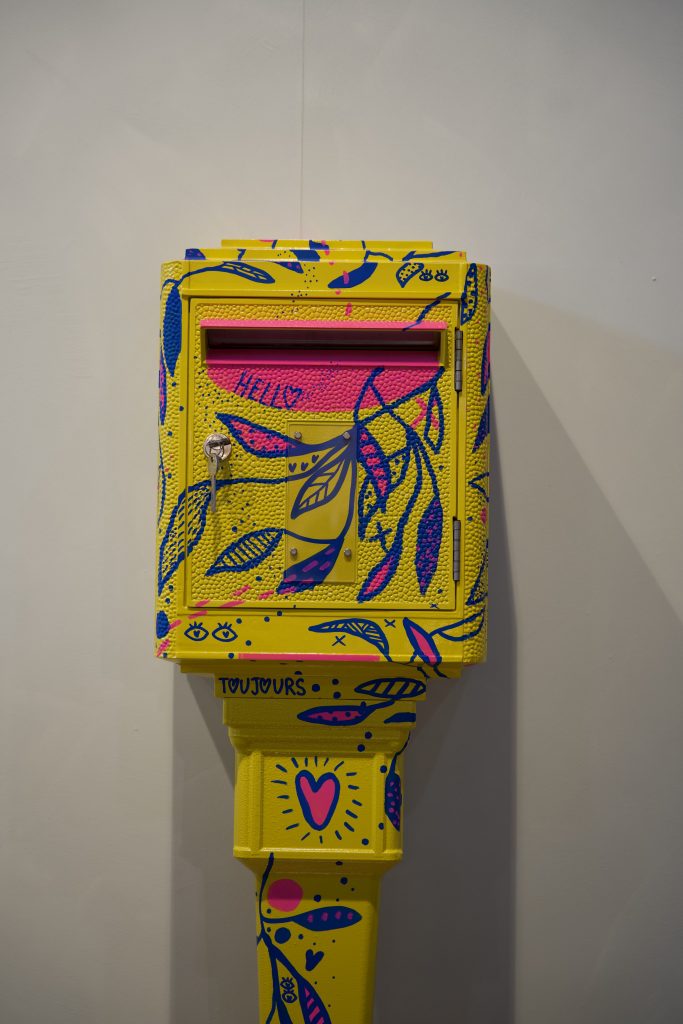
La boîte aux lettres française devenue objet de design

Icône du paysage français, la boîte jaune change de statut et s’invite dans l’univers du design.

ÉDITION #3

Retour sur Maison&Objet 2026 : retour aux sources et à l’essentiel

L’édition 2026 affirme une vision où artisanat, design et mémoire façonnent l’habitat contemporain, international actuel.

ÉDITION #3

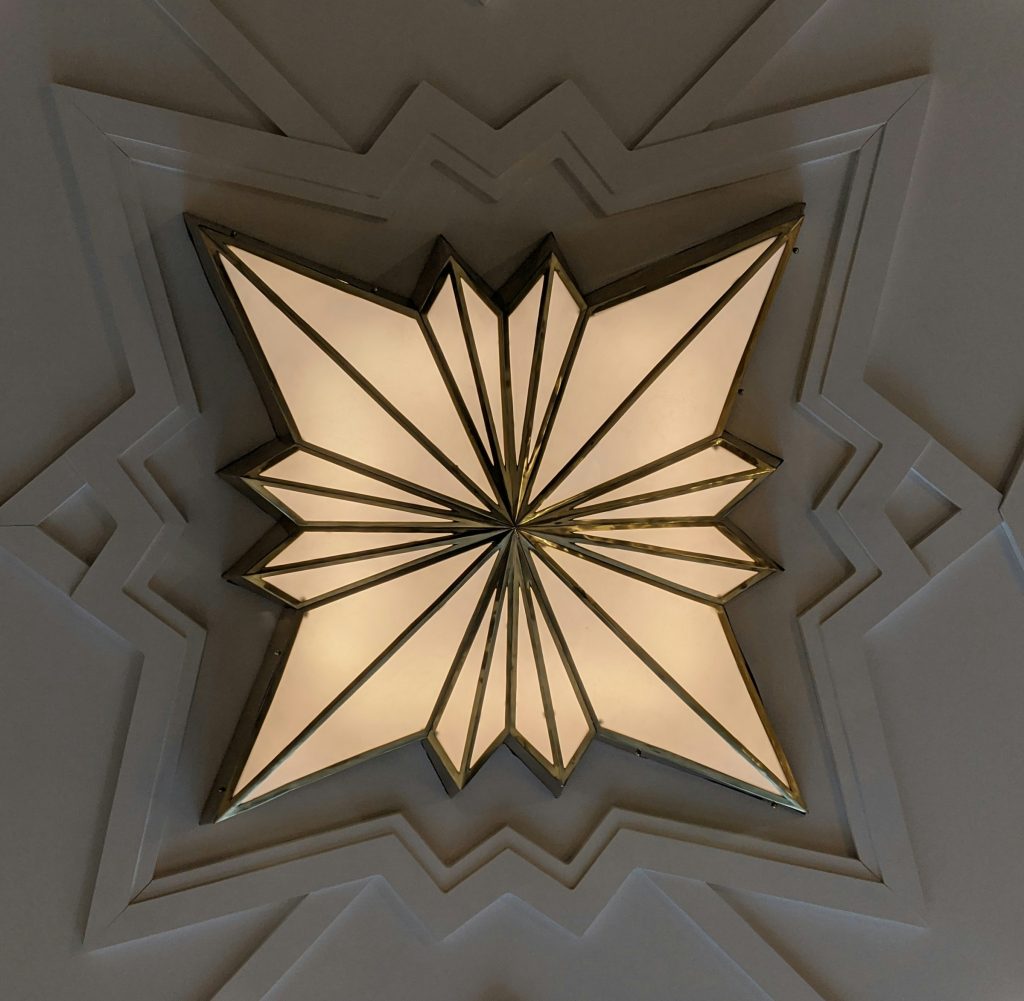
Art Deco: un mouvement centenaire, plus actuel que jamais

Cent ans après 1925, l’Art déco revient dans nos villes et intérieurs avec géométrie, audace, optimisme.

ÉDITION #3

Royal Limoges, deux siècles d’histoire au présent

Depuis plus de deux cents ans, Royal Limoges conjugue porcelaine, savoir-faire industriel et création contemporaine.

ÉDITION #3

Du terrain à la rue et au catwalk : les sneakers à travers les époques

Des terrains de sport aux podiums, la sneaker raconte un siècle de mutations culturelles, techniques et stylistiques.

ÉDITION #2

La formidable aventure du papier peint de luxe

Design, mode, artisanat : des créations où la forme et la matière se répondent avec justesse, loin de tout effet de mode.

ÉDITION #1

Icônes, détails, rituels
‎

Décorations artisanales, calendriers ultra-luxe et pièces de collection pour s’enivrer de joie avant l’heure.

ÉDITION #3

Anton Laborde

Entre marqueterie monumentale et jungle symbolique, Anton Laborde transforme le bois en récit contemporain poétique engagé.

ÉDITION #3

Thierry Laudren

À Maison & Objet, Thierry Laudren présente des meubles sculptés où fonction, matière et lenteur façonnent une présence.

ÉDITION #3

Jean Nouvel

Jean Nouvel conçoit une architecture attentive aux contextes, où lumière, histoire et usages façonnent chaque projet.

ÉDITION #3

Sophie Morel

À Lyon, Sophie Morel rénove des lieux historiques en alliant respect du bâti et écriture contemporaine.

ÉDITION #3

Pascal Grasso

Au Centre d’Études Picasso, l’architecte compose une architecture où lumière, géométrie et héritage dialoguent avec précision.

ÉDITION #2

Alexandre Danan

Entretien avec le fondateur d’EDO (European Design Office)

ÉDITION #2

Aziz Temimi

Portrait d’un visionnaire qui transforme l’art de recevoir en expérience totale.

ÉDITION #1

Visages, gestes, inspirations

Personnalités, artisans et créateurs qui donnent à la fête sa profondeur humaine.

ÉDITION #3

Chemins de traverse : parenthèse d’exception en Bordelais

De Bordeaux au Bassin, art, vignobles et bien-être composent une échappée élégante au cœur de la Gironde.

ÉDITION #2

Voyage en Toscane
‎

Vers une région de l’Italie habitée par le temps, où paysages, culture et usages s’accordent dans une continuité rare.

ÉDITION #1

Horizons, saisons, traditions
‎

Destinations et rituels qui réinventent la fête, du soleil tropical aux marchés d’hiver.

Dates, adresses, invitations

Expositions, événements et repères culturels pour vivre pleinement la saison des fêtes.