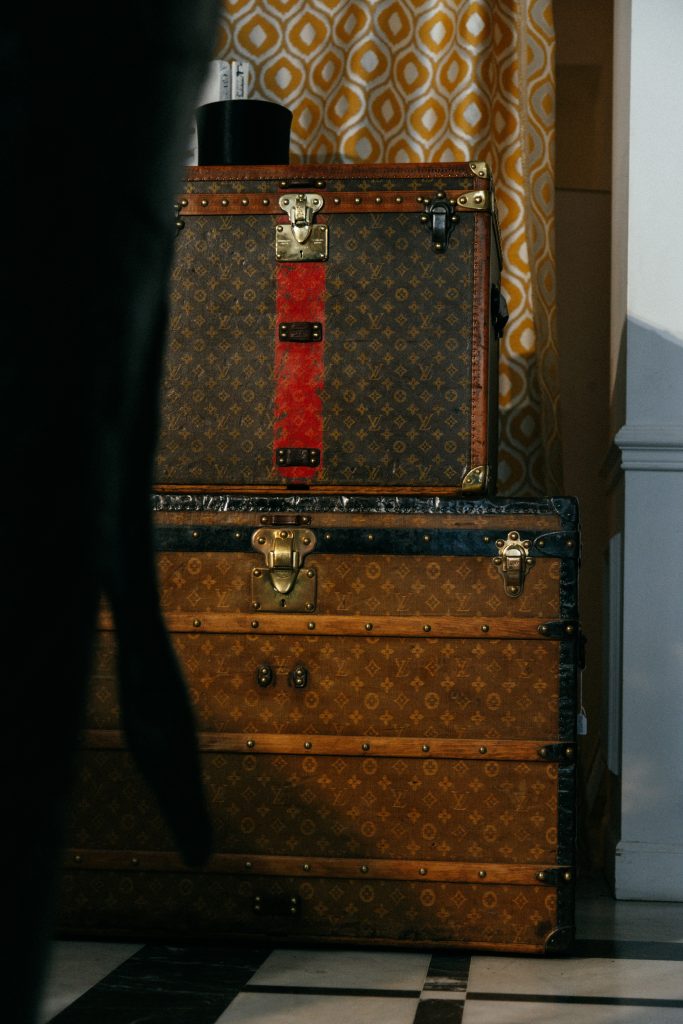
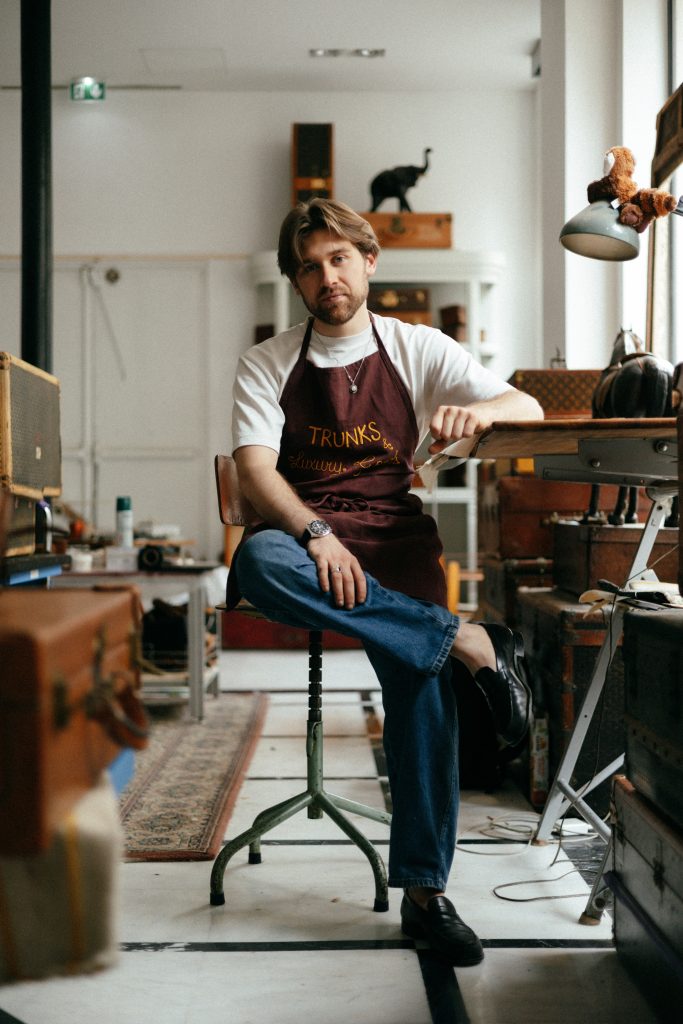
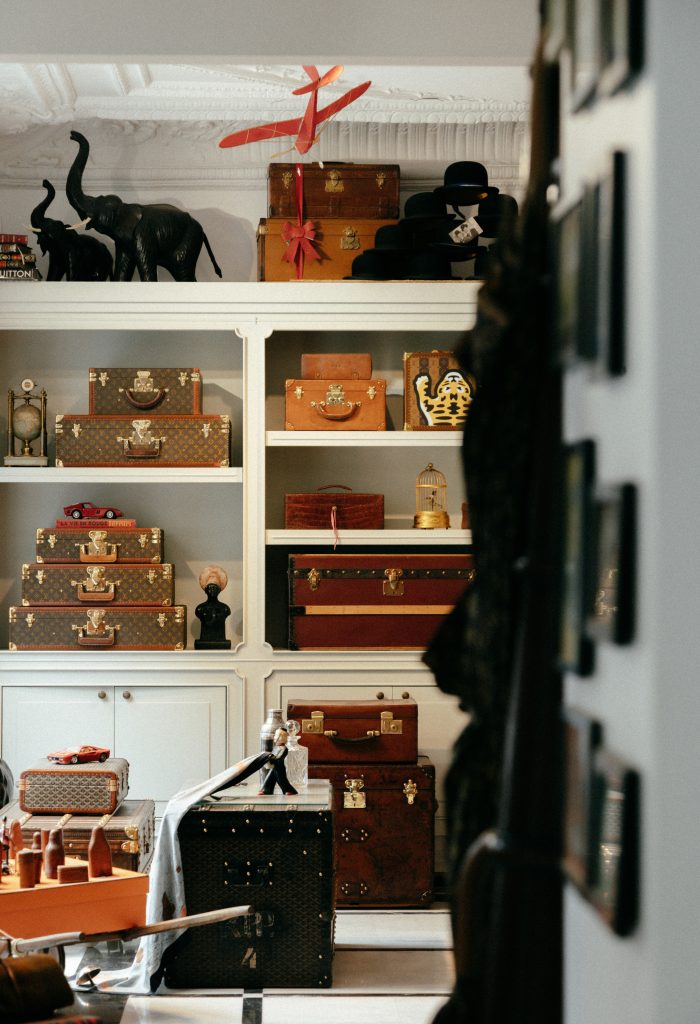
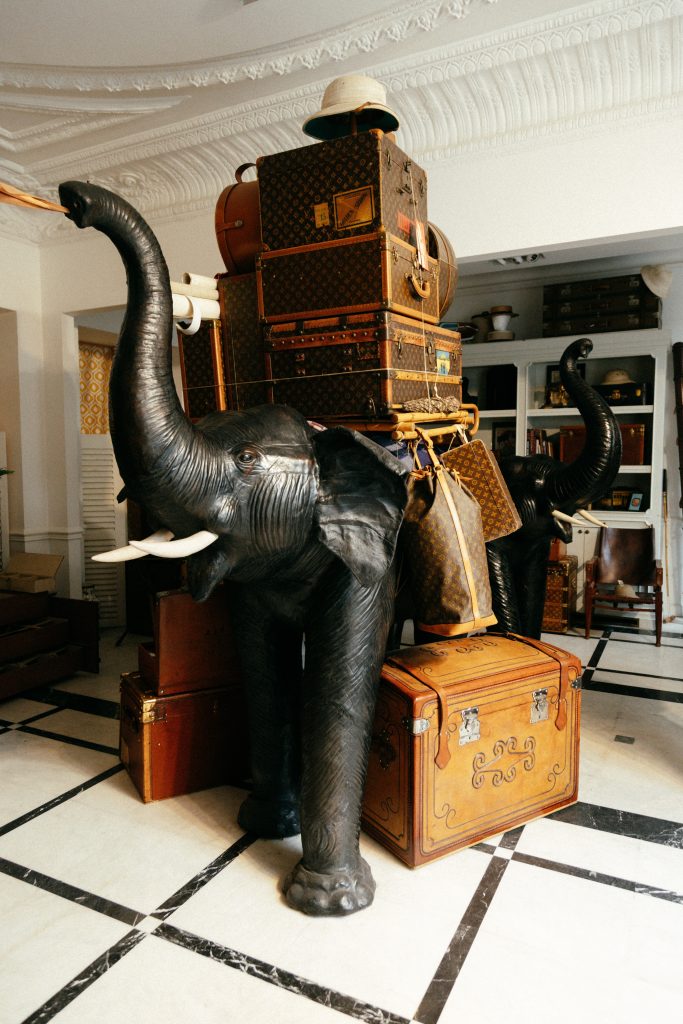
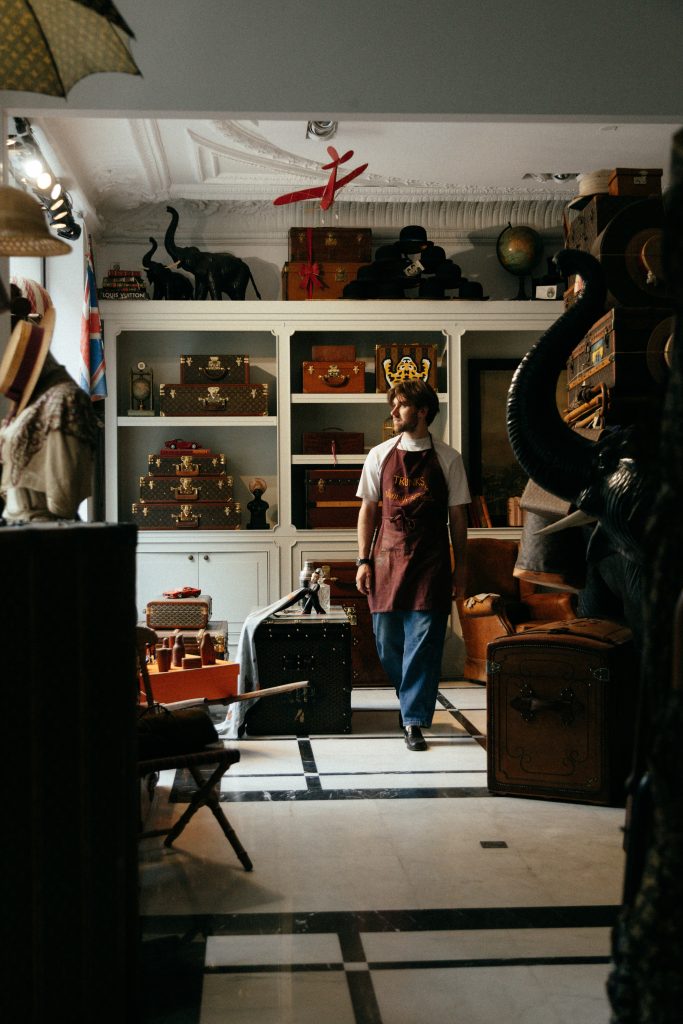
These trunks have travelled aboard transatlantic liners and in the carriages of the Orient Express, alongside royalty, writers, and leading industrialists. A century later, some are still gathering dust in attics, neglected by their owners. Since 1997, one family in Normandy has been breathing new life into them. Sandrine, David and Charly Martin are restorers and collectors of rare trunks, seeking out the finest travel trunks produced between 1880 and 1939. This is the story of a discreet craft, where every trunk bears traces of its past life.
It all began in 1997 in an attic. While restoring antique furniture, passionate antique dealers Sandrine and David Martin unearthed an old trunk forgotten in David’s childhood home. Drawing on his woodworking skills, David restored it. The result impressed his mentor, who remarked – a comment that has stayed with him ever since – ‘Trunks are your thing; you have a real talent for restoring them’. David went on to buy more trunks, starting with modest models made of curved wood and moving on to rarer pieces. In 2004, he acquired his first Louis Vuitton trunk: a black car trunk. This marked the beginning of a quest: every weekend, the family scoured the flea markets of France, visiting stalls laden with antique trunks. Charly grew up surrounded by these objects and joined the family business in 2015.
Bagage Collection; Charly Martin
Restoring an antique trunk requires a level of expertise that is rare in France today. Trunk-making combines three specialities: leatherworking, upholstery and cabinetmaking. Restoration is a long, painstaking process, and this craft has been passed down through the family for nearly thirty years in the heart of Normandy. Today, the roles have been divided. David spends most of his time sourcing beautiful pieces, while Charly carries out almost all the restoration work. For the most delicate elements, he calls upon external craftsmen, such as cabinetmakers, leatherworkers and upholsterers. “I’m the conductor. I play a few instruments and specialist musicians support me,” he sums up. He learnt the craft from his father, the best of teachers. It is a passion born in childhood, between the workshop and the workbench, and one that he continues in his own way.

Bagage Collection; Charly Martin
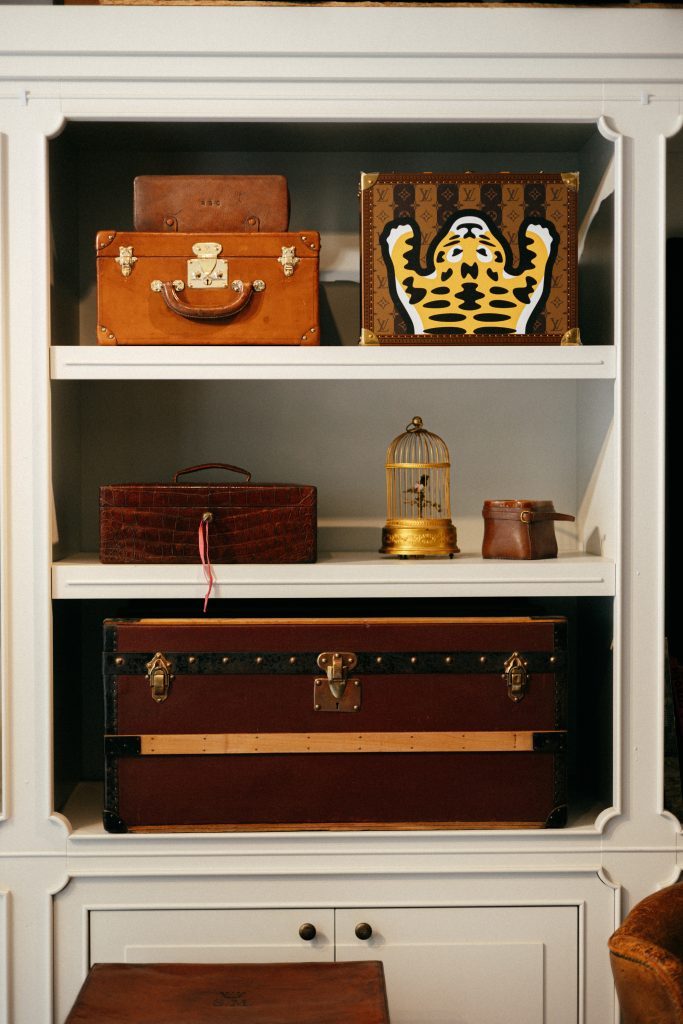
To understand these trunks, we must go back to the company that made them famous. Louis Vuitton founded his Parisian workshop in 1854. A former basket and trunk maker, he invented the flat trunk covered in grey canvas known as ‘Gris Trianon’, which was lightweight and waterproof. He soon became the supplier to Empress Eugénie. His luxury luggage soon accompanied the most influential travellers of the late 19th and early 20th centuries from continent to continent. Bagage Collection focuses its research on the finest pieces produced between 1880 and 1939. A notable detail is the initials painted on the sides, which reveal how they were used. Created by lettering artists at railway stations, ports, and shops, these initials enabled staff to distinguish one Vuitton trunk from another and ensure that each piece of luggage was routed to the correct hotel or ocean liner.
Bagage Collection; Charly Martin
Each one bears traces of its former owner. The labels tell a story: the Orient Express, the liner Normandie and luxury hotels around the world. Charly Martin gives an example. ‘This trunk comes from Egypt,’ he says, referring to a 1930s Louis Vuitton laundry trunk adorned with a label from the Old Cataract hotel in Aswan, which is linked to Agatha Christie and was a favourite of Lady Di’s. An Orient Express label appears on the back. Acquiring such a piece is an adventure in itself. ‘There’s a whole psychological aspect to it, first and foremost with the client,’ he explains, as these items are often family heirlooms. The Martins travel to collect the trunks from their owners’ last place of residence and deliver them in person. This personal connection fosters a sense of emotion that Charly embraces, describing himself as “a conduit for all that history, a conduit and a witness”.
Bagage Collection; Charly Martin
It is becoming increasingly difficult to find these pieces every year. With the internet and the global popularity of Louis Vuitton, few owners today are unaware of what they possess. Yet it is still necessary to find the right people to speak to. The family are among the few specialists who will authenticate and value a trunk free of charge before, in some cases, making an offer to purchase it. Charly Martin emphasises just how precious and hard to find these items remain. “More than ever, we are on the hunt for the finest pieces,” he says. Many exceptional trunks still lie dormant in attics, their owners unaware of their value. The company, for its part, is constantly on the lookout and ready to travel far and wide for a piece that is worth the effort.
Bagage Collection; Charly Martin
This expertise is also on display. In Paris, the company runs a pop-up shop on Rue du Boccador, a stone’s throw from the Plaza Athénée. Across the Atlantic, where a large proportion of its clientele is based, the company exhibits at Round Top in Texas and runs a permanent shop in High Point, North Carolina. It has also forged a partnership with the MAXFIELD boutique in Los Angeles. In September 2026, Bagage Collection took part in the Maison&Objet trade fair in Paris. For once, the centrepiece on display was not a trunk, but a huge, hand-painted cinema screen produced in Foix in 1922. Measuring six metres by six, it is currently being cleaned by Sandrine Martin. We’ll be discussing this object further in WeAreKollectors Magazine.
Février, 2026
Créer avec l’existant, penser avec l’histoire
De l’architecture au design, cette édition explore comment lieux, savoir-faire et matières héritées deviennent terrains de création actuelle.
Janvier, 2026
Le luxe se réinvente.
Finis les logos clignotants, place à une sobriété raffinée, à l’immersion personnelle, à l’excellence artisanale, à la durabilité sensible.
Décembre, 2025
Héritages, gestes contemporains et plaisirs essentiels
Parce que la fête n’est jamais qu’apparence : elle reflète notre manière d’habiter le monde, de transmettre, de fabriquer des souvenirs durables.
ÉDITION #3
Upcycling et kintsugi transforment l’objet contemporain, faisant de la trace, de la réparation et de la matière un langage esthétique.
ÉDITION #3
Artisans et designers donnent une seconde vie aux matériaux anciens, entre création contemporaine, patrimoine et réemploi.
ÉDITION #3
Bunkers, wagons et kiosques renaissent grâce à la création, révélant comment l’art redonne sens aux lieux délaissés.
ÉDITION #2
Un regard transversal sur le quiet luxury à travers des lieux, des objets et des figures qui expriment l’élégance.
ÉDITION #1
Une sélection de marques, architectures, objets et escapades qui donnent corps au sens de la fête.
ÉDITION #3
Usines et gares délaissées deviennent lieux culturels ouverts, où mémoire industrielle et usages contemporains redessinent la ville.
ÉDITION #3
L’audacieuse métamorphose d’un palace parisien
ÉDITION #3
Au cœur du Marais, un lieu discret révèle comment archives, architecture et recherche font dialoguer l’œuvre de Picasso.
ÉDITION #2
Une expérience shopping unique dans un magasin emblématique.
ÉDITION #2
Voyage culinaire et architectural au cœur de la Seine
ÉDITION #2
Dans le 9e arrondissement, un établissement qui invite au quiet luxury
ÉDITION #1
Chante! vient d’ouvrir ses portes. Une invitation à vibrer !
ÉDITION #3
Icône du paysage français, la boîte jaune change de statut et s’invite dans l’univers du design.
ÉDITION #3
L’édition 2026 affirme une vision où artisanat, design et mémoire façonnent l’habitat contemporain, international actuel.
ÉDITION #3
Cent ans après 1925, l’Art déco revient dans nos villes et intérieurs avec géométrie, audace, optimisme.
ÉDITION #3
Depuis plus de deux cents ans, Royal Limoges conjugue porcelaine, savoir-faire industriel et création contemporaine.
ÉDITION #3
Des terrains de sport aux podiums, la sneaker raconte un siècle de mutations culturelles, techniques et stylistiques.
ÉDITION #2
Design, mode, artisanat : des créations où la forme et la matière se répondent avec justesse, loin de tout effet de mode.
ÉDITION #1
Décorations artisanales, calendriers ultra-luxe et pièces de collection pour s’enivrer de joie avant l’heure.
ÉDITION #3
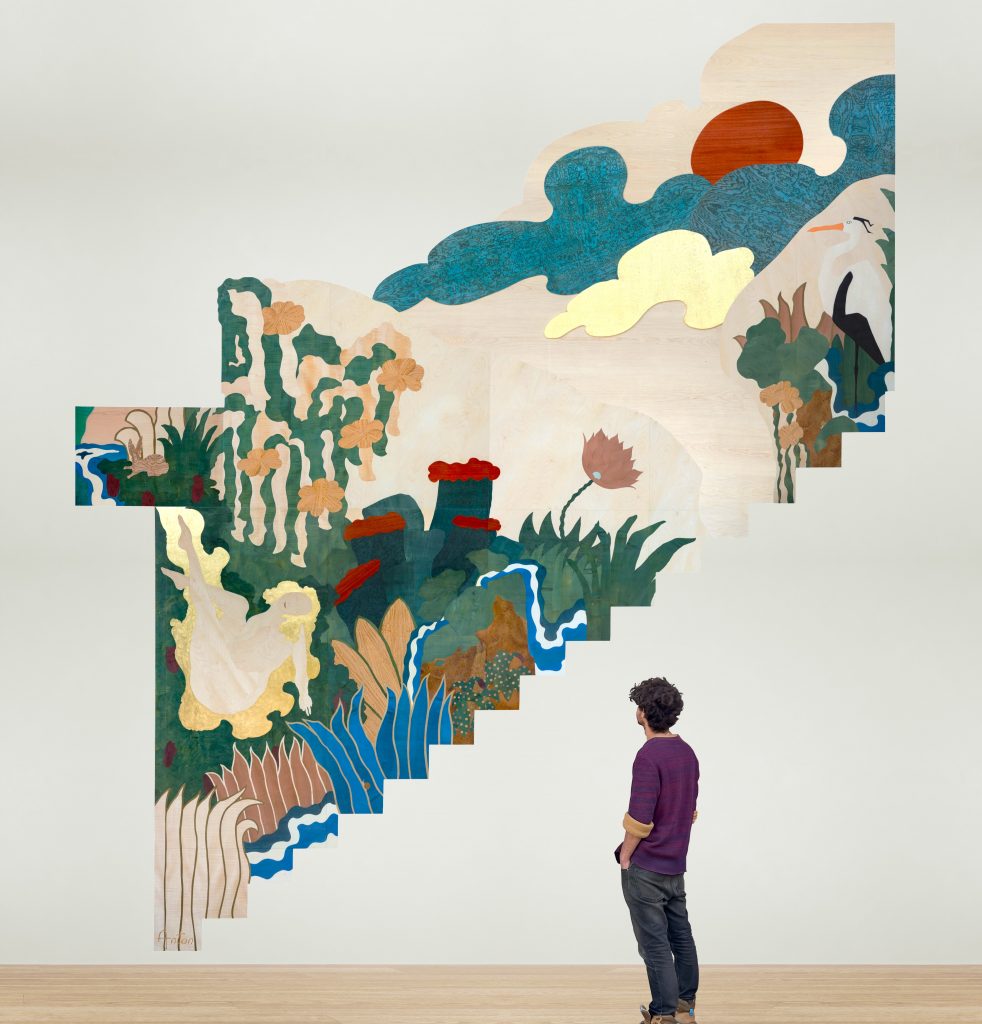
Entre marqueterie monumentale et jungle symbolique, Anton Laborde transforme le bois en récit contemporain poétique engagé.
ÉDITION #3
À Maison & Objet, Thierry Laudren présente des meubles sculptés où fonction, matière et lenteur façonnent une présence.
ÉDITION #3
Jean Nouvel conçoit une architecture attentive aux contextes, où lumière, histoire et usages façonnent chaque projet.
ÉDITION #3
À Lyon, Sophie Morel rénove des lieux historiques en alliant respect du bâti et écriture contemporaine.
ÉDITION #3
Au Centre d’Études Picasso, l’architecte compose une architecture où lumière, géométrie et héritage dialoguent avec précision.
ÉDITION #2
Entretien avec le fondateur d’EDO (European Design Office)
ÉDITION #2
Portrait d’un visionnaire qui transforme l’art de recevoir en expérience totale.
ÉDITION #1
Personnalités, artisans et créateurs qui donnent à la fête sa profondeur humaine.
ÉDITION #3
De Bordeaux au Bassin, art, vignobles et bien-être composent une échappée élégante au cœur de la Gironde.
ÉDITION #2
Vers une région de l’Italie habitée par le temps, où paysages, culture et usages s’accordent dans une continuité rare.
ÉDITION #1
Destinations et rituels qui réinventent la fête, du soleil tropical aux marchés d’hiver.