Tom Waugh, sculpteur sur pierre : la longue vie des objets jetables

Tom Waugh, stone sculptor, the long life of disposable things

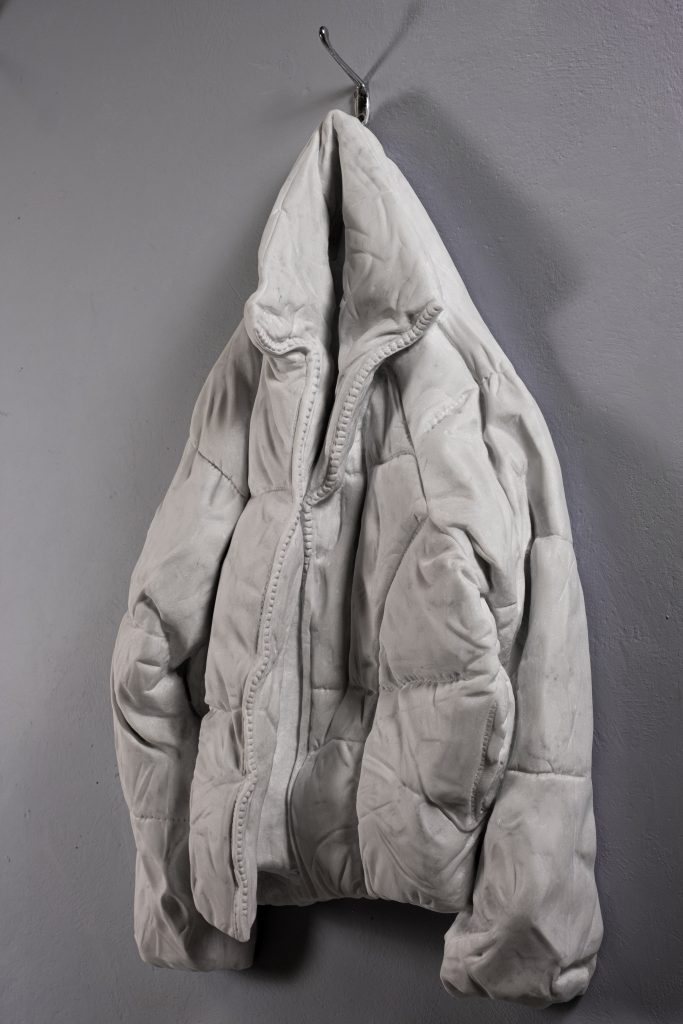
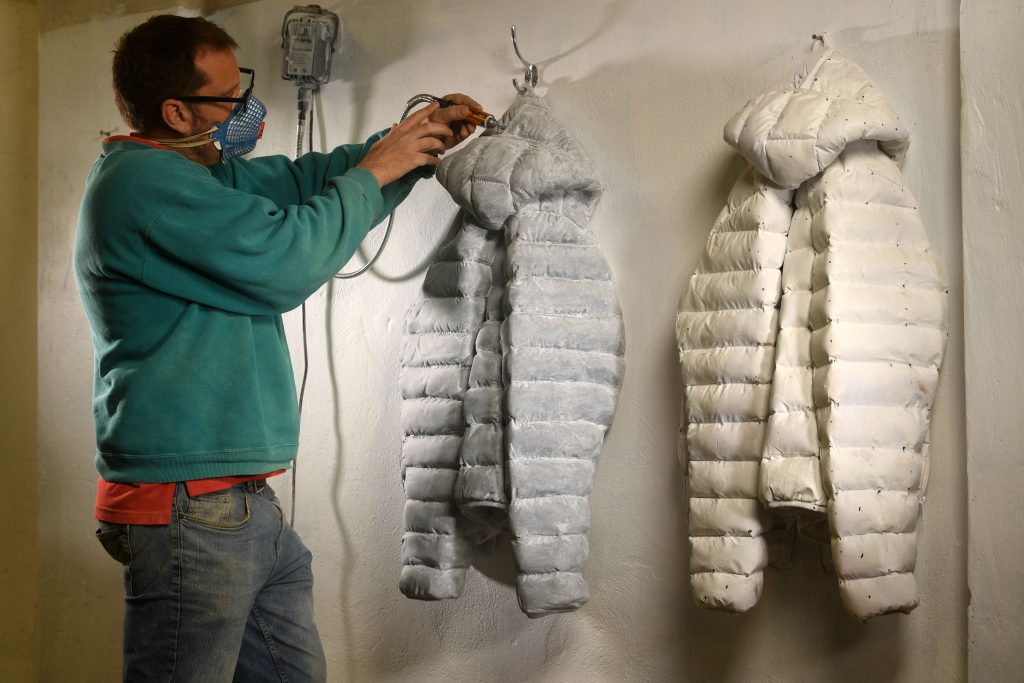
A puffer jacket hangs from a hook, quilted, slack at the shoulders, the kind of thing dropped there at the end of an evening. The eye accepts it for a second, then refuses. Every seam has been carved by hand from a block of Carrara marble. Tom Waugh has spent more than twenty years moving from masonry to decorative carving and, finally, to his own contemporary work, teaching stone to lie convincingly.

“There’s something powerful about carving warmth and softness into a cold, unforgiving material.”

ATTENTION DE NE PAS COUPER L’IMAGE : NI SUR LA PAGE D’ACCUEIL, NI SUR L’ARTICLE

A scaffold in Bristol

Tom Waugh

Tom Waugh

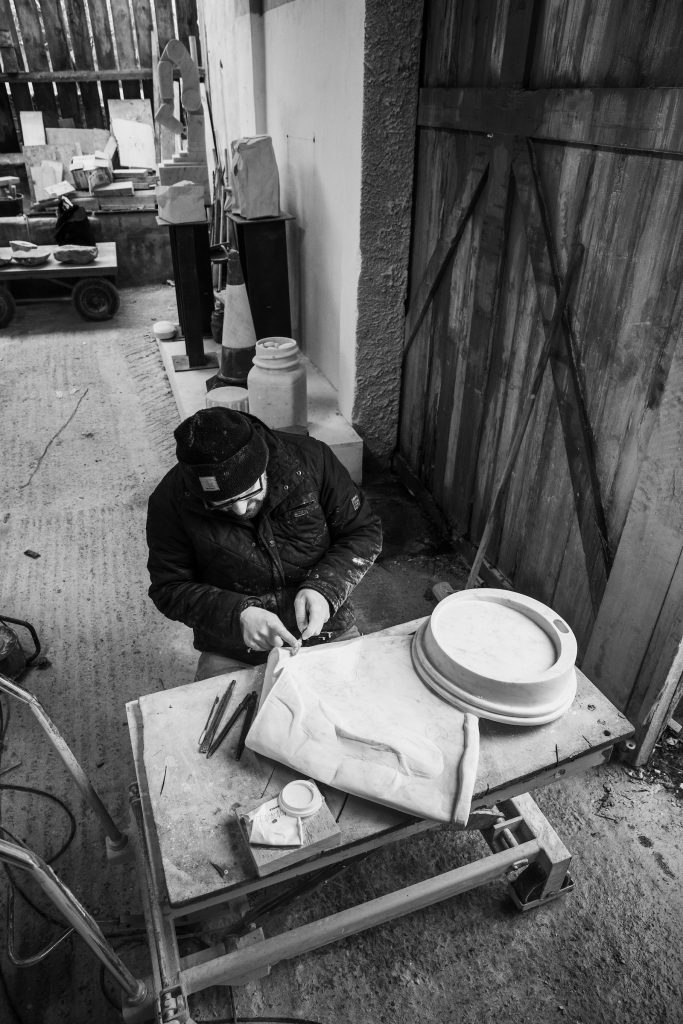
He was in his early twenties when a church near where he lived in Bristol went under scaffolding. Something about what the stonemasons were doing drew him in, and he asked whether they needed an extra pair of hands. Everything since has followed from that job.

From basic masonry he moved into decorative carving, and eventually into contemporary work of his own. What has kept him with stone is the sense that there is always further to go, in materials, in technique, in the difficulty of the next piece.

Learning to serve a building

Tom Waugh

Tom Waugh

That instinct was given a formal foundation at the City and Guilds of London Art School, where, in 2004, Waugh studied architectural stone carving with the support of the Queen Elizabeth Scholarship Trust. He came out the following year with a First and went on to work on major historic buildings including St Paul’s Cathedral, Windsor Castle, St Pancras Station and St Martin-in-the-Fields.

Architectural carving is a discipline of self-effacement. The carver matches a weathered original so closely that the repair is meant to disappear into the building. Waugh gave years to that tradition before returning to Somerset in 2008 to work freelance. One restoration he worked on, the Bath stone bridge at Halswell Park, received a Georgian Group award in 2021.

The line that never broke

Tom Waugh

Tom Waugh

A travel bursary in 2006 sent him a long way from English church fabric. The Ballardie award supported a period in India studying temple carving with Raja Saceran, and what struck Waugh there was the continuity of the tradition. Skills had been passed directly from one generation to the next, rather than being reconstructed from historical evidence.

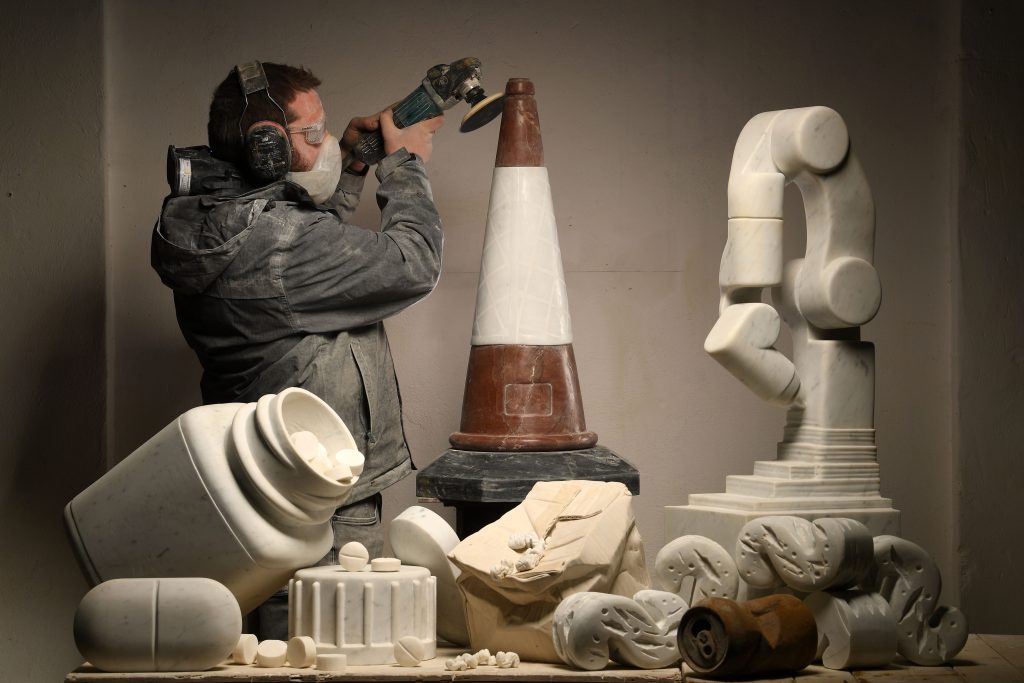
Along with his carving diploma, those techniques became the foundation of his work. Even now, with contemporary subjects, the tools and the methods come from history. Sometimes the connection is surprisingly direct. Crumpled cardboard can echo the folds of Baroque drapery. Joining differently coloured marbles, as in Traffic Cone, comes directly from classical portrait carving.

A cardboard box, in the gaps between commissions

Tom Waugh

Tom Waugh

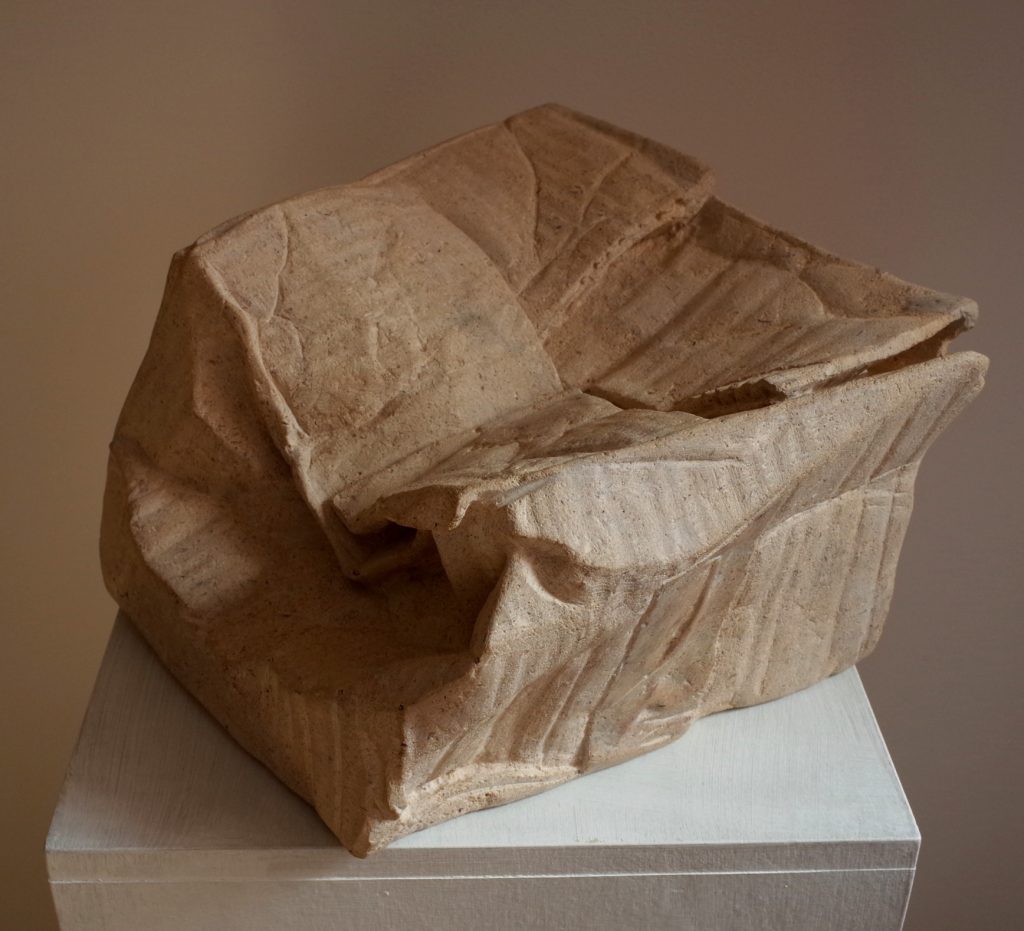
The first of the objects arrived almost as an experiment. In the quiet moments between commissions, he took a piece of Portland stone and carved a crumpled cardboard box, wondering how realistic he could make something so ordinary.

He loved the tension immediately: a fragile, temporary object carved in a material associated with permanence and reverence. From there he began exploring other everyday things, looking for stones that could bring their textures to life.

The humble subject and the noble material remain in constant friction. A disposable object is given the time, care and permanence of a sculpture. The result can be funny, strange or unexpectedly affecting.

Reading the block

Tom Waugh

Tom Waugh

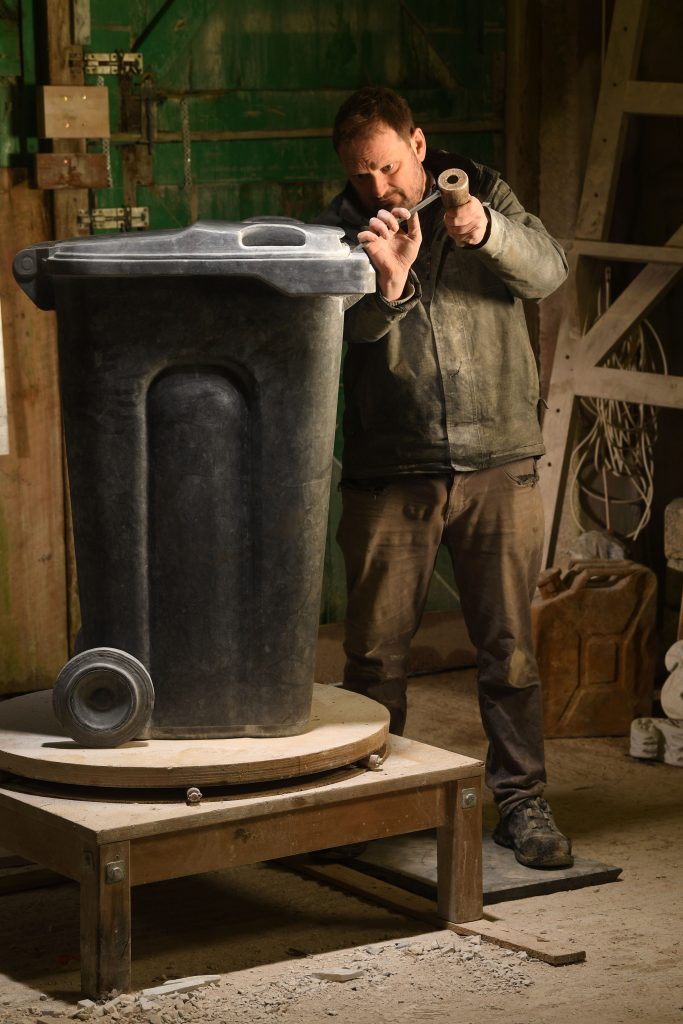
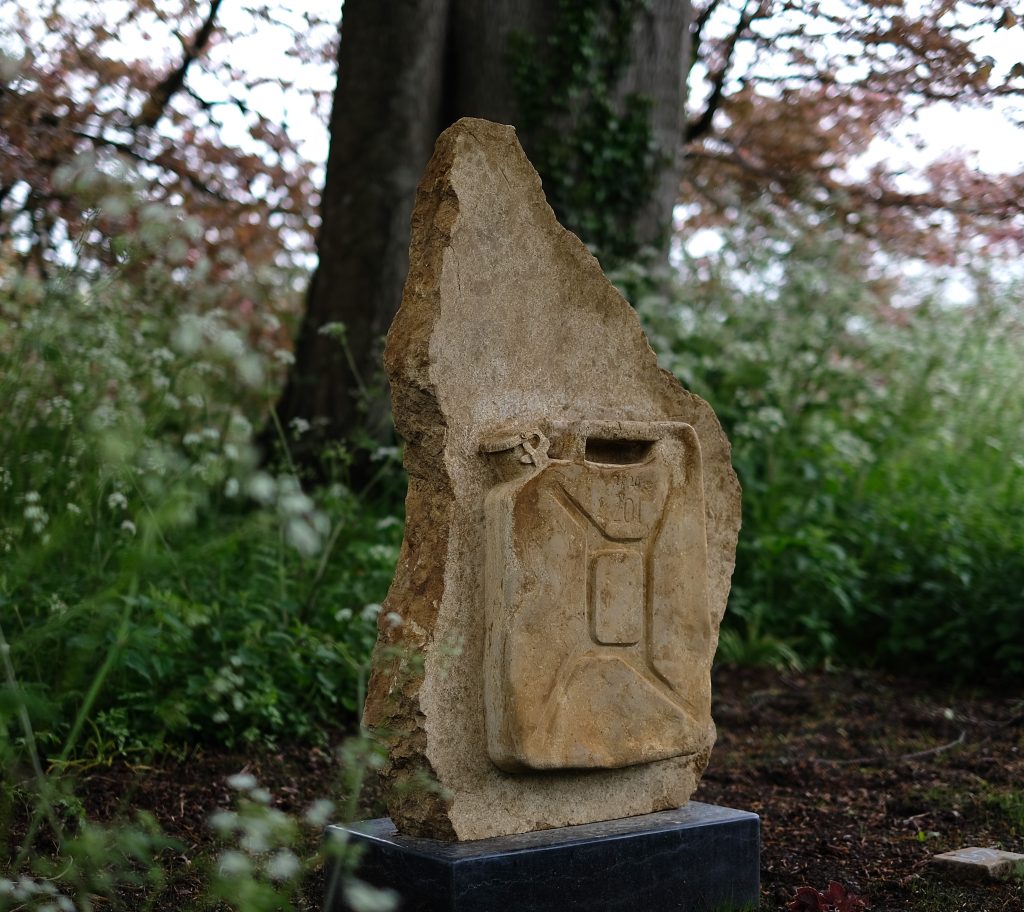
Everything depends on the stone, and the choice begins with the object. White marble for plastic and polystyrene, ironstone for rusted metal, limestone for paper: some pairings are obvious. “The challenge, and the fun, is finding a stone that doesn’t just imitate the object, but reveals something about it.”

That search has become part of the practice. Waugh is always looking for new objects and new stones. Great Tew ironstone comes out of the ground rust-coloured and gritty, so that a can carved from it seems to have corroded rather than been cut. Statuario, cool and grey-veined, gives a polythene bag the hang of drapery.

For Traffic Cone, three marbles are joined within a single body, in the way portrait busts were once assembled from coloured stone. The old language of sculpture remains present even when the subject has been pulled from the street, the supermarket or the recycling bin.

What the ground will remember

Tom Waugh

Tom Waugh

Some of the work gives up the pretence of being an object at all and turns into geology. In the Anthropocene Fossils series, everyday manufactured forms are imagined as the fossils that might remain from our era.

It is easy to forget how many objects pass through our hands every day. In the past, man-made things were precious and built to last. Now so much of what we produce is temporary and disposable. These imagined fossils ask what traces those objects might leave behind.

The point is not delivered as a lecture. Waugh is explicit that he never wants the work to preach. Humour provides the counterpoint. A viewer can enjoy the craftsmanship and playfulness, or follow the thread into the deeper questions about how we treat the natural world and the things that pass through our hands. Both responses are valid.

Eight hours, and the moment it comes alive

Tom Waugh

Tom Waugh

The studio runs on office hours. Waugh treats carving as a nine to five job, most days amounting to eight hours of steady work. There is something meditative about the concentration it requires, he says, and he cannot imagine doing anything else now.

His favourite moment comes around two-thirds of the way through a piece, when the form is fully realised and the detail begins to emerge. For a moment, the sculpture seems to come alive. Then comes the long stretch of sanding and polishing.

And finally there is the reaction he is looking for: the instant when the eye corrects itself. Take the puffer jackets. Waugh loves it when people initially think they are looking at an ordinary jacket hanging from a hook, then realise that the whole thing is marble.

He hopes they appreciate the carving and the detail, but he also enjoys the questions the work raises. The object may have been designed to disappear; the stone insists otherwise.

“People often assume I use 3D scanning or CNC machines, and I take that as a compliment. It opens up a conversation about fine art and craft, and how inseparable they really are in my work.”

Continue exploring

Adeline Giffon, interior designer: volume, light and materials
Isabelle de Lasteyrie: from materials to connections
Atelier Tuffery, French jeans since 1892
Chloé Hoquet, artisan jeweller and metalsmith: gold sculpted in ancient forms
Guillaume Catay, edge-gilder: ‘Gold throughout the pages.’
Cyril Lancelin, the artist who breathes dreams into public spaces

Février, 2026

Édition 3 : Patrimoine et création

Créer avec l’existant, penser avec l’histoire

De l’architecture au design, cette édition explore comment lieux, savoir-faire et matières héritées deviennent terrains de création actuelle.

Janvier, 2026

Édition 2 : Quiet luxury

Le luxe se réinvente.

Finis les logos clignotants, place à une sobriété raffinée, à l’immersion personnelle, à l’excellence artisanale, à la durabilité sensible.

Décembre, 2025

Édition 1 : Le sens de la fête

Héritages, gestes contemporains et plaisirs essentiels

Parce que la fête n’est jamais qu’apparence : elle reflète notre manière d’habiter le monde, de transmettre, de fabriquer des souvenirs durables.

ÉDITION #3

Révéler la beauté
‎

Upcycling et kintsugi transforment l’objet contemporain, faisant de la trace, de la réparation et de la matière un langage esthétique.

ÉDITION #3

Les nouveaux artisans du patrimoine

Artisans et designers donnent une seconde vie aux matériaux anciens, entre création contemporaine, patrimoine et réemploi.

ÉDITION #3

L'art à la rescousse des friches et lieux oubliés

Bunkers, wagons et kiosques renaissent grâce à la création, révélant comment l’art redonne sens aux lieux délaissés.

ÉDITION #2

Le murmure du beau
‎

Un regard transversal sur le quiet luxury à travers des lieux, des objets et des figures qui expriment l’élégance.

ÉDITION #1

Lieux, maisons et matières en éclats

Une sélection de marques, architectures, objets et escapades qui donnent corps au sens de la fête.

ÉDITION #3

La création au secours des bâtiments promis à l’oubli

Usines et gares délaissées deviennent lieux culturels ouverts, où mémoire industrielle et usages contemporains redessinent la ville.

ÉDITION #3

Hôtel Normandy Le Chantier

L’audacieuse métamorphose d’un palace parisien

ÉDITION #3

Dans les coulisses du Centre d'Études Picasso à Paris

Au cœur du Marais, un lieu discret révèle comment archives, architecture et recherche font dialoguer l’œuvre de Picasso.

ÉDITION #2

Shopping iconique dans un décor Tudor

Une expérience shopping unique dans un magasin emblématique.

ÉDITION #2

Gastronomie et architecture

Voyage culinaire et architectural au cœur de la Seine

ÉDITION #2

L'art de l'hospitalité parisienne

Dans le 9e arrondissement, un établissement qui invite au quiet luxury

ÉDITION #1

Chante!

Chante! vient d’ouvrir ses portes. Une invitation à vibrer !

ÉDITION #3

La boîte aux lettres française devenue objet de design

Icône du paysage français, la boîte jaune change de statut et s’invite dans l’univers du design.

ÉDITION #3

Retour sur Maison&Objet 2026 : retour aux sources et à l’essentiel

L’édition 2026 affirme une vision où artisanat, design et mémoire façonnent l’habitat contemporain, international actuel.

ÉDITION #3

Art Deco: un mouvement centenaire, plus actuel que jamais

Cent ans après 1925, l’Art déco revient dans nos villes et intérieurs avec géométrie, audace, optimisme.

ÉDITION #3

Royal Limoges, deux siècles d’histoire au présent

Depuis plus de deux cents ans, Royal Limoges conjugue porcelaine, savoir-faire industriel et création contemporaine.

ÉDITION #3

Du terrain à la rue et au catwalk : les sneakers à travers les époques

Des terrains de sport aux podiums, la sneaker raconte un siècle de mutations culturelles, techniques et stylistiques.

ÉDITION #2

La formidable aventure du papier peint de luxe

Design, mode, artisanat : des créations où la forme et la matière se répondent avec justesse, loin de tout effet de mode.

ÉDITION #1

Icônes, détails, rituels
‎

Décorations artisanales, calendriers ultra-luxe et pièces de collection pour s’enivrer de joie avant l’heure.

ÉDITION #3

Anton Laborde

Entre marqueterie monumentale et jungle symbolique, Anton Laborde transforme le bois en récit contemporain poétique engagé.

ÉDITION #3

Thierry Laudren

À Maison & Objet, Thierry Laudren présente des meubles sculptés où fonction, matière et lenteur façonnent une présence.

ÉDITION #3

Jean Nouvel

Jean Nouvel conçoit une architecture attentive aux contextes, où lumière, histoire et usages façonnent chaque projet.

ÉDITION #3

Sophie Morel

À Lyon, Sophie Morel rénove des lieux historiques en alliant respect du bâti et écriture contemporaine.

ÉDITION #3

Pascal Grasso

Au Centre d’Études Picasso, l’architecte compose une architecture où lumière, géométrie et héritage dialoguent avec précision.

ÉDITION #2

Alexandre Danan

Entretien avec le fondateur d’EDO (European Design Office)

ÉDITION #2

Aziz Temimi

Portrait d’un visionnaire qui transforme l’art de recevoir en expérience totale.

ÉDITION #1

Visages, gestes, inspirations

Personnalités, artisans et créateurs qui donnent à la fête sa profondeur humaine.

ÉDITION #3

Chemins de traverse : parenthèse d’exception en Bordelais

De Bordeaux au Bassin, art, vignobles et bien-être composent une échappée élégante au cœur de la Gironde.

ÉDITION #2

Voyage en Toscane
‎

Vers une région de l’Italie habitée par le temps, où paysages, culture et usages s’accordent dans une continuité rare.

ÉDITION #1

Horizons, saisons, traditions
‎

Destinations et rituels qui réinventent la fête, du soleil tropical aux marchés d’hiver.

Dates, adresses, invitations

Expositions, événements et repères culturels pour vivre pleinement la saison des fêtes.