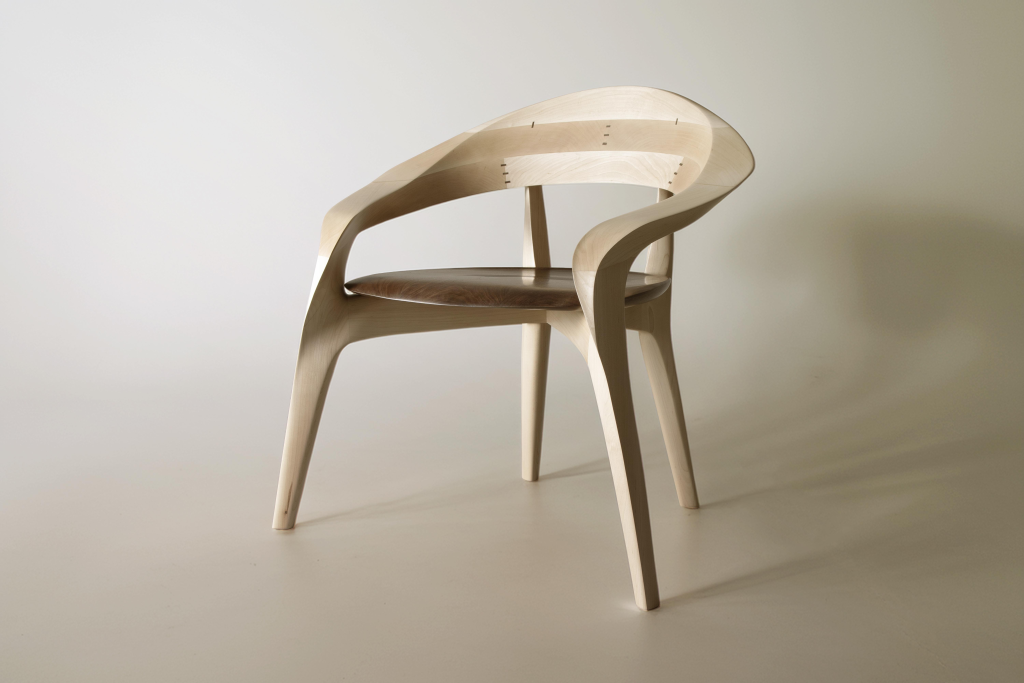
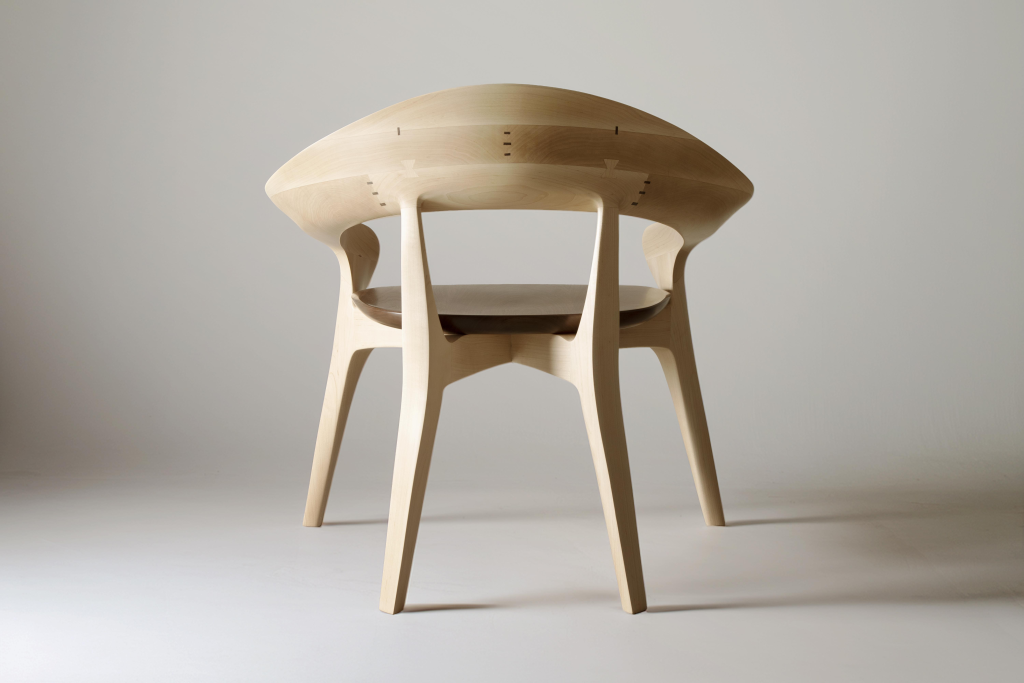
Conceived in the confined space of a shared studio in Shinjuku, the ORUHA chair has won ten international awards and been included in the Museum of Outstanding Design’s permanent collection. Hand-carved from maple and walnut using a Japanese plane, the ORUHA chair offers an intimate refuge within shared spaces. The Yedit studio is now opening a dedicated workshop and launching its first limited-edition production run.
Photographer Mitsuaki Takahashi, 2025
The ORUHA chair was designed for a specific purpose: to preserve a sense of privacy in shared spaces. The chair creates an enveloping enclave around the person sitting in it: a wooden presence that defines a space without closing it off. Described by Yuya Nakazawa as a personal sanctuary within a public space, it is a discreet shelter that the form suggests rather than imposes. The armrests, which are the parts of the chair that come into closest contact with the body, have sharp edges whilst offering a soft and secure grip. This tension between visual rigour and tactile comfort is what makes the piece so special. The expansive, generously curved surfaces capture and reveal every variation in light, so that the appearance of the chair changes as the hours pass and the viewing angle shifts.
ORUHA Chair ; Mitsuaki Takahashi, 2025
Moving Image Editor Yuya Nakazawa, 2025
Soundtrack Composer Heitaro Ashibe, 2025
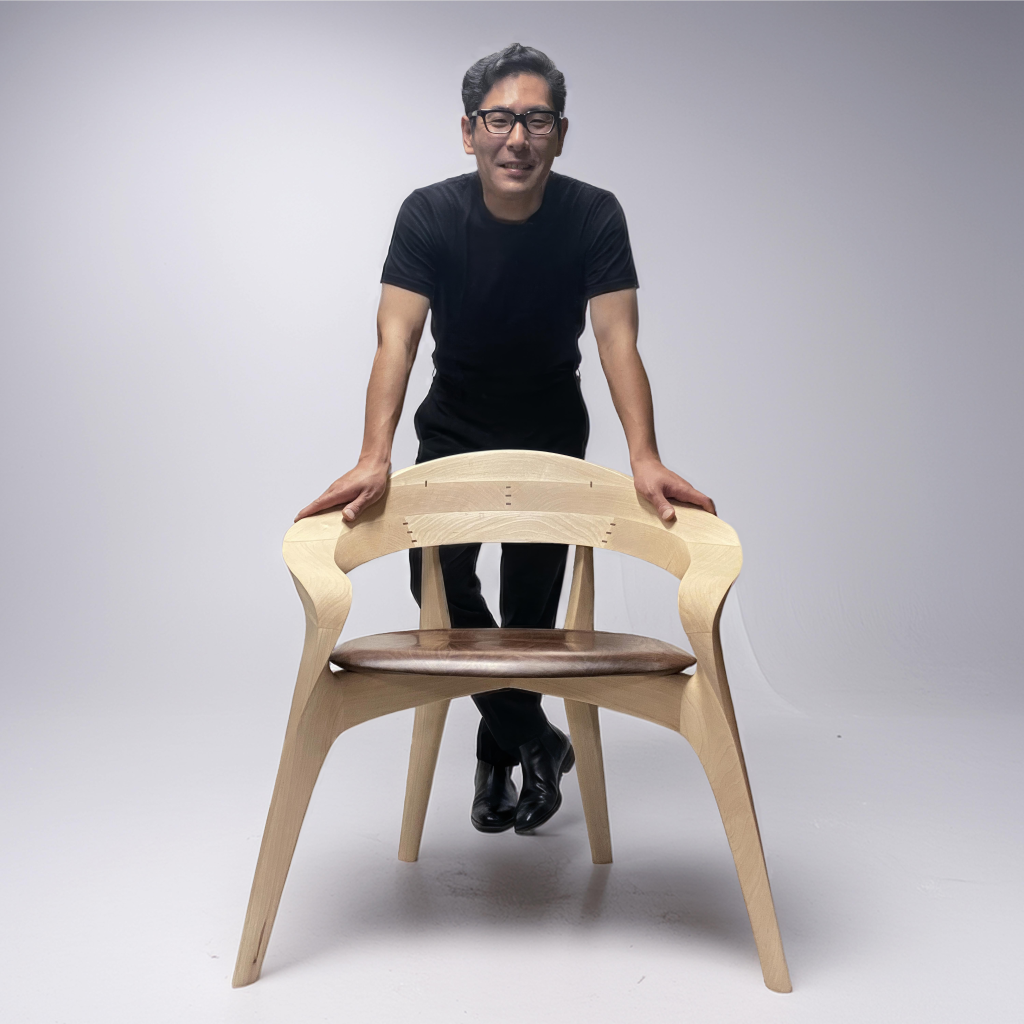
Before working with wood, Yuya Nakazawa spent many years editing advertising films and audiovisual productions. From this experience, he has adopted one approach: arranging individual sequences to create rhythm, continuity, and emotional progression. ORUHA transposes this principle into the material. The lines, proportions, and sequence of surfaces form a path for the eye to follow before the body settles into the chair. The designer worked with clay models and successive prototypes, shaping the form directly by hand rather than through drawing. The frame is carved from hard maple and the seat from walnut. Traditional Japanese joinery tools were used for the finishing, foremost among them the kanna, a plane whose passage determines the final smoothness of the solid wood.
A’ Design Award & Competition
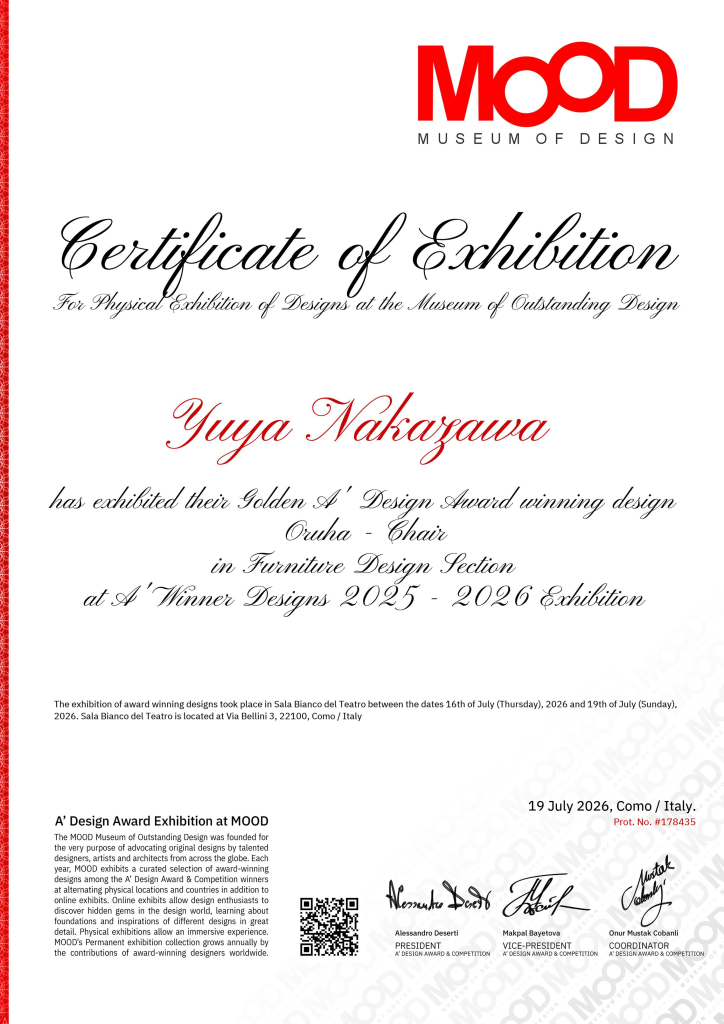
In less than two years, ORUHA has won ten international awards. In 2026, the A’ Design Award jury awarded it Gold in the Furniture Design category following a blind evaluation. The London International Creative Competition had previously honoured it with a Best in Category award. Further awards have been received in New York, Paris, London, Rome, Tokyo and across Asia. Beyond the competitions, the chair was included in the permanent collection of the Museum of Outstanding Design in Como and exhibited at the 40×40 Design Exhibition in New York. This recognition preceded any market launch: for a long time, ORUHA remained an exhibited and award-winning prototype, and the constraints of the shared workshop prevented its production, storage and dispatch.

Photographer Mitsuaki Takahashi, 2025
In order to elevate the chair from prototype to production without compromising on the requirement for handcrafted quality, Yedit established a dedicated workshop in Shinjuku. This facility is designed to enable structured artisanal production in limited editions, where each piece retains the hand-finished quality of the original. To mark this milestone, the studio is opening a waiting list and launching promotional channels aimed at an international audience. No price has been announced at this stage. This approach raises a question that Yuya Nakazawa is willing to address: how can a creation recognised by a museum find its way into private and public interiors without losing its artisanal identity? At the same time, Yedit is preparing a new furniture collection based on the same design philosophy, combining visual rhythm with sculpted form.
Février, 2026
Créer avec l’existant, penser avec l’histoire
De l’architecture au design, cette édition explore comment lieux, savoir-faire et matières héritées deviennent terrains de création actuelle.
Janvier, 2026
Le luxe se réinvente.
Finis les logos clignotants, place à une sobriété raffinée, à l’immersion personnelle, à l’excellence artisanale, à la durabilité sensible.
Décembre, 2025
Héritages, gestes contemporains et plaisirs essentiels
Parce que la fête n’est jamais qu’apparence : elle reflète notre manière d’habiter le monde, de transmettre, de fabriquer des souvenirs durables.
ÉDITION #3
Upcycling et kintsugi transforment l’objet contemporain, faisant de la trace, de la réparation et de la matière un langage esthétique.
ÉDITION #3
Artisans et designers donnent une seconde vie aux matériaux anciens, entre création contemporaine, patrimoine et réemploi.
ÉDITION #3
Bunkers, wagons et kiosques renaissent grâce à la création, révélant comment l’art redonne sens aux lieux délaissés.
ÉDITION #2
Un regard transversal sur le quiet luxury à travers des lieux, des objets et des figures qui expriment l’élégance.
ÉDITION #1
Une sélection de marques, architectures, objets et escapades qui donnent corps au sens de la fête.
ÉDITION #3
Usines et gares délaissées deviennent lieux culturels ouverts, où mémoire industrielle et usages contemporains redessinent la ville.
ÉDITION #3
L’audacieuse métamorphose d’un palace parisien
ÉDITION #3
Au cœur du Marais, un lieu discret révèle comment archives, architecture et recherche font dialoguer l’œuvre de Picasso.
ÉDITION #2
Une expérience shopping unique dans un magasin emblématique.
ÉDITION #2
Voyage culinaire et architectural au cœur de la Seine
ÉDITION #2
Dans le 9e arrondissement, un établissement qui invite au quiet luxury
ÉDITION #1
Chante! vient d’ouvrir ses portes. Une invitation à vibrer !
ÉDITION #3
Icône du paysage français, la boîte jaune change de statut et s’invite dans l’univers du design.
ÉDITION #3
L’édition 2026 affirme une vision où artisanat, design et mémoire façonnent l’habitat contemporain, international actuel.
ÉDITION #3
Cent ans après 1925, l’Art déco revient dans nos villes et intérieurs avec géométrie, audace, optimisme.
ÉDITION #3
Depuis plus de deux cents ans, Royal Limoges conjugue porcelaine, savoir-faire industriel et création contemporaine.
ÉDITION #3
Des terrains de sport aux podiums, la sneaker raconte un siècle de mutations culturelles, techniques et stylistiques.
ÉDITION #2
Design, mode, artisanat : des créations où la forme et la matière se répondent avec justesse, loin de tout effet de mode.
ÉDITION #1
Décorations artisanales, calendriers ultra-luxe et pièces de collection pour s’enivrer de joie avant l’heure.
ÉDITION #3
Entre marqueterie monumentale et jungle symbolique, Anton Laborde transforme le bois en récit contemporain poétique engagé.
ÉDITION #3
À Maison & Objet, Thierry Laudren présente des meubles sculptés où fonction, matière et lenteur façonnent une présence.
ÉDITION #3
Jean Nouvel conçoit une architecture attentive aux contextes, où lumière, histoire et usages façonnent chaque projet.
ÉDITION #3
À Lyon, Sophie Morel rénove des lieux historiques en alliant respect du bâti et écriture contemporaine.
ÉDITION #3
Au Centre d’Études Picasso, l’architecte compose une architecture où lumière, géométrie et héritage dialoguent avec précision.
ÉDITION #2
Entretien avec le fondateur d’EDO (European Design Office)
ÉDITION #2
Portrait d’un visionnaire qui transforme l’art de recevoir en expérience totale.
ÉDITION #1
Personnalités, artisans et créateurs qui donnent à la fête sa profondeur humaine.
ÉDITION #3
De Bordeaux au Bassin, art, vignobles et bien-être composent une échappée élégante au cœur de la Gironde.
ÉDITION #2
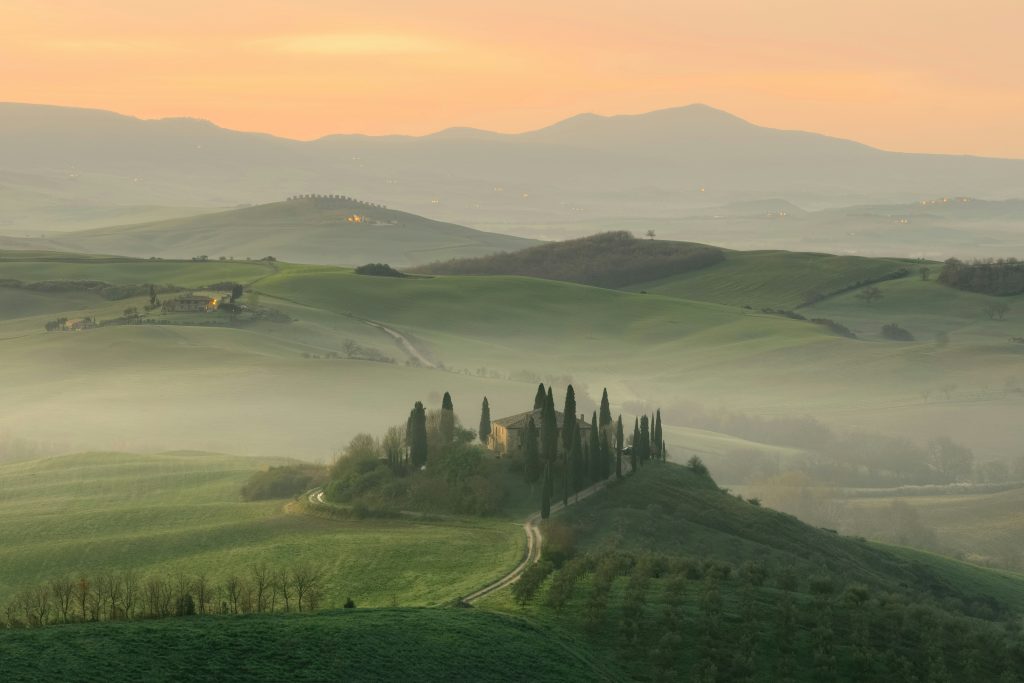
Vers une région de l’Italie habitée par le temps, où paysages, culture et usages s’accordent dans une continuité rare.
ÉDITION #1
Destinations et rituels qui réinventent la fête, du soleil tropical aux marchés d’hiver.