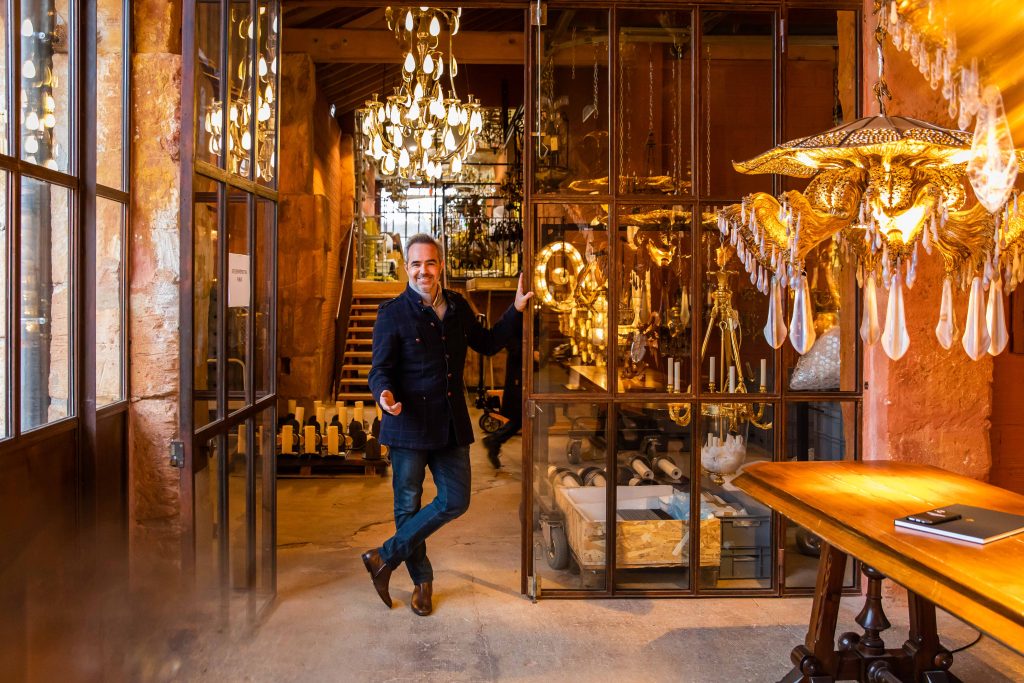
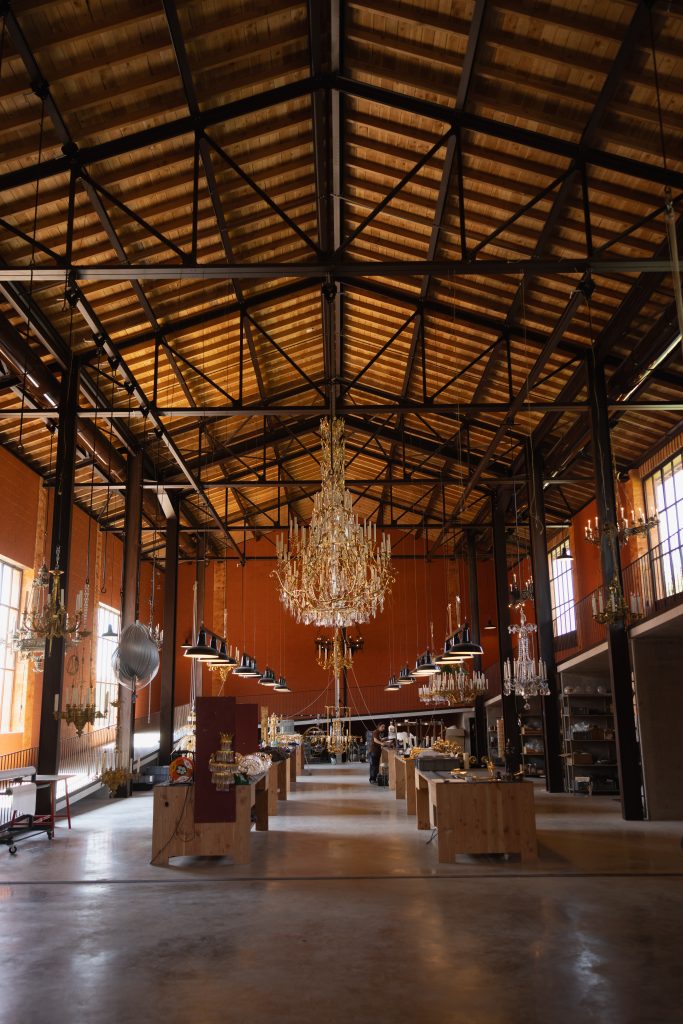
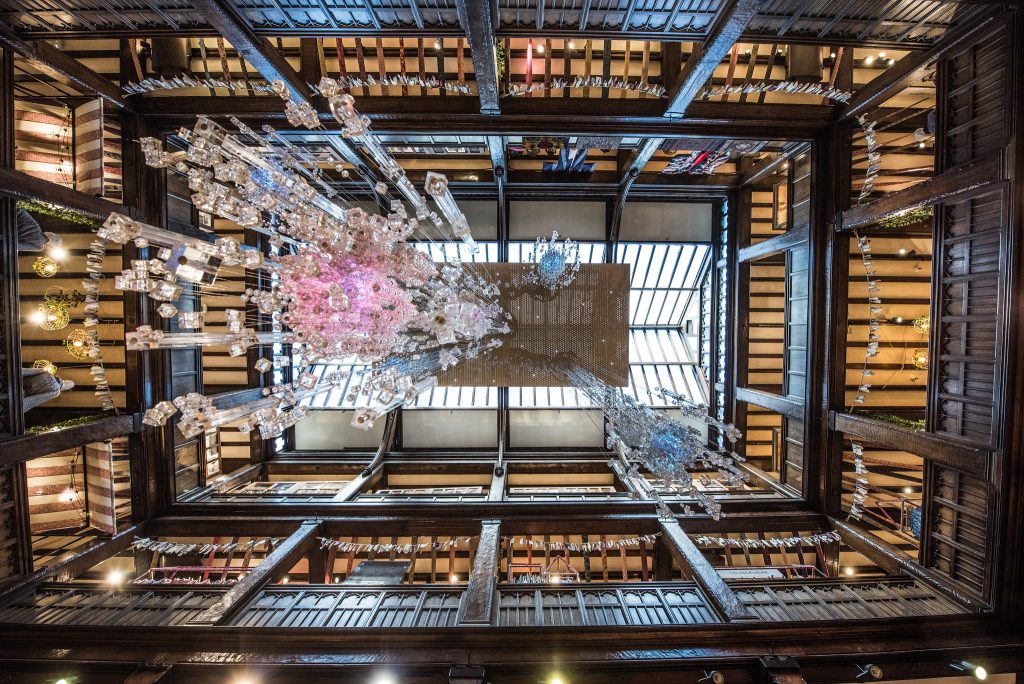
In Gargas, in the Luberon, the former ochre factories house a unique collection of almost a thousand chandeliers, ranging from medieval designs to contemporary pieces. Here, craftsmen breathe new life into these objects. As the driving force behind Mathieu Lustrerie, Régis Mathieu is on a mission that is both a passion and an obsession: to ensure that these objects endure through the centuries without losing their ability to captivate. His work illuminates some of France’s most iconic cultural heritage sites, from the salons of Versailles to Notre-Dame de Paris. However, his ambition lies elsewhere too: to encourage us to look up once again.
Photo: Lustrerie Mathieu
Lustrerie Mathieu
For Régis Mathieu, it all begins with a glance. As a child, he spent his weekends in the workshop of his father, Henri, the founder of the company in 1948. Museums, antique dealers, and family discussions shaped his upbringing. One habit he has retained is looking up at the ceiling whenever he enters a room. “A chandelier,” he believes, “says a great deal about those who live there.”
In 1992, when he was in his early twenties, he took over the family business. However, this was not an era for pendants and gilding. Indirect lighting had taken over, ceilings were being lowered and antique chandeliers were ending up in second-hand shops. However, Régis Mathieu chose to buck this trend. He devoted himself to restoring historic pieces, developing his own designs, and undertaking research to better understand the history of this object, which is all too often reduced to its decorative function.
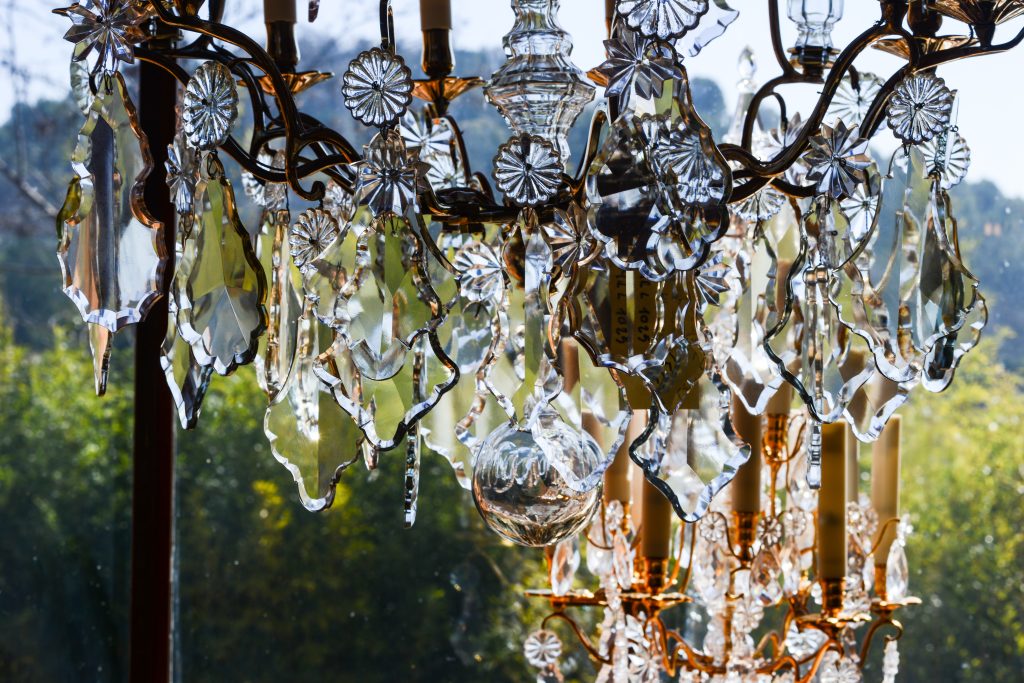
After all, a chandelier is also a work of art: a suspended structure designed to interact with its surroundings. It is the final element to be installed once the painters, gilders, sculptors, and other craftsmen have finished working. Like a piece of jewellery on an evening gown, it adds the finishing touch.
Régis Mathieu likes to point out that these objects tell stories. A remarkable example is the chandelier crafted by Jacques Caffieri and given by Louis XV to the Marquise de Pompadour: the partridges symbolise love, the hunting horns recall their first meeting, and the three towers refer to the Marquise’s coat of arms. Mathieu Lustrerie first restored the original, held at the Mazarine Library, before producing a reproduction. The work here is not simply about restoring an object to its former beauty. It is also about preserving the story it has to tell.
Lustrerie Mathieu
Lustrerie Mathieu
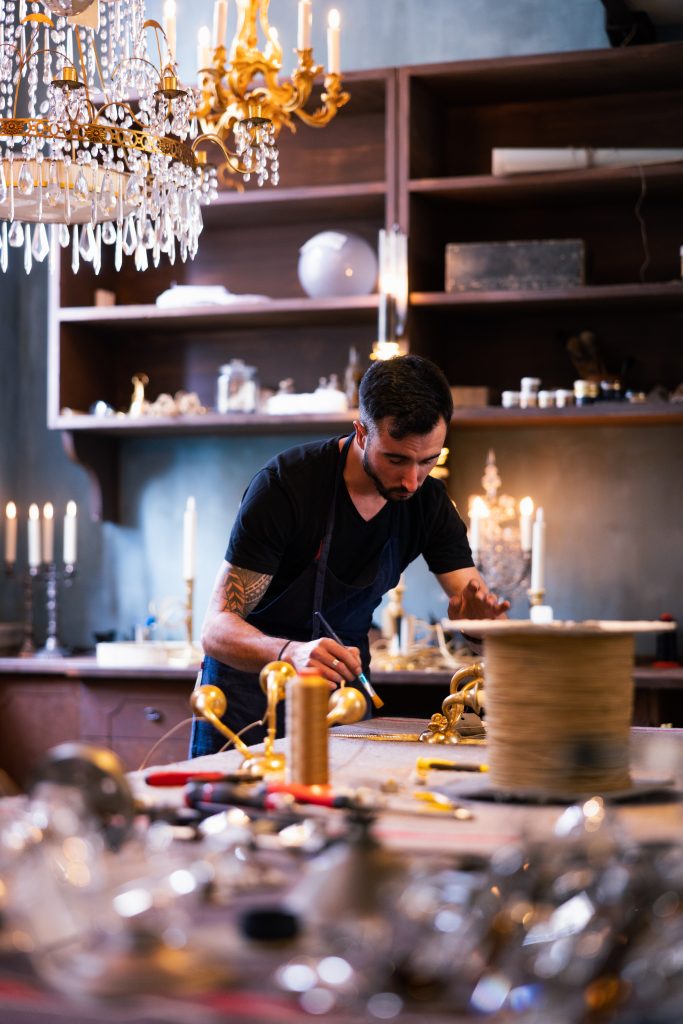
This attention to history is particularly evident on major heritage restoration projects. Following the fire in 2019, the workshop restored the chandeliers and choir candelabra in Notre-Dame de Paris, as well as several other lighting fixtures in the cathedral. In Gargas, experienced craftsmen, ‘Compagnons du Tour de France’, and young apprentices work together to create these pieces. Expertise is passed on through hands-on work and direct contact with the objects, fostering an understanding of their fragility.
But Régis Mathieu does more than just restore. He also researches, documents, compares and analyses. At his Centre for the Study and Conservation of Antique Chandeliers, he explores manufacturing techniques and the traces left by successive interventions.
For example, analyses of metallic layers can distinguish gilding from varnish and identify the alterations a piece has undergone.
This research also informs a unique museum housed in the former ochre factories in Gargas. The exhibition takes visitors on a journey through time, revealing how forms echo one another from one century to the next. The collection came about almost out of necessity. Régis Mathieu needed original pieces to show curators what could not be explained in books. He eventually brought them together in a museum which is open to the public free of charge.
This speaks volumes about his philosophy. “I don’t make chandeliers to make money. I make money to make chandeliers.” The company funds an ambition that goes beyond its own scope: preserving heritage, developing knowledge, and passing on culture. In Gargas, visitors can explore the collections and watch the craftsmen at work, with no obligation to buy.
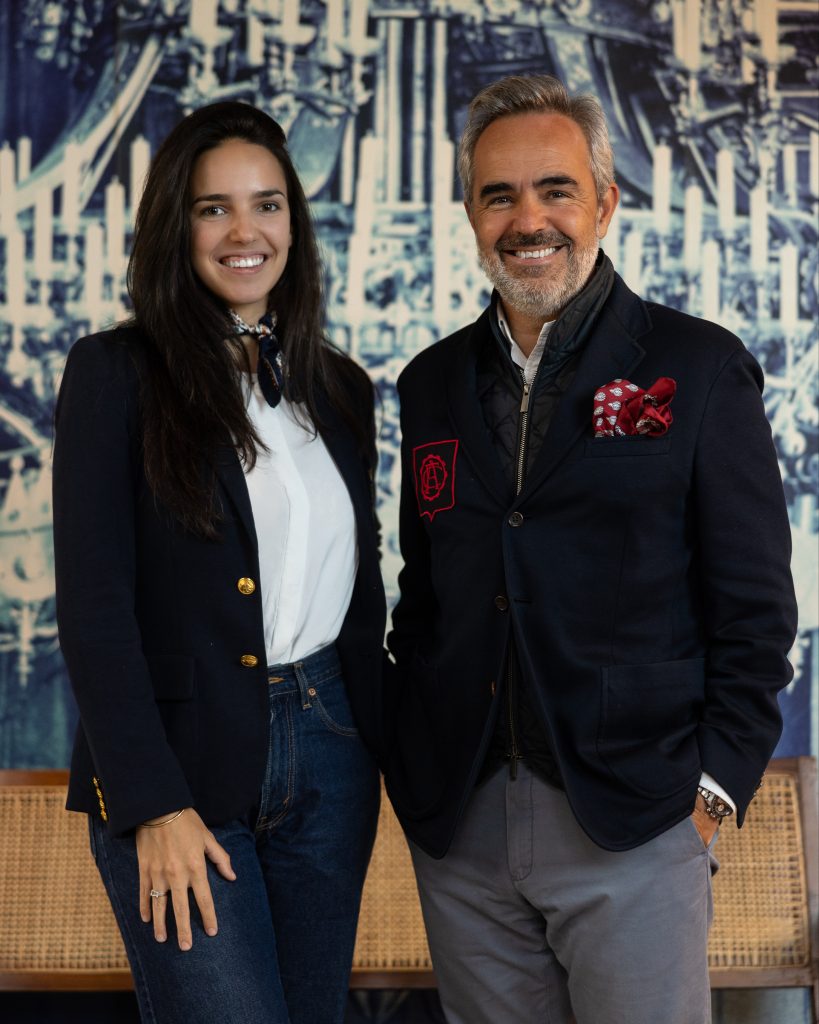
Inès et Régis Mathieu; Lustrerie Mathieu
Lustrerie Mathieu
Régis Mathieu also champions a less obvious idea: a chandelier is not merely a decorative item. It can be a way of entertaining, of expressing one’s personality and of evoking emotion.
A work of art hung on the wall is something to be contemplated; a chandelier, on the other hand, transforms the atmosphere of an entire room. By candlelight, a dinner becomes a moment unlike any other. The act of lighting it, the softness of the light and the fleeting nature of the flame all contribute to an experience that cannot be reduced to the object itself or its price.
Yet many still hesitate to bring a baroque, exuberant or simply unusual piece into their homes. Régis Mathieu observes this in his clients’ choices: they are sometimes drawn to designs they do not dare to embrace in everyday life.
His daughter Inès, who is now at the helm of the company, has devised a solution: renting. Instead of owning a chandelier forever, why not choose one for a season, a celebration or a whim, and then replace it? A classic crystal piece for Christmas and a bolder design for summer, for example, allow the heritage to become a freely accessible collection.
This is another way of breathing new life into antique objects, rather than freezing them in the past. It is also a way of passing on the family legacy: Inès is continuing her father’s work whilst opening up new horizons.
In the Mathieu family, the Notre-Dame chandeliers have illuminated two successive New Year’s Eves: the first time, they were still blackened by the fire; the second time, they were restored and gilded. Two images of the same object, two moments in an ongoing story.
In Gargas, Régis Mathieu does not seek to preserve the chandeliers in a glass case. He wants to preserve them, understand them and pass them on, but above all he wants to enable them to regain their place in our lives. People come and go, fashions change, but a well-crafted chandelier can continue to light up a room and tell the story of its era long after we are gone.

Lustrerie Mathieu
Février, 2026
Créer avec l’existant, penser avec l’histoire
De l’architecture au design, cette édition explore comment lieux, savoir-faire et matières héritées deviennent terrains de création actuelle.
Janvier, 2026
Le luxe se réinvente.
Finis les logos clignotants, place à une sobriété raffinée, à l’immersion personnelle, à l’excellence artisanale, à la durabilité sensible.
Décembre, 2025
Héritages, gestes contemporains et plaisirs essentiels
Parce que la fête n’est jamais qu’apparence : elle reflète notre manière d’habiter le monde, de transmettre, de fabriquer des souvenirs durables.
ÉDITION #3
Upcycling et kintsugi transforment l’objet contemporain, faisant de la trace, de la réparation et de la matière un langage esthétique.
ÉDITION #3
Artisans et designers donnent une seconde vie aux matériaux anciens, entre création contemporaine, patrimoine et réemploi.
ÉDITION #3
Bunkers, wagons et kiosques renaissent grâce à la création, révélant comment l’art redonne sens aux lieux délaissés.
ÉDITION #2
Un regard transversal sur le quiet luxury à travers des lieux, des objets et des figures qui expriment l’élégance.
ÉDITION #1
Une sélection de marques, architectures, objets et escapades qui donnent corps au sens de la fête.
ÉDITION #3
Usines et gares délaissées deviennent lieux culturels ouverts, où mémoire industrielle et usages contemporains redessinent la ville.
ÉDITION #3
L’audacieuse métamorphose d’un palace parisien
ÉDITION #3
Au cœur du Marais, un lieu discret révèle comment archives, architecture et recherche font dialoguer l’œuvre de Picasso.
ÉDITION #2
Une expérience shopping unique dans un magasin emblématique.
ÉDITION #2
Voyage culinaire et architectural au cœur de la Seine
ÉDITION #2
Dans le 9e arrondissement, un établissement qui invite au quiet luxury
ÉDITION #1
Chante! vient d’ouvrir ses portes. Une invitation à vibrer !
ÉDITION #3
Icône du paysage français, la boîte jaune change de statut et s’invite dans l’univers du design.
ÉDITION #3
L’édition 2026 affirme une vision où artisanat, design et mémoire façonnent l’habitat contemporain, international actuel.
ÉDITION #3
Cent ans après 1925, l’Art déco revient dans nos villes et intérieurs avec géométrie, audace, optimisme.
ÉDITION #3
Depuis plus de deux cents ans, Royal Limoges conjugue porcelaine, savoir-faire industriel et création contemporaine.
ÉDITION #3
Des terrains de sport aux podiums, la sneaker raconte un siècle de mutations culturelles, techniques et stylistiques.
ÉDITION #2
Design, mode, artisanat : des créations où la forme et la matière se répondent avec justesse, loin de tout effet de mode.
ÉDITION #1
Décorations artisanales, calendriers ultra-luxe et pièces de collection pour s’enivrer de joie avant l’heure.
ÉDITION #3
Entre marqueterie monumentale et jungle symbolique, Anton Laborde transforme le bois en récit contemporain poétique engagé.
ÉDITION #3
À Maison & Objet, Thierry Laudren présente des meubles sculptés où fonction, matière et lenteur façonnent une présence.
ÉDITION #3
Jean Nouvel conçoit une architecture attentive aux contextes, où lumière, histoire et usages façonnent chaque projet.
ÉDITION #3
À Lyon, Sophie Morel rénove des lieux historiques en alliant respect du bâti et écriture contemporaine.
ÉDITION #3
Au Centre d’Études Picasso, l’architecte compose une architecture où lumière, géométrie et héritage dialoguent avec précision.
ÉDITION #2
Entretien avec le fondateur d’EDO (European Design Office)
ÉDITION #2
Portrait d’un visionnaire qui transforme l’art de recevoir en expérience totale.
ÉDITION #1
Personnalités, artisans et créateurs qui donnent à la fête sa profondeur humaine.
ÉDITION #3
De Bordeaux au Bassin, art, vignobles et bien-être composent une échappée élégante au cœur de la Gironde.
ÉDITION #2
Vers une région de l’Italie habitée par le temps, où paysages, culture et usages s’accordent dans une continuité rare.
ÉDITION #1
Destinations et rituels qui réinventent la fête, du soleil tropical aux marchés d’hiver.