A folded sheet of paper, a palm fibre stretched over a needle, a pheasant feather that still seems to breathe. A graduate of the École nationale supérieure des Arts Décoratifs and a designer of technical clothing for many years, Georgine Glaenzer has turned her attention to craftsmanship and raw materials. A bespoke milliner and feather artist, and a member of Ateliers d’Art de France, she creates ceremonial hats and feather artworks in her studio in the Île-de-France region. ‘The material guides me. I tame it, and it takes me beyond my own will.’
Photo: Georgine Glaenzer
Georgine Glaenzer
Georgine Glaenzer’s career began at one of France’s most prestigious design schools. She graduated from the École nationale supérieure des Arts Décoratifs in Paris, specialising in fashion design, and received recognition at the Salon des artistes décorateurs, held at the Grand Palais in 1987. Her training can be summed up in two words: form and function.
For around ten years, she applied these principles to the world of sport. Working with well-known brands and alongside athletes, she developed technical clothing for sailors, high-altitude mountaineers, hunters and equestrians. The nature of the work took her abroad to production sites, where she gained first-hand experience of the rigour of industrial processes.
Then came family life, and a question she could no longer avoid. As her responsibilities grew, creativity gradually took a back seat to coordination and commercial decisions. She chose to return to the essentials: working independently, with her own hands, and rediscovering creativity in its purest form.
Georgine Glaenzer
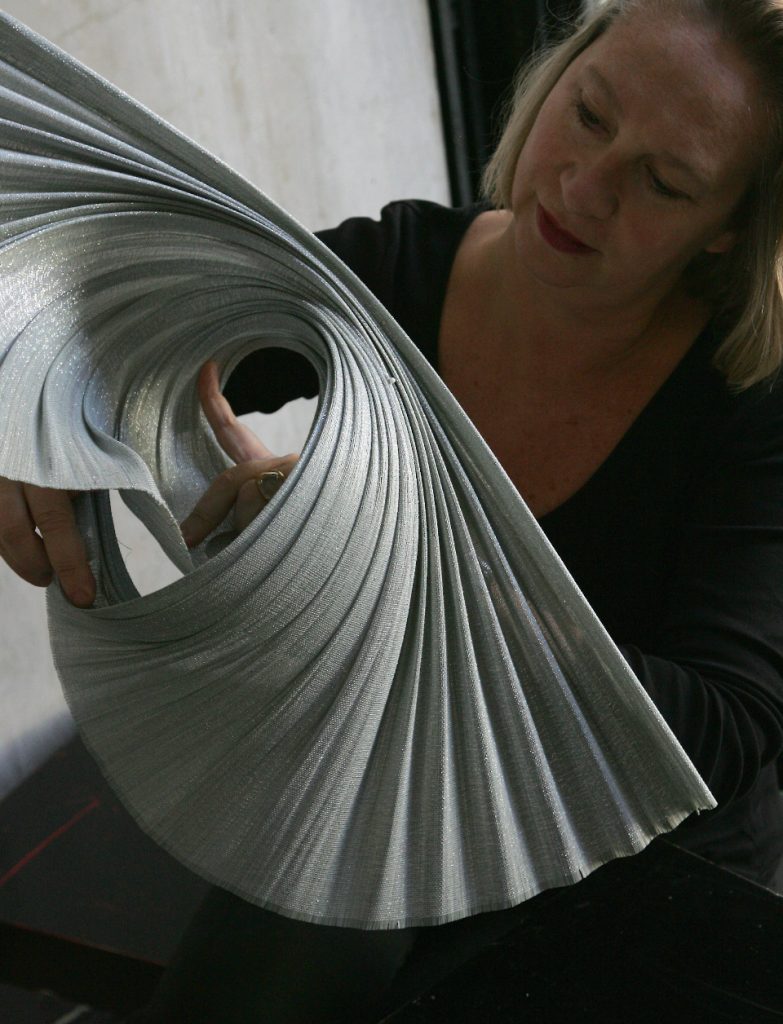
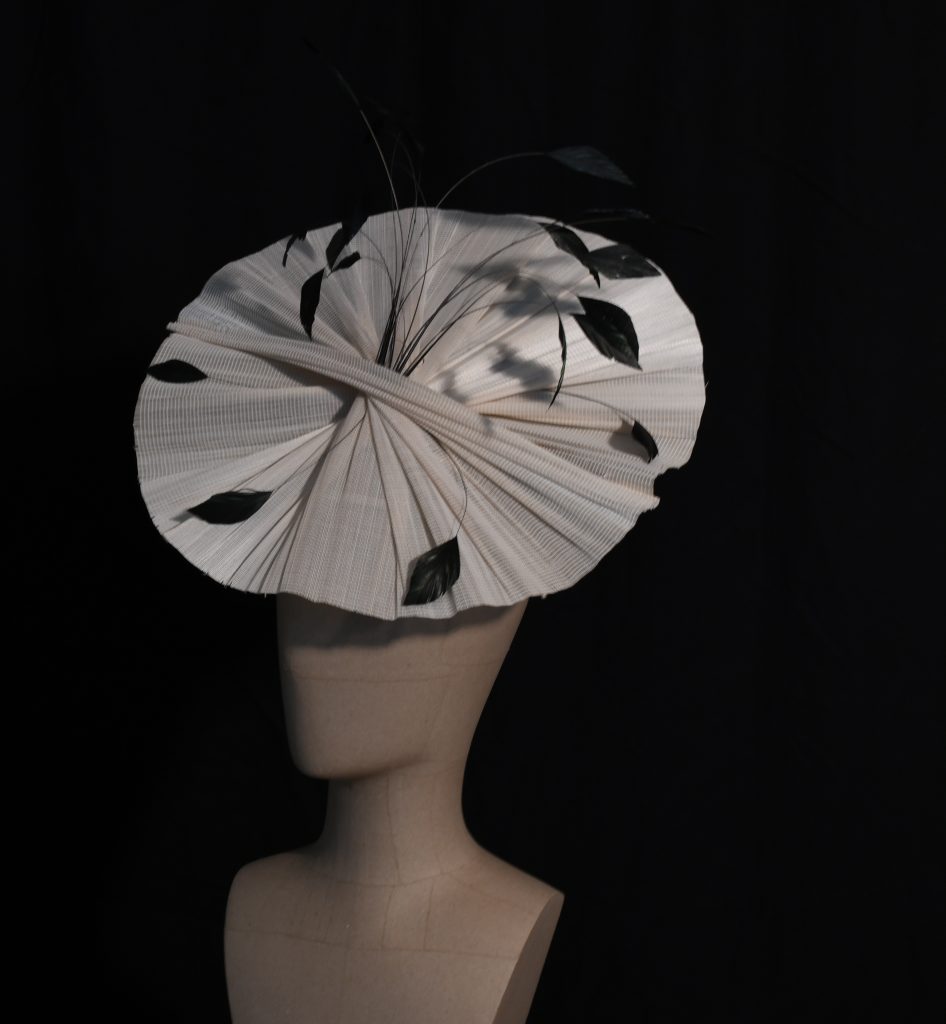
Her first material was the simplest of all: a sheet of paper. Georgine Glaenzer folds and refolds it, developing a pleating technique inspired by origami that allows her to create a variety of hat styles. Paper soon gave way to tarlatan, a starched cotton gauze that holds its pleats just as readily.
Her collaboration with the Palais Galliera, the City of Paris’s fashion museum, and her meeting with Madame Carven – a leading figure in pleating whose collection was donated to the museum – paved the way for educational workshops devoted to these sunburst pleats. She continues to lead these workshops on request.
Even then, the principle that would guide all her work was beginning to emerge: starting with the raw material and revealing its inherent qualities, while allowing it to determine its own form.
Georgine Glaenzer
In 2005, another fibre found its way into her studio. Buntal, a palm fibre woven in the Philippines by a family-run business with which she works directly, proved both supple and resilient.
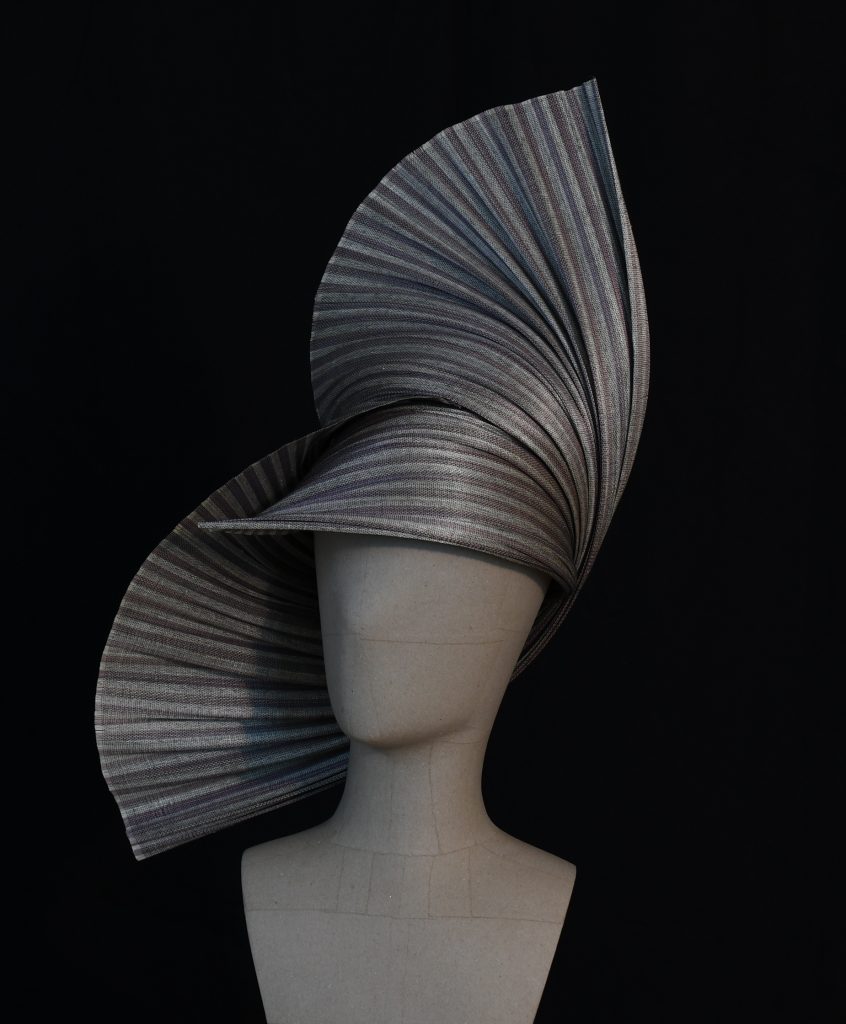
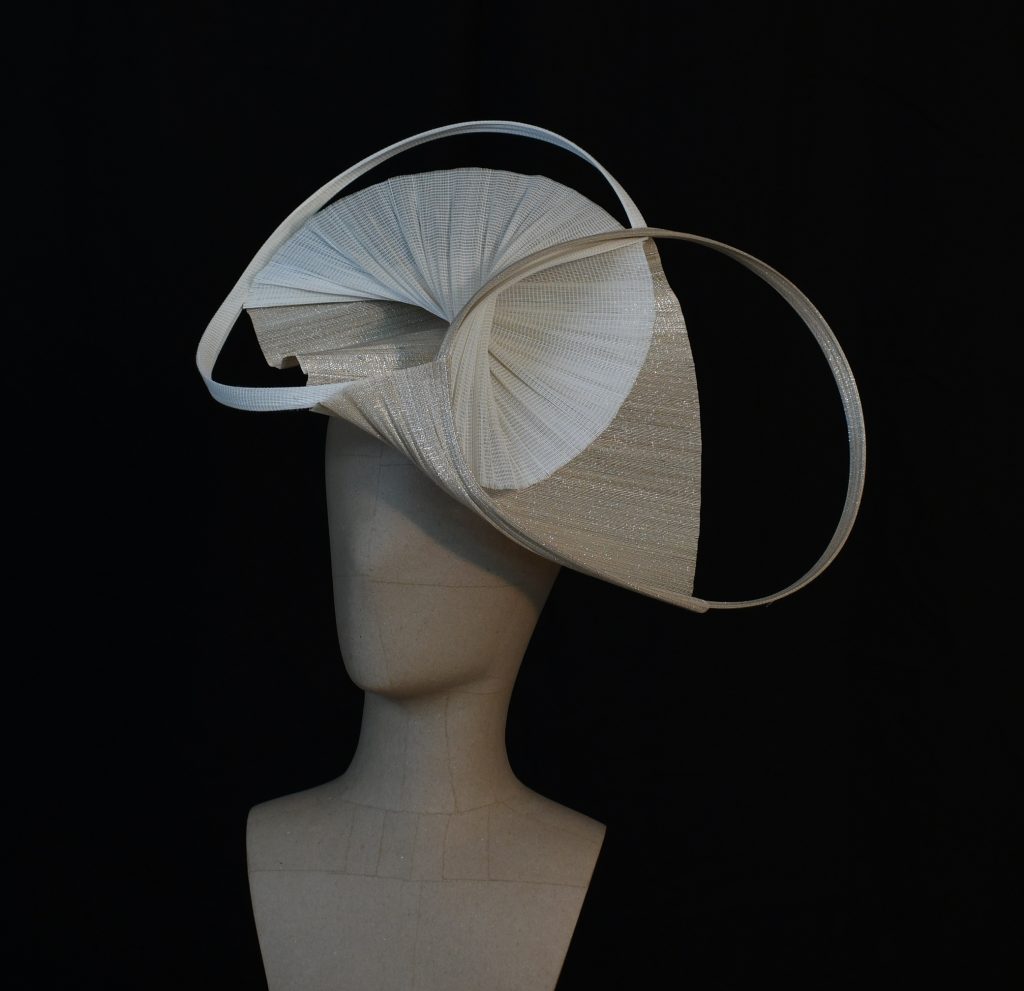
Georgine Glaenzer gradually moved beyond the traditional wooden hat blocks used in millinery. Working with pins, she pleats, drapes and twists the fibre, while scissors and blades allow her to accentuate or soften its curves. Her technique is closer to that of a sculptor, shaping a form freely in space.
These fluid arrangements give rise to what she calls ‘headwear sculptures’: turbans, floppy hats, headbands, curlers and arabesques. Each piece is unique, modular and made to measure, never symmetrical. The fibre dictates its own form, and the hand follows.
Much like a stonemason following the grain of marble or a cabinetmaker working with the natural grain of wood, Georgine follows the movement of each piece of buntal, respecting its character while bringing it to light.

Georgine Glaenzer
A formal hat begins with a conversation. Drawing on her training as a designer, Georgine Glaenzer retains a fondness for developing a detailed brief in collaboration with each client. She takes an interest in the occasion and its context, the client’s personality, body shape and hairstyle, and only then considers the outfit.
Elegance takes a thousand forms: mischievous in one woman, solemn and dignified in another. Fittings follow, sometimes once, sometimes twice, until the client feels entirely at ease in her creation and fully embraces it.
The milliner insists that each client collects her hat in person, marking the end of the journey they have undertaken together. True to her preferred material, she works exclusively with buntal, and clients come to her for this distinctive signature style.
‘A successful creation takes the whole person into account. That is what gives rise to elegance.’
Georgine Glaenzer
Feathers entered the picture through her clients, who suggested that she use them to adorn her hats. Georgine Glaenzer then sought out some of the last remaining feather specialists in Paris, including the house of Legeron, a historic florist and feather-work specialist founded in the eighteenth century and subsequently acquired by Chanel.
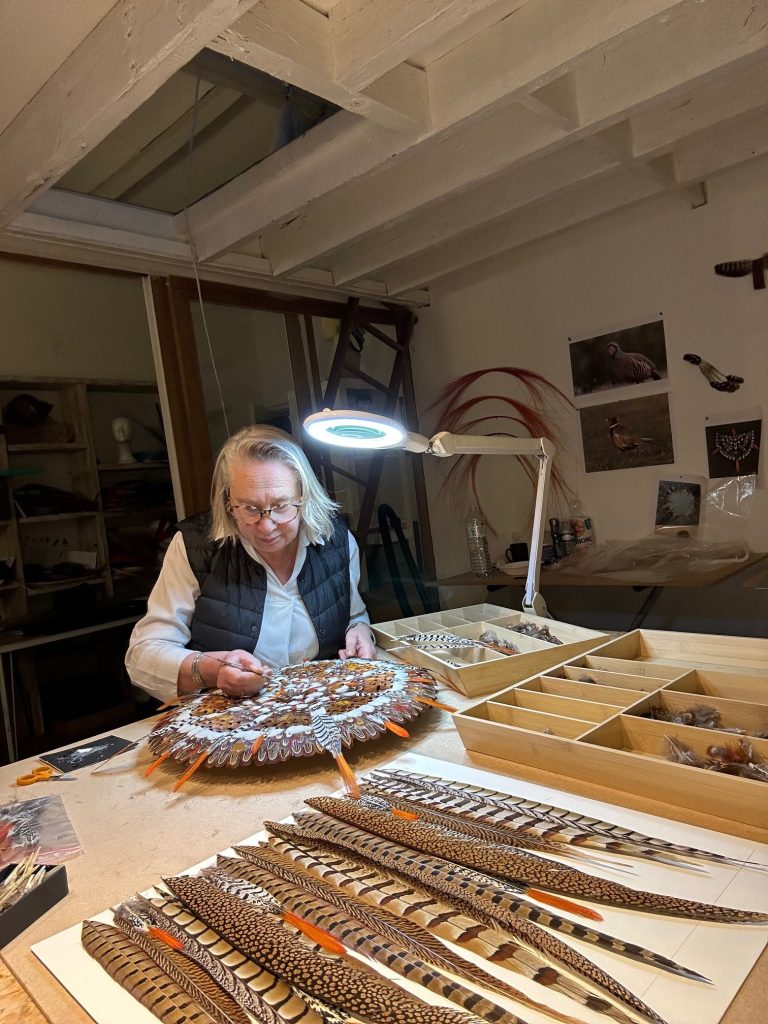
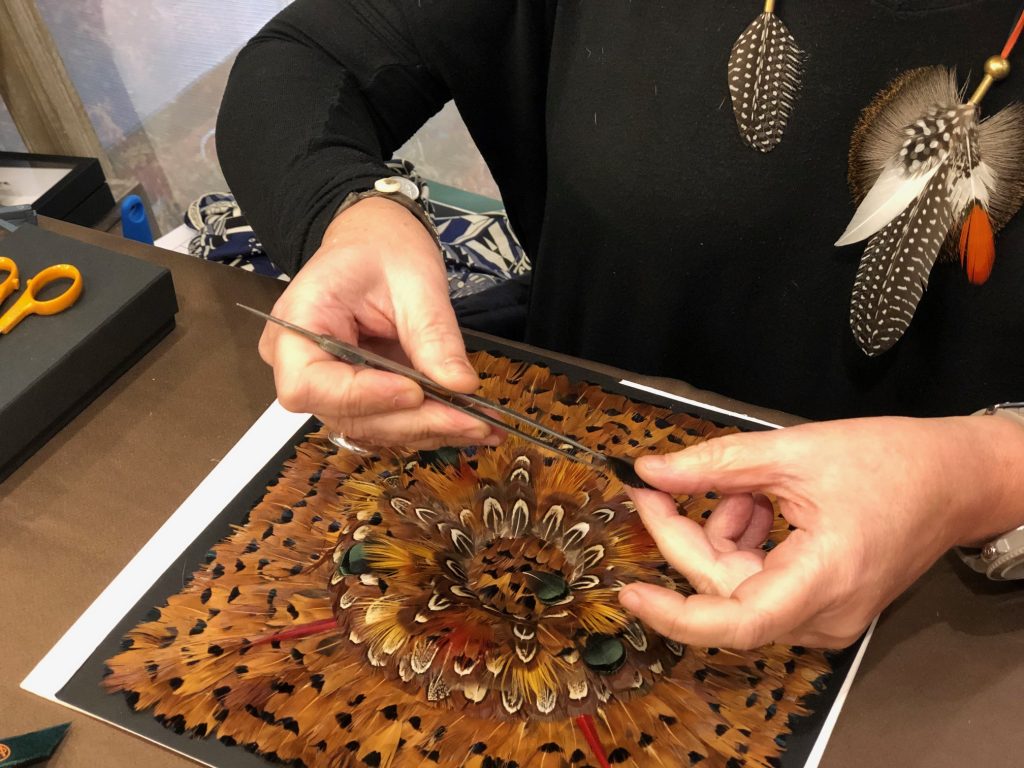
She was captivated by this discovery. She purchased batches of feathers, observing, comparing and assessing their richness of pattern, colour and texture. From then on, she embraced the art of featherwork, adopting an experimental approach that straddles art and the natural sciences, in the spirit of a cabinet of curiosities.
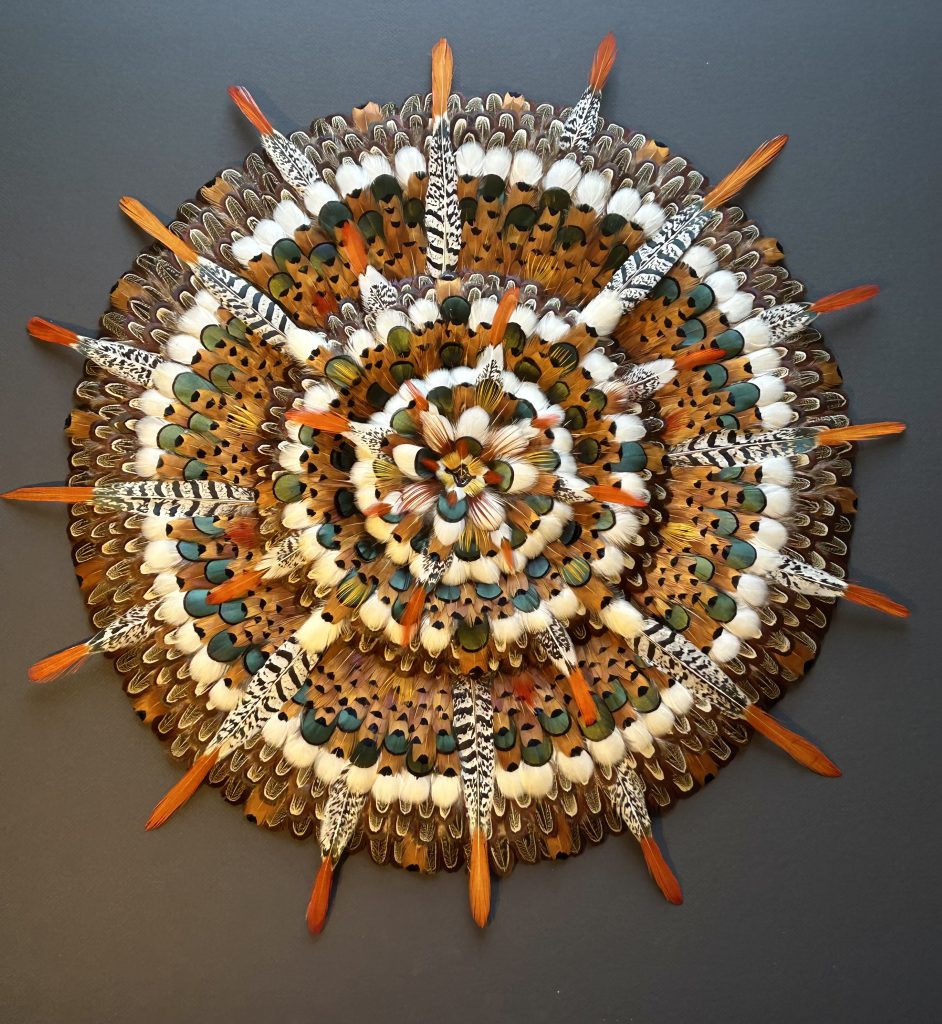
Pheasant feathers are her favourites, thanks to their extraordinary diversity of shapes and patterns: golden pheasant, Lady Amherst’s pheasant and Colchis pheasant, not to mention peacock feathers. Roe deer hair, with its subtle shades, has also found its way into her compositions.
She never uses dyes in her work: nature is presented exactly as it is.
Georgine Glaenzer
Her feather marquetry and bas-reliefs never lie completely flat. Georgine Glaenzer attaches each feather along only part of its length, leaving the remainder free and slightly raised, much like a bird puffing out its plumage. The composition breathes. Nothing is repeated, as every feather settles into place in its own individual way.
Some themes emerge through happy coincidence. One day, silver pheasant feathers arranged on a leaf reminded her of sails in the midst of a regatta. A whole series of sailing ships grew out of this unexpected association.
Before the creative process begins, however, the work requires the patience of a naturalist. The feathers come from wholesalers supplying the haute couture and entertainment industries, accompanied by certificates documenting their origin and processing. Certain species are protected under CITES (the Convention on International Trade in Endangered Species of Wild Fauna and Flora). Georgine works only with legally sourced and permitted species, preparing the raw feathers herself.
Georgine Glaenzer
Sharing her knowledge holds a special place in Georgine Glaenzer’s studio. On request, she runs origami-inspired hat-making workshops for groups of around twenty participants, at birthday parties, treasure hunts and seminars. She also organises small-group feather jewellery workshops, where participants learn to create their own brooches and earrings.
Through the art of hat-making, people who have never met come together. Each discovers something about themselves through what they create, and some reveal an entirely different side of themselves when it comes to the fashion show.
A member of Ateliers d’Art de France since 2025, she values the support of this professional association, particularly in connecting with trade fairs and reaching a clientele of interior designers, galleries and collectors.
Her next venture involves an as-yet-unexplored combination: bringing plant fibres and feathers together in more experimental pieces, perhaps one day as part of an artist residency.
‘I take nature as it is and reveal it, so that we may marvel at it anew. Breathing new life into life – that is the essence of my work.’
Février, 2026
Créer avec l’existant, penser avec l’histoire
De l’architecture au design, cette édition explore comment lieux, savoir-faire et matières héritées deviennent terrains de création actuelle.
Janvier, 2026
Le luxe se réinvente.
Finis les logos clignotants, place à une sobriété raffinée, à l’immersion personnelle, à l’excellence artisanale, à la durabilité sensible.
Décembre, 2025
Héritages, gestes contemporains et plaisirs essentiels
Parce que la fête n’est jamais qu’apparence : elle reflète notre manière d’habiter le monde, de transmettre, de fabriquer des souvenirs durables.
ÉDITION #3
Upcycling et kintsugi transforment l’objet contemporain, faisant de la trace, de la réparation et de la matière un langage esthétique.
ÉDITION #3
Artisans et designers donnent une seconde vie aux matériaux anciens, entre création contemporaine, patrimoine et réemploi.
ÉDITION #3
Bunkers, wagons et kiosques renaissent grâce à la création, révélant comment l’art redonne sens aux lieux délaissés.
ÉDITION #2
Un regard transversal sur le quiet luxury à travers des lieux, des objets et des figures qui expriment l’élégance.
ÉDITION #1
Une sélection de marques, architectures, objets et escapades qui donnent corps au sens de la fête.
ÉDITION #3
Usines et gares délaissées deviennent lieux culturels ouverts, où mémoire industrielle et usages contemporains redessinent la ville.
ÉDITION #3
L’audacieuse métamorphose d’un palace parisien
ÉDITION #3
Au cœur du Marais, un lieu discret révèle comment archives, architecture et recherche font dialoguer l’œuvre de Picasso.
ÉDITION #2
Une expérience shopping unique dans un magasin emblématique.
ÉDITION #2
Voyage culinaire et architectural au cœur de la Seine
ÉDITION #2
Dans le 9e arrondissement, un établissement qui invite au quiet luxury
ÉDITION #1
Chante! vient d’ouvrir ses portes. Une invitation à vibrer !
ÉDITION #3
Icône du paysage français, la boîte jaune change de statut et s’invite dans l’univers du design.
ÉDITION #3
L’édition 2026 affirme une vision où artisanat, design et mémoire façonnent l’habitat contemporain, international actuel.
ÉDITION #3
Cent ans après 1925, l’Art déco revient dans nos villes et intérieurs avec géométrie, audace, optimisme.
ÉDITION #3
Depuis plus de deux cents ans, Royal Limoges conjugue porcelaine, savoir-faire industriel et création contemporaine.
ÉDITION #3
Des terrains de sport aux podiums, la sneaker raconte un siècle de mutations culturelles, techniques et stylistiques.
ÉDITION #2
Design, mode, artisanat : des créations où la forme et la matière se répondent avec justesse, loin de tout effet de mode.
ÉDITION #1
Décorations artisanales, calendriers ultra-luxe et pièces de collection pour s’enivrer de joie avant l’heure.
ÉDITION #3
Entre marqueterie monumentale et jungle symbolique, Anton Laborde transforme le bois en récit contemporain poétique engagé.
ÉDITION #3
À Maison & Objet, Thierry Laudren présente des meubles sculptés où fonction, matière et lenteur façonnent une présence.
ÉDITION #3
Jean Nouvel conçoit une architecture attentive aux contextes, où lumière, histoire et usages façonnent chaque projet.
ÉDITION #3
À Lyon, Sophie Morel rénove des lieux historiques en alliant respect du bâti et écriture contemporaine.
ÉDITION #3
Au Centre d’Études Picasso, l’architecte compose une architecture où lumière, géométrie et héritage dialoguent avec précision.
ÉDITION #2
Entretien avec le fondateur d’EDO (European Design Office)
ÉDITION #2
Portrait d’un visionnaire qui transforme l’art de recevoir en expérience totale.
ÉDITION #1
Personnalités, artisans et créateurs qui donnent à la fête sa profondeur humaine.
ÉDITION #3
De Bordeaux au Bassin, art, vignobles et bien-être composent une échappée élégante au cœur de la Gironde.
ÉDITION #2
Vers une région de l’Italie habitée par le temps, où paysages, culture et usages s’accordent dans une continuité rare.
ÉDITION #1
Destinations et rituels qui réinventent la fête, du soleil tropical aux marchés d’hiver.