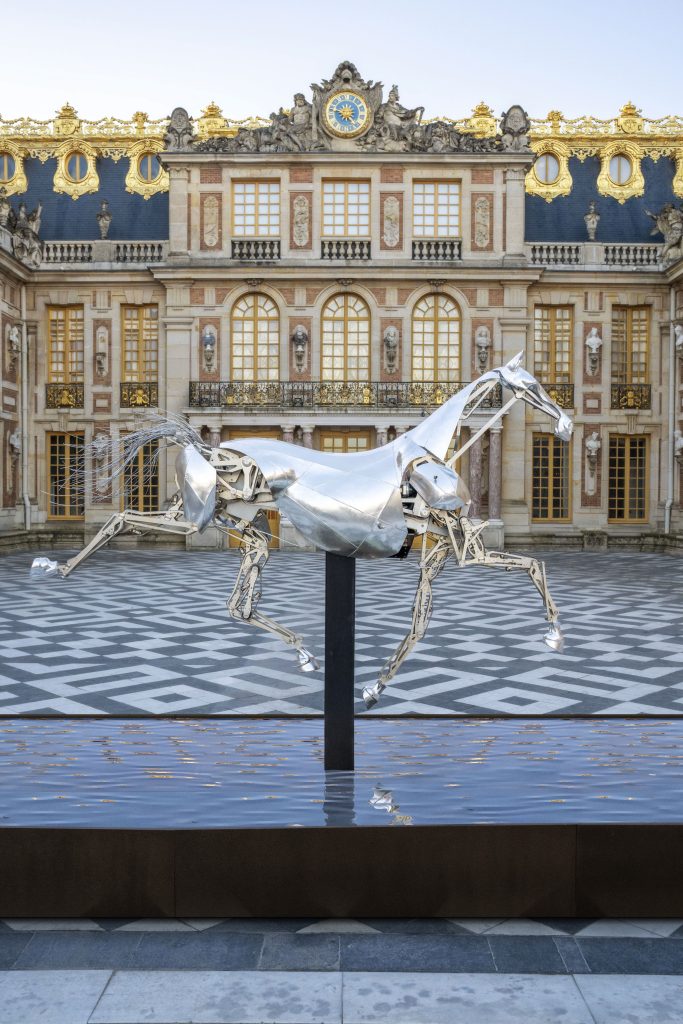
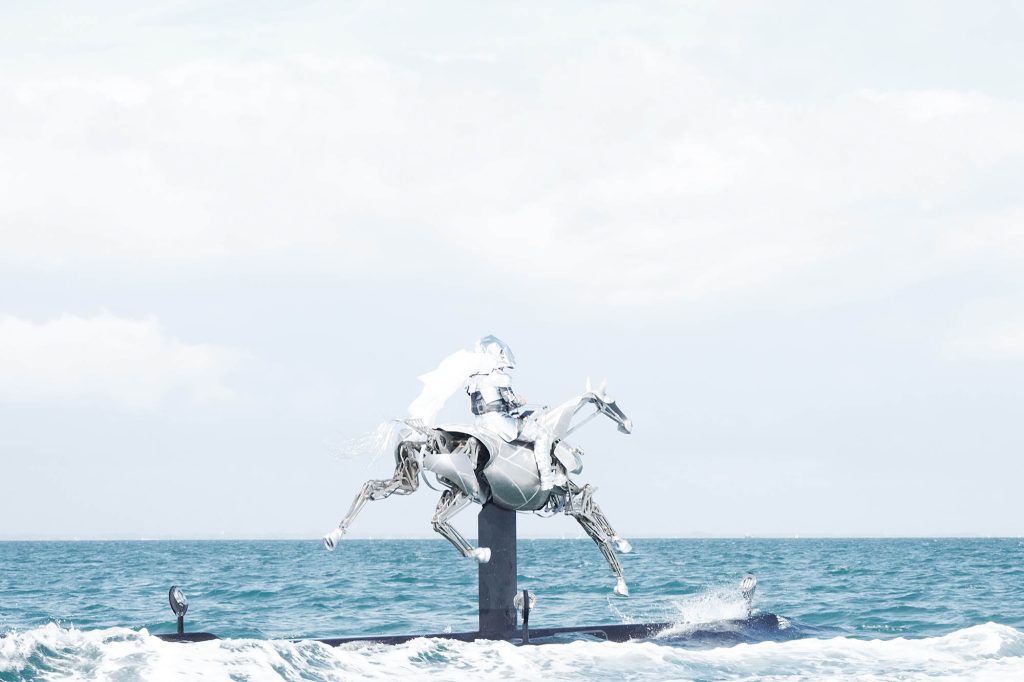
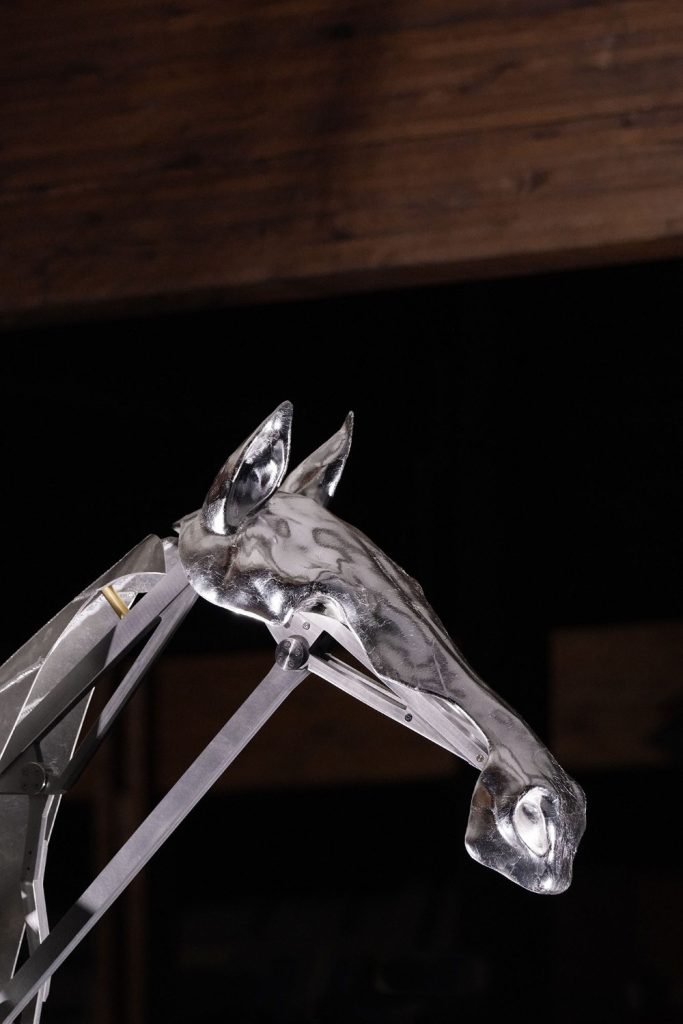
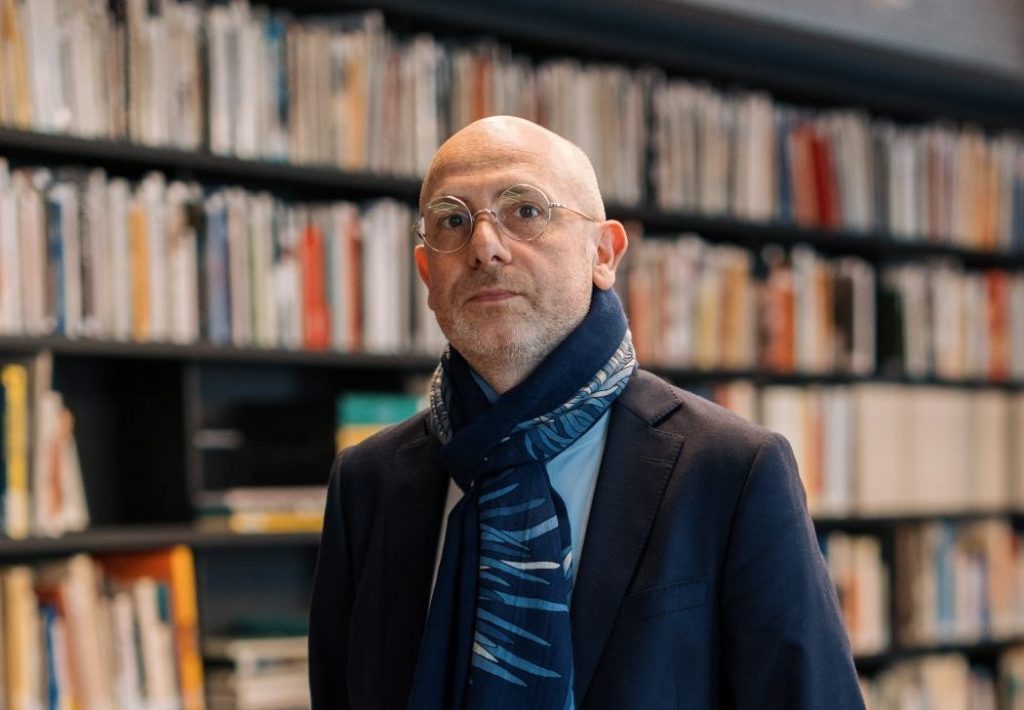
On the evening of 26 July 2024, a silver horse will gallop across the Seine, watched by the whole world. Then, a ring of mist and light rises above the Tuileries. These two images were created by blam, a Nantes-based studio founded by visual artist and designer Aurélien Meyer, who was trained at the Beaux-Arts de Nantes, along with a team of engineers, architects, designers and craftspeople.
“You need people in the sails for a boat to move forward. You need just as many for a project to come to life.”
Since 2015, blam has occupied a unique place in the French design landscape. Aurélien Meyer describes it as a hybrid structure capable of transforming ambitious artistic visions into tangible, functional, technically masterful works, including site-specific installations, objects, architecture, and mechanical devices. Part design agency, part engineering consultancy and part production workshop, blam supports an idea from start to finish, from the initial sketch to installation. The agency is based in Nantes, while the workshop is located in Couëron on the banks of the Loire. Projects flow between the two sites, along with the joy of collaboration that the founder says he experiences daily.
Zeus – Versailles – atelier blam ©blam
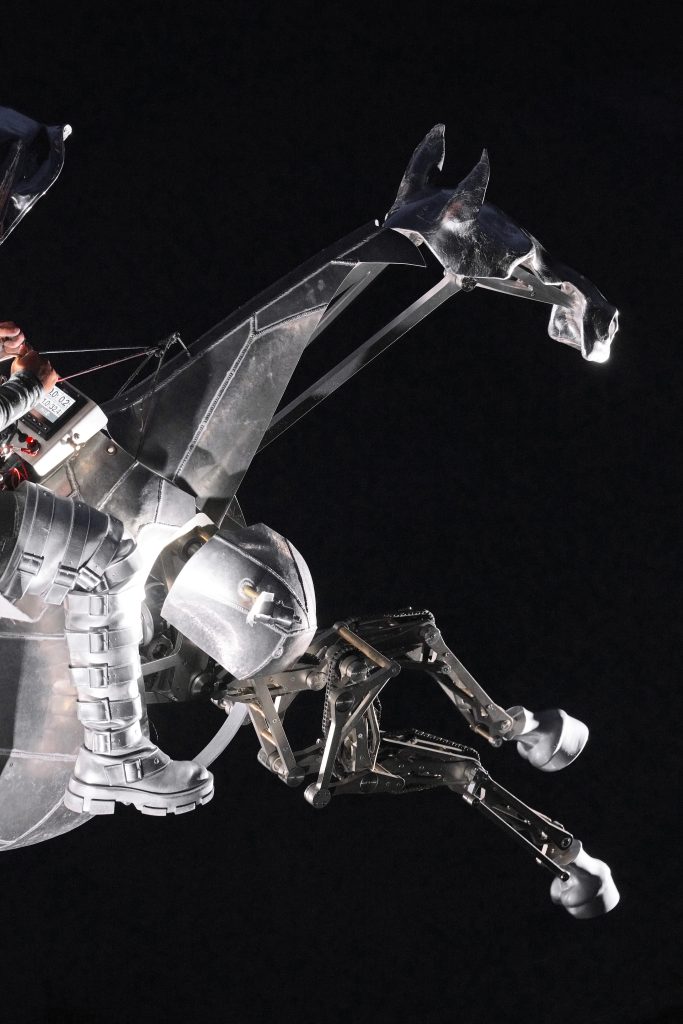
Zeus – Essais lumière – atelier blam ©blam
Zeus was born from an unlikely encounter – the kind that Lautréamont would have loved: a sewing machine and an umbrella brought together on a dissection table to create a horse galloping across the water. The challenge was to bring this idea to life. The workshop spent over a year on research, development and fabrication, combining various specialist skills. The head was 3D-printed, the body’s curves were created through copperwork and hammering, and the articulated limbs were the result of precision machining. Sheets of silver catch the light. An almost invisible trimaran designed by MMProcess in Quiberon carries the silhouette on the water. For Aurélien Meyer, however, the challenge went beyond the ceremony. Zeus was to become a work of art in its own right, raising the curtain on a discreet workshop. “I wanted to demonstrate our brilliance as a team and show that this is something everyone can relate to.” Owned by Sanofi, the horse continues its journey from town to town, from Versailles to Mont Saint-Michel.
Image 1 : ©Mathias Filippini · Crédit des 3 dernières images : atelier blam – ©blam
That same night, a second piece from the workshop took flight. EDF originally envisaged a flame without combustion and had some promising ideas, though these still needed to be fleshed out, so they brought in blam right from the early preliminary design stages. Designed by Mathieu Lehanneur, the basin was conceived and produced by the studio: a ring approximately seven metres in diameter where 200 nozzles disperse a mist that 40 LED projectors transform into an electric fire. Within six months, the team had won the support of EDF, the organising committee of the Games, and subsequently the International Olympic Committee.
It was a huge gamble for the company. Aurélien Meyer took it on with the conviction of an entrepreneur for whom the value of a decision is measured by its soundness. His appetite for risk runs deep: he comes from a line of creators and entrepreneurs and was raised by nature-loving parents to be bold. The studio is quick to persuade and patient in refining details, and has brought these two approaches together in the basin.
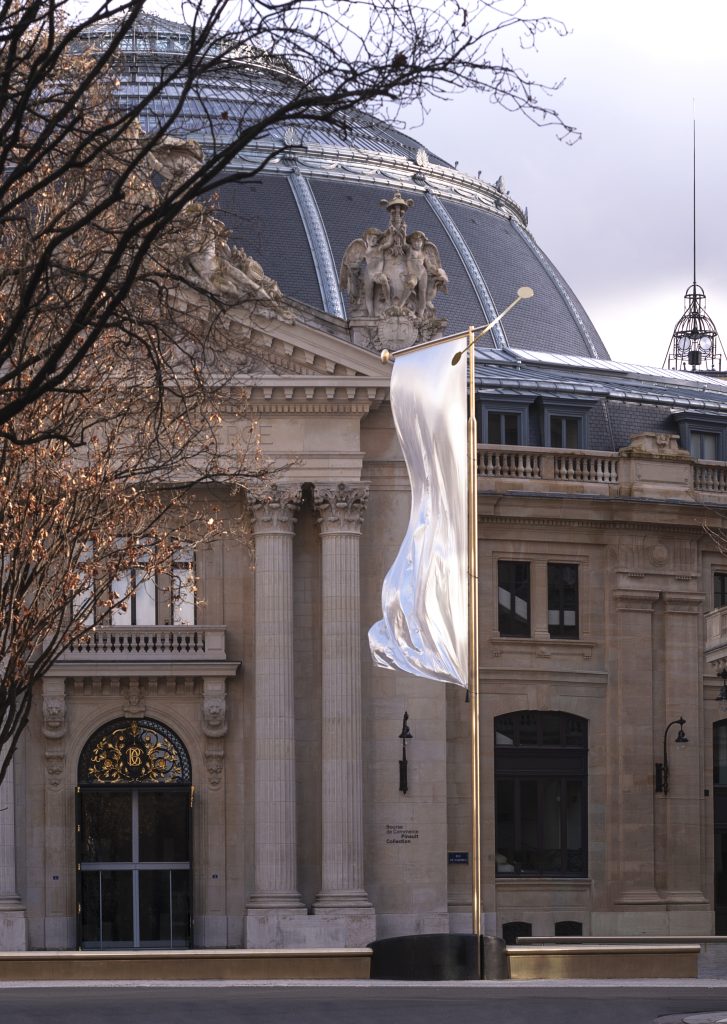
Ronan & Erwan Bouroullec – Bourse du Commerce ©studio bouroullec
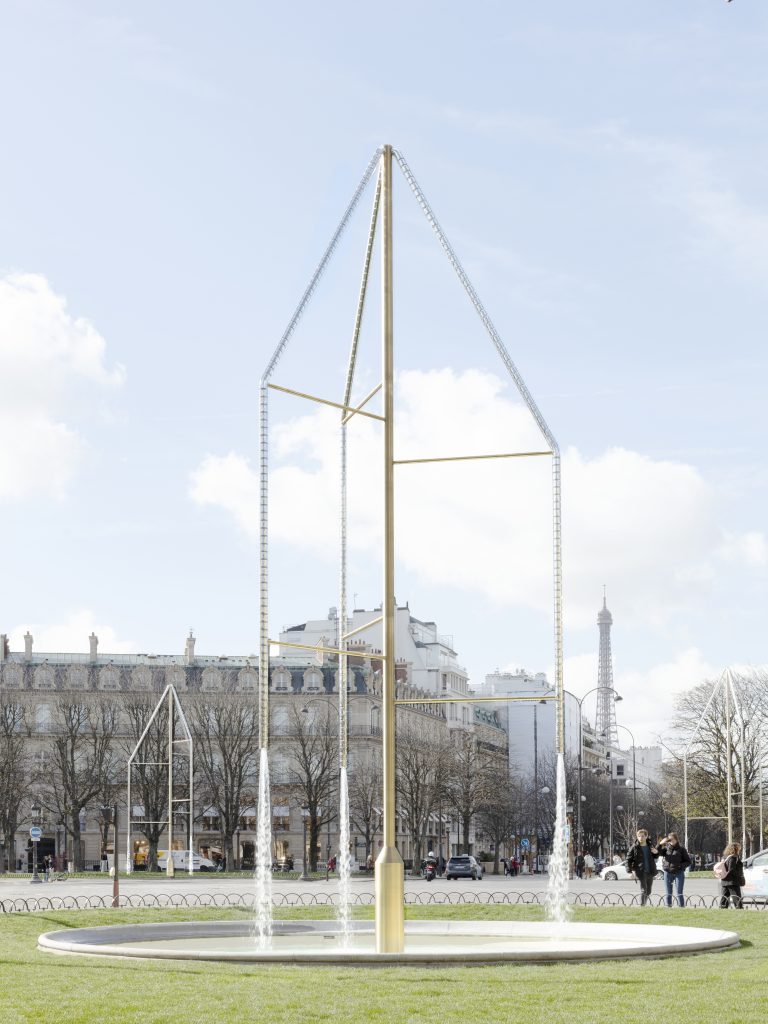
To truly appreciate the area, you must visit Couëron. The workshop is located on the edge of a marsh, where the young Jean-Jacques Audubon — the future painter of American birds — created his first sketches. The banks are inhabited by little egrets and storks, the Loire flows nearby and at night, the area belongs more to wild boars than to humans. The site preserves the memory of an industrial utopia: in the late 1980s, this industrial estate was home to the production of Venturi French grand tourers, which were renowned for their superb styling. In the 2000s, a building was constructed there for the assembly of heavy frames for Naval Group, and blam now occupies a cathedral-like hall with exceptionally high ceilings and a workbench measuring around one thousand square metres, which is exceptionally flat and capable of supporting one hundred and twenty tonnes. The workshop produces everything from tiny, delicate parts to monumental assemblies, such as the masts and curved copper-aluminium tubes that adorn the forecourt of the Bourse du Commerce in Paris.
The Champs-Élysées fountains – Studio Bouroullec ©Claire Lavabre – Studio Bouroullec
The permanent staff comprises around twenty people. On major projects, the team grows to around fifty. Engineers, architects, designers, workshop managers, metalworkers and a metalworking apprentice all work together at blam, each playing their part. Aurélien Meyer places great value on education and the knowledge it brings, as well as on the energy, diversity of backgrounds, and richness of personalities. For him, education is a powerful tool for social empowerment, particularly for those from working-class and middle-class backgrounds. Talent comes from three main sources. Firstly, there are schools, which Aurélien has always valued: his workshop colleagues deliver masterclasses at institutions ranging from Centrale to the University of Technology of Compiègne, as well as at architecture and art schools. They engage with young people who are eager to turn their ideals into reality. Secondly, the Nantes area, home to several flagship French industrial companies. Finally, culture is the most precious source of talent in his view. Nantes is home to the Royal de Luxe theatre company and La Machine, and a whole community of artists and performance technicians fuels the studio’s projects.

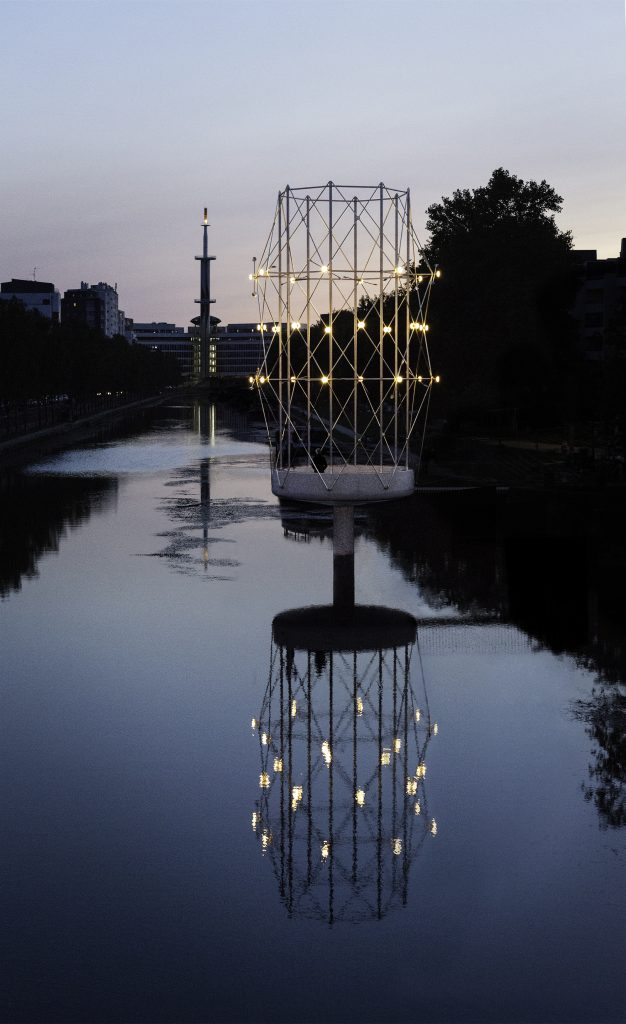
Belvedere de Rennes ©Studio Bouroullec
Aurélien Meyer approaches creation with the perspective of a historian. The Renaissance popularised the concept of the individual genius by divorcing the artist from their workshop, while Romanticism romanticised the moment of inspiration. This dual legacy makes it difficult even today to fully recognise the value of multiple contributions. Meyer likes to recount the tale of the Eiffel Tower, which was initially sketched in 1884 by two in-house engineers, Maurice Koechlin and Émile Nouguier. Gustave Eiffel, whose name alone has gone down in history, was initially reserved about the idea. However, the founder of blam sees a new generation that is more attentive to everyone’s contributions. His role, and that of the studio, is growing, with the studio involved in every project from conception to installation. This dialogue has nourished his long-standing collaboration with Ronan and Erwan Bouroullec, from the six crystal fountains on the Champs-Élysées to the Belvédère overlooking the Vilaine in Rennes. They are brought together by similar educational backgrounds – Ronan studied at the École des Arts Décoratifs and Erwan and he himself studied at the École des Beaux-Arts – and shared values: design rooted in the long term, precision, and lasting emotion.
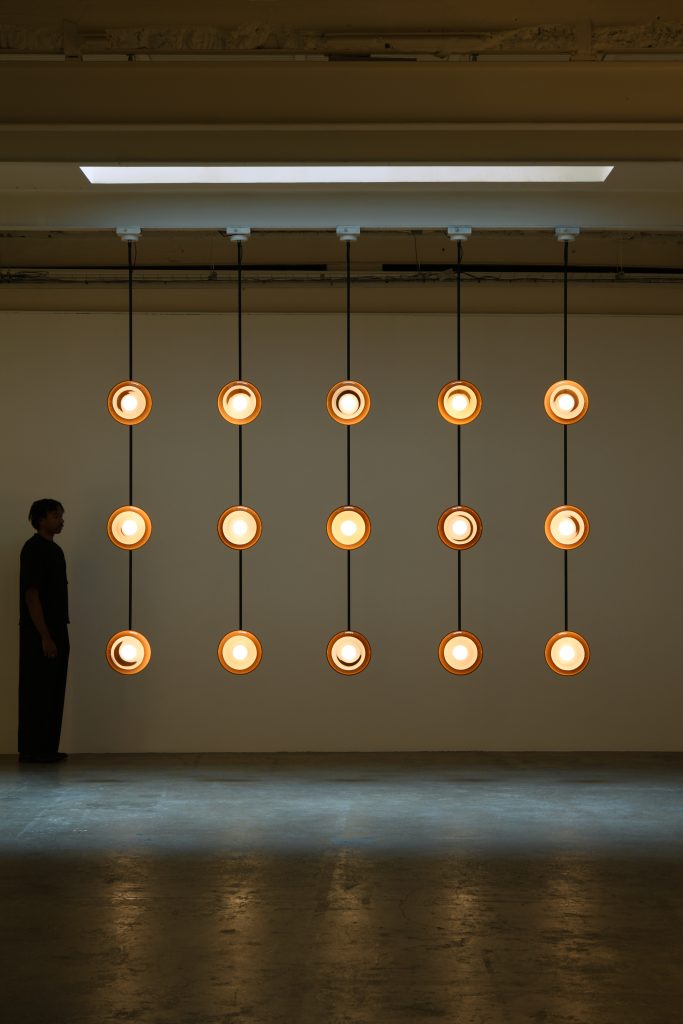
Clair-Obscur ; ©Morgane Le Gall
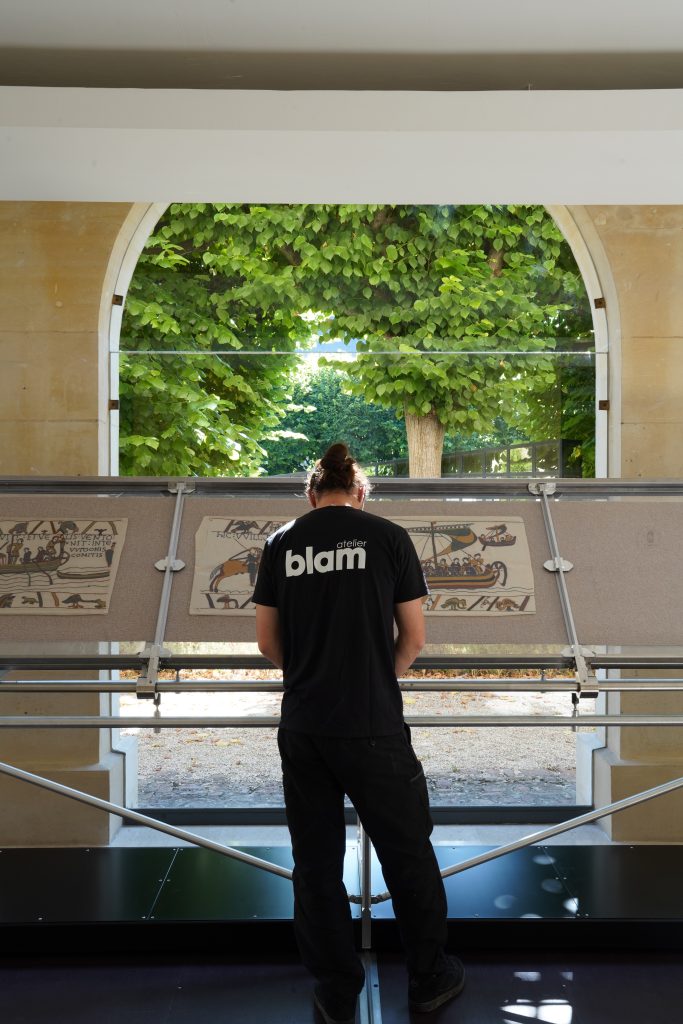
At blam, productivity takes a back seat to the long-term perspective—that of precision. This is exemplified by Clair-Obscur, which involved three years of research into glass forms, anodised finishes and assembly systems. The result was twenty-three pieces designed by Ronan Bouroullec and exhibited at the Galerie kreo in 2025. The pieces are made of smoked, amber or clear blown glass and anodised aluminium. Behind their apparent simplicity lies a complex assembly process, the result of a long and rigorous development process. The workshop reserves the right to decline commissions with overly tight deadlines, as doing things properly takes precedence above all else. This approach now guides its major heritage project. For the future Bayeux Tapestry Museum, blam is designing the table that will house the embroidery – nearly seventy metres long – in collaboration with the RSHP agency and the exhibition designers at FL & CO. A deliberately simple turning mechanism will allow conservators to work on both sides of the embroidery without ever folding it. Designing the setting for such a masterpiece in collaboration with the town, the museum and its curators is a great responsibility for Aurélien Meyer — and above all, a joy.
Table de la tapisserie de Bayeux; ©blam
Zeus, ©blam
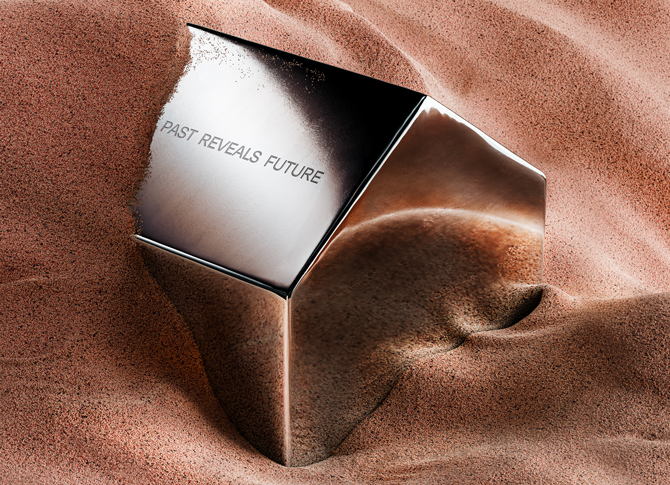
At blam, a rare sense of cheerfulness finally reigns. Aurélien Meyer’s playful approach allows the objects to retain all their beauty, while making time for experimentation, including testing, making mistakes, understanding and seeking out new materials. Failure is part of the process and efficiency goes hand in hand with curiosity. The ‘Trophées des Victoires de la Bretagne’, created in 2025 for Le Télégramme, encapsulate this spirit: seventeen pieces born from fragments of the studio’s history, including aluminium from the Olympic cauldron, bronze from the Bourse de Commerce, offcuts from the Zeus sculpture and glass resulting from a collaboration with the Japanese firm Tasaki. In his hands, the material is elevated and flows from one piece to the next. A stunning piece is currently being prepared for Louis Vuitton’s new architectural project on the Champs-Élysées. One dream remains: to one day see Zeus enter New York Harbour, much like the Statue of Liberty. Above all, what Aurélien Meyer takes away from all this is a team whose dedication moves him. “I found them, and they found me. We share a wonderful history.”
Février, 2026
Créer avec l’existant, penser avec l’histoire
De l’architecture au design, cette édition explore comment lieux, savoir-faire et matières héritées deviennent terrains de création actuelle.
Janvier, 2026
Le luxe se réinvente.
Finis les logos clignotants, place à une sobriété raffinée, à l’immersion personnelle, à l’excellence artisanale, à la durabilité sensible.
Décembre, 2025
Héritages, gestes contemporains et plaisirs essentiels
Parce que la fête n’est jamais qu’apparence : elle reflète notre manière d’habiter le monde, de transmettre, de fabriquer des souvenirs durables.
ÉDITION #3
Upcycling et kintsugi transforment l’objet contemporain, faisant de la trace, de la réparation et de la matière un langage esthétique.
ÉDITION #3
Artisans et designers donnent une seconde vie aux matériaux anciens, entre création contemporaine, patrimoine et réemploi.
ÉDITION #3
Bunkers, wagons et kiosques renaissent grâce à la création, révélant comment l’art redonne sens aux lieux délaissés.
ÉDITION #2
Un regard transversal sur le quiet luxury à travers des lieux, des objets et des figures qui expriment l’élégance.
ÉDITION #1
Une sélection de marques, architectures, objets et escapades qui donnent corps au sens de la fête.
ÉDITION #3
Usines et gares délaissées deviennent lieux culturels ouverts, où mémoire industrielle et usages contemporains redessinent la ville.
ÉDITION #3
L’audacieuse métamorphose d’un palace parisien
ÉDITION #3
Au cœur du Marais, un lieu discret révèle comment archives, architecture et recherche font dialoguer l’œuvre de Picasso.
ÉDITION #2
Une expérience shopping unique dans un magasin emblématique.
ÉDITION #2
Voyage culinaire et architectural au cœur de la Seine
ÉDITION #2
Dans le 9e arrondissement, un établissement qui invite au quiet luxury
ÉDITION #1
Chante! vient d’ouvrir ses portes. Une invitation à vibrer !
ÉDITION #3
Icône du paysage français, la boîte jaune change de statut et s’invite dans l’univers du design.
ÉDITION #3
L’édition 2026 affirme une vision où artisanat, design et mémoire façonnent l’habitat contemporain, international actuel.
ÉDITION #3
Cent ans après 1925, l’Art déco revient dans nos villes et intérieurs avec géométrie, audace, optimisme.
ÉDITION #3
Depuis plus de deux cents ans, Royal Limoges conjugue porcelaine, savoir-faire industriel et création contemporaine.
ÉDITION #3
Des terrains de sport aux podiums, la sneaker raconte un siècle de mutations culturelles, techniques et stylistiques.
ÉDITION #2
Design, mode, artisanat : des créations où la forme et la matière se répondent avec justesse, loin de tout effet de mode.
ÉDITION #1
Décorations artisanales, calendriers ultra-luxe et pièces de collection pour s’enivrer de joie avant l’heure.
ÉDITION #3
Entre marqueterie monumentale et jungle symbolique, Anton Laborde transforme le bois en récit contemporain poétique engagé.
ÉDITION #3
À Maison & Objet, Thierry Laudren présente des meubles sculptés où fonction, matière et lenteur façonnent une présence.
ÉDITION #3
Jean Nouvel conçoit une architecture attentive aux contextes, où lumière, histoire et usages façonnent chaque projet.
ÉDITION #3
À Lyon, Sophie Morel rénove des lieux historiques en alliant respect du bâti et écriture contemporaine.
ÉDITION #3
Au Centre d’Études Picasso, l’architecte compose une architecture où lumière, géométrie et héritage dialoguent avec précision.
ÉDITION #2
Entretien avec le fondateur d’EDO (European Design Office)
ÉDITION #2
Portrait d’un visionnaire qui transforme l’art de recevoir en expérience totale.
ÉDITION #1
Personnalités, artisans et créateurs qui donnent à la fête sa profondeur humaine.
ÉDITION #3
De Bordeaux au Bassin, art, vignobles et bien-être composent une échappée élégante au cœur de la Gironde.
ÉDITION #2
Vers une région de l’Italie habitée par le temps, où paysages, culture et usages s’accordent dans une continuité rare.
ÉDITION #1
Destinations et rituels qui réinventent la fête, du soleil tropical aux marchés d’hiver.