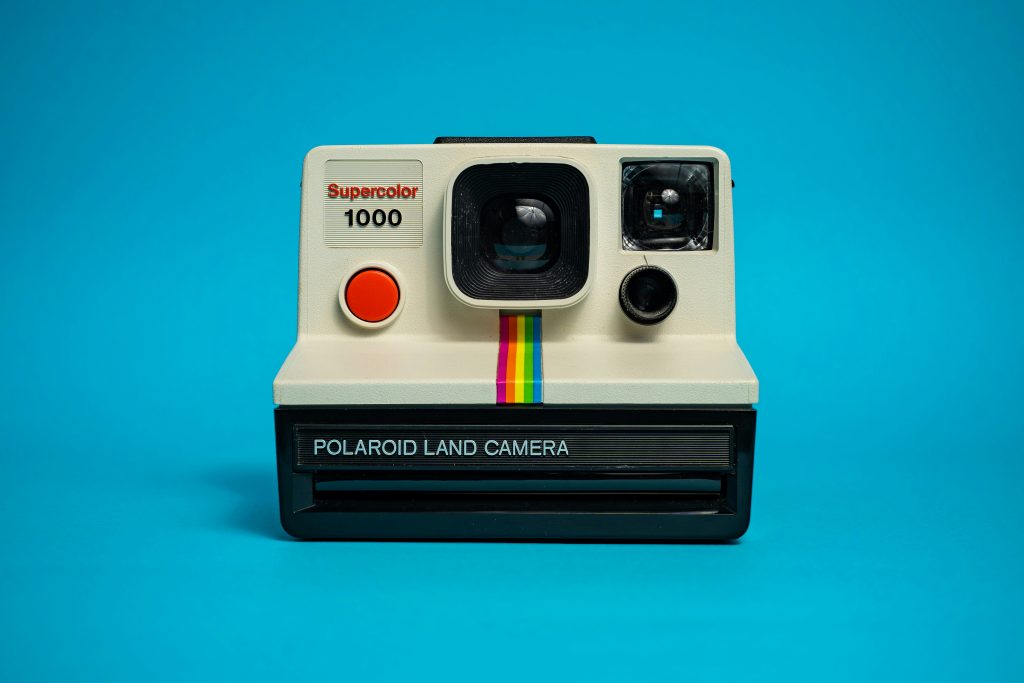
It fits in one hand, spits out a white rectangle with its distinctive border, and enforces a rule that no smartphone has ever been able to replicate: it can’t be done again. Press the button, hear the click and the clatter of the rollers, and watch the image slowly appear before your eyes, like a thought rising to the surface. The Polaroid has never been the most accurate, sharpest or most economical of cameras. It is something else entirely: an object that has transformed waiting into a pleasure and photography into an act of generosity.
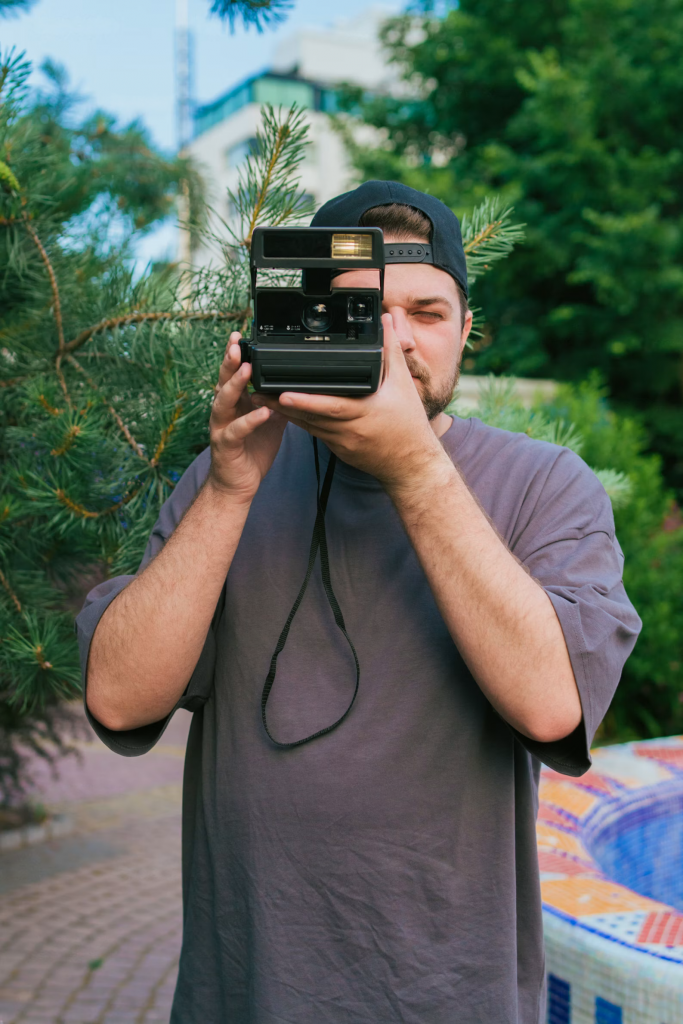
Valeriia Miller ; Unsplash
It all began with a sense of impatience. In 1943, in Santa Fe, the American inventor Edwin Herbert Land photographed his three-year-old daughter, Jennifer. She asked him why she couldn’t see the photo he’d just taken straight away. This seemingly trivial question became an obsession for the physicist. Since 1932, Land had been working on the polarisation of light and had developed a filter that eliminated glare. In 1937, he founded the Polaroid Corporation, which initially specialised in polarised lenses and anti-glare goggles for the army during the war. The name itself reveals the project: ‘polar’, for polarisation, and the suffix ‘-oid’, suggesting resemblance and the transformation of reality. This childish question sparked a revolutionary idea for its time: what if a photograph could develop by itself in under a minute, outside of a darkroom?
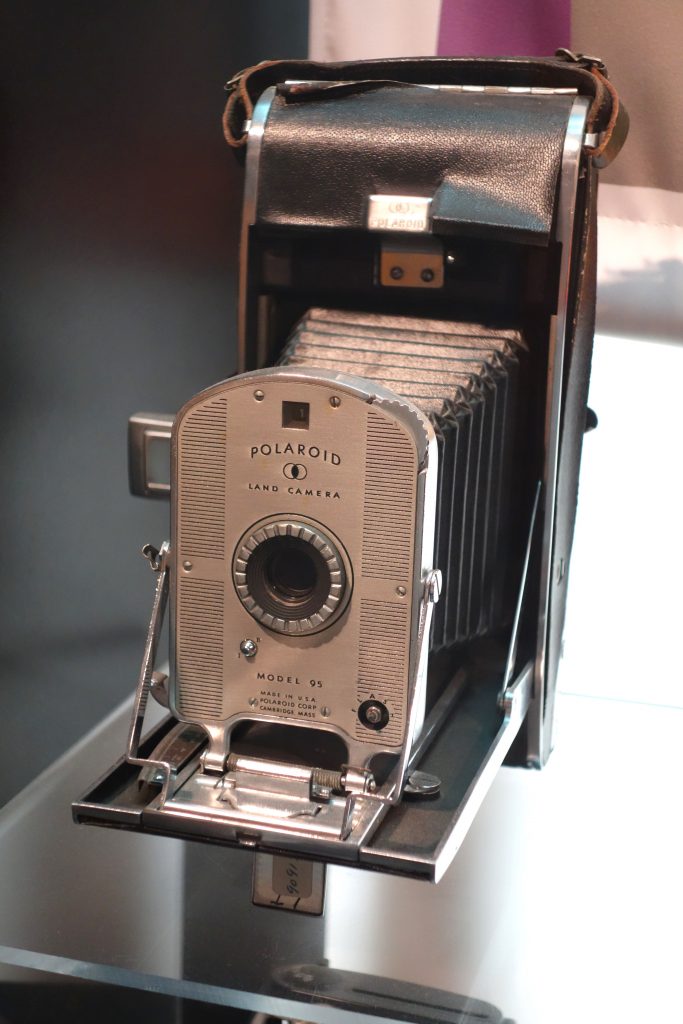
Daderot ; Wikimedia
It took Land five years to bring this idea to fruition. In 1948, the Polaroid Corporation unveiled the Model 95 — the world’s first instant camera. The concept was nothing short of revolutionary: there was no need to hand over film to a lab or wait days on end for prints. You simply looked through the viewfinder, pressed the shutter, waited sixty seconds, and a sepia-toned image appeared. In 1950, a true black-and-white version was released, followed by colour film in 1963. America fell in love with the camera; owning a Polaroid meant being able to capture special moments such as birthdays, trips and newborn babies without the need for a professional photographer. Photography ceased to be a technical process carried out later and became an immediate pleasure, almost like playing a board game. For the first time, people could watch an image appear together.
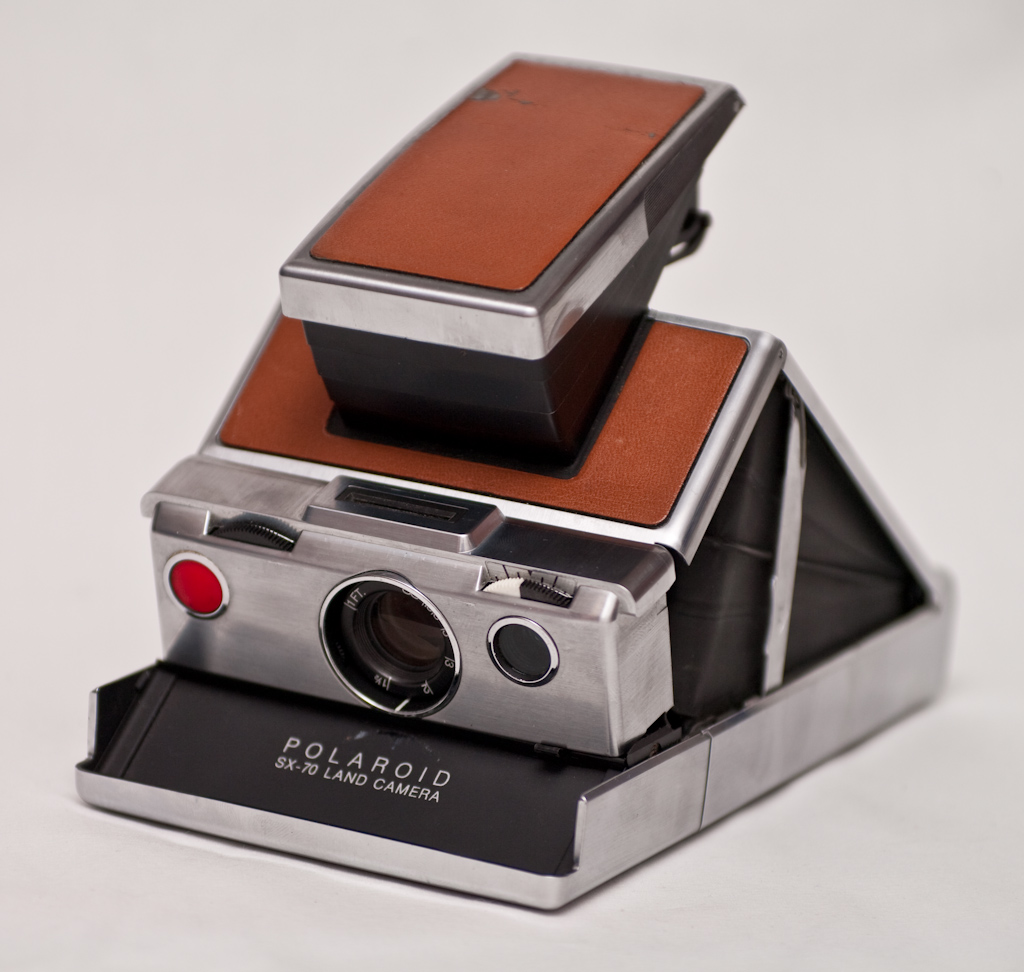
Thomas Backa ; Wikimedia
The brand enjoyed its moment of absolute glory that year with the release of the SX-70. This marvel of engineering was a foldable SLR body clad in leather and chrome that could be slipped into a pocket and would automatically eject a square photograph which developed in the open air without any need to peel or wipe anything. Photographer and filmmaker Wim Wenders, who arrived in the United States that year, remembers it as a technological marvel: “At the dawn of the digital age, it was a promise of things to come”. Christopher Bonanos, the company’s biographer, readily compares Polaroid to Apple and Edwin Land to an early Steve Jobs — they both had the same product genius and created the same cult of desirable objects. The white square, centred in the frame, became a global visual signature. Half a century later, Instagram borrowed its form and its promise.
The U.S. National Archives; Picryl
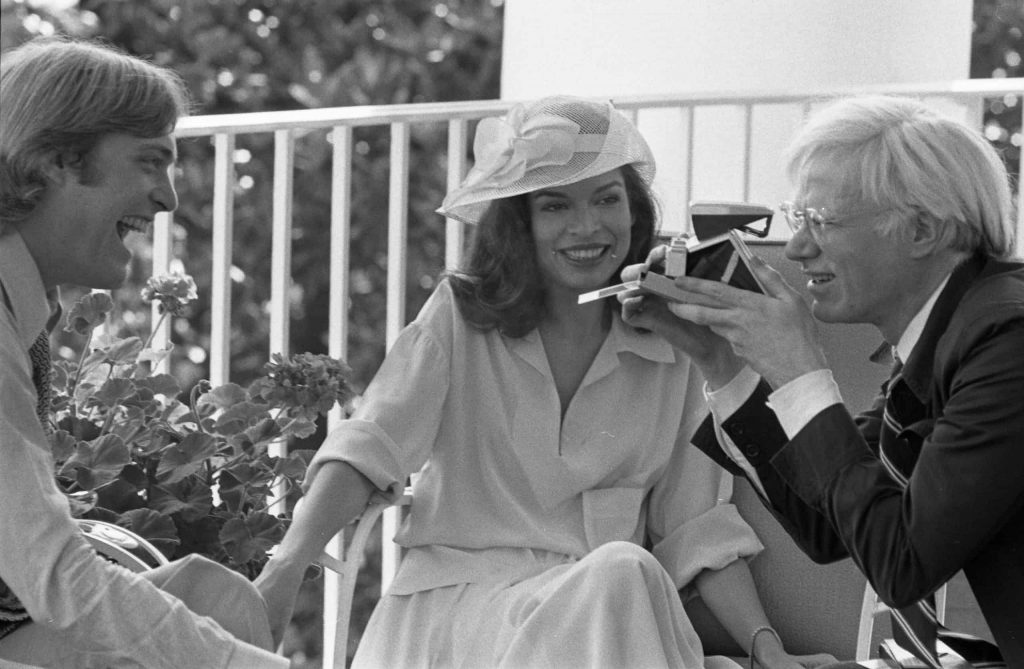
Very quickly, the Polaroid ceased to be merely a family camera and became a creative tool. Andy Warhol made it his constant companion, snapping away at the Factory and its muses — Debbie Harry, Grace Jones, and a young Madonna — in those iconic, high-contrast, nonchalant frontal portraits. David Hockney assembled his instant snaps into vast Cubist collages. Ansel Adams, Robert Mapplethorpe, Helmut Newton, Guy Bourdin, Paolo Roversi and Nobuyoshi Araki all pushed the boundaries of the format, captivated by its grain and slightly unreal colours, as well as the unique relationship created between photographer and subject. The uniqueness of the Polaroid lies therein: each image is a one-off, with no negative and impossible to reproduce identically. You don’t print ten copies of a Polaroid; you give it away or keep it. In the right hands, the mass-market camera becomes a studio medium.

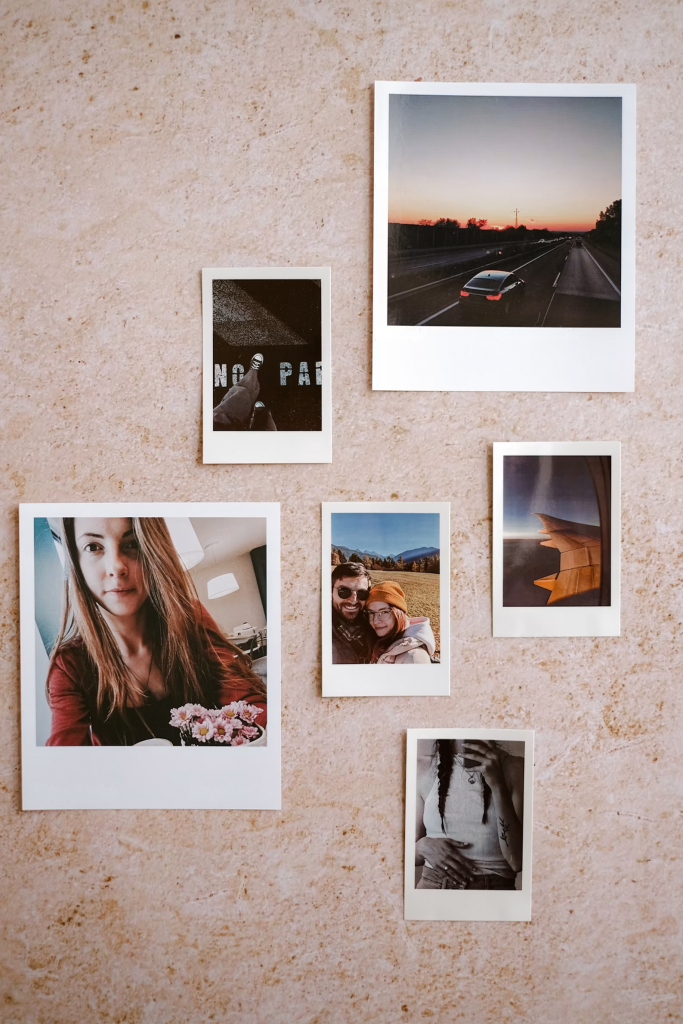
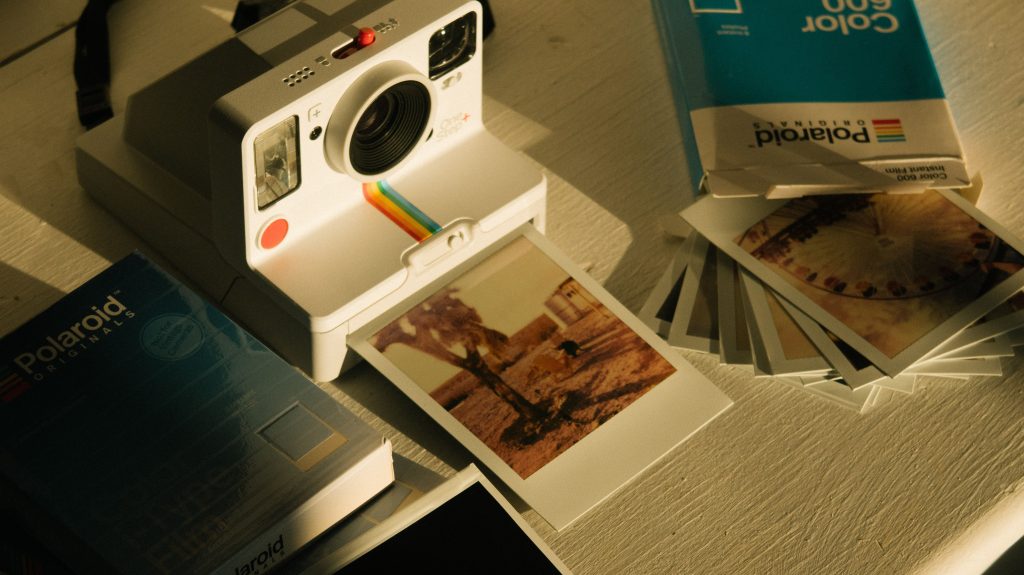
It is worth mentioning what physically defines a Polaroid: the wide white border, which is thicker at the bottom where people used to write their name, the date or the place. Initially, this border was nothing more than a technical necessity – a strip containing the chemical reagents for development – but it has become the object’s defining feature, even inspiring the design of the Instagram app icon. The Polaroid’s charm lies in its imperfections: pastel colours, unpredictable contrasts and colour casts, and light halos. Each image is a small-scale chemical lottery, dependent on temperature, exposure time and how it is protected while developing. In an age of photo editing and perfect pixels, it is precisely this element of chance that appeals: the Polaroid does not hide what it is – a living, dated, fallible, and therefore moving object.
Athena Sandrini ; Pexels
All good things must come to an end. As early as 1976, Kodak attempted to break into the instant photography market, but Polaroid sued for infringement. After years of legal proceedings, Polaroid won the case in the early 1990s, and Kodak was ordered to pay nearly 900 million dollars. This forced Kodak to abandon its instant cameras. But the real threat came from elsewhere. In 1998, the Japanese firm Fujifilm launched its more affordable Instax range. Above all, however, it was digital photography that turned everything on its head. Why wait and pay for an expensive film cartridge when an image is displayed instantly and for free on a screen? The land-based company, which had produced up to 120 million film cartridges a year at its peak, began to falter. After filing for bankruptcy in 2001, it tried its hand at printers and digital hybrid cameras, but these were quickly forgotten. The singer Lady Gaga even served as its artistic director for a brief period from 2010. Then, in 2008, it ceased production of film and closed its factory in Enschede, the Netherlands.
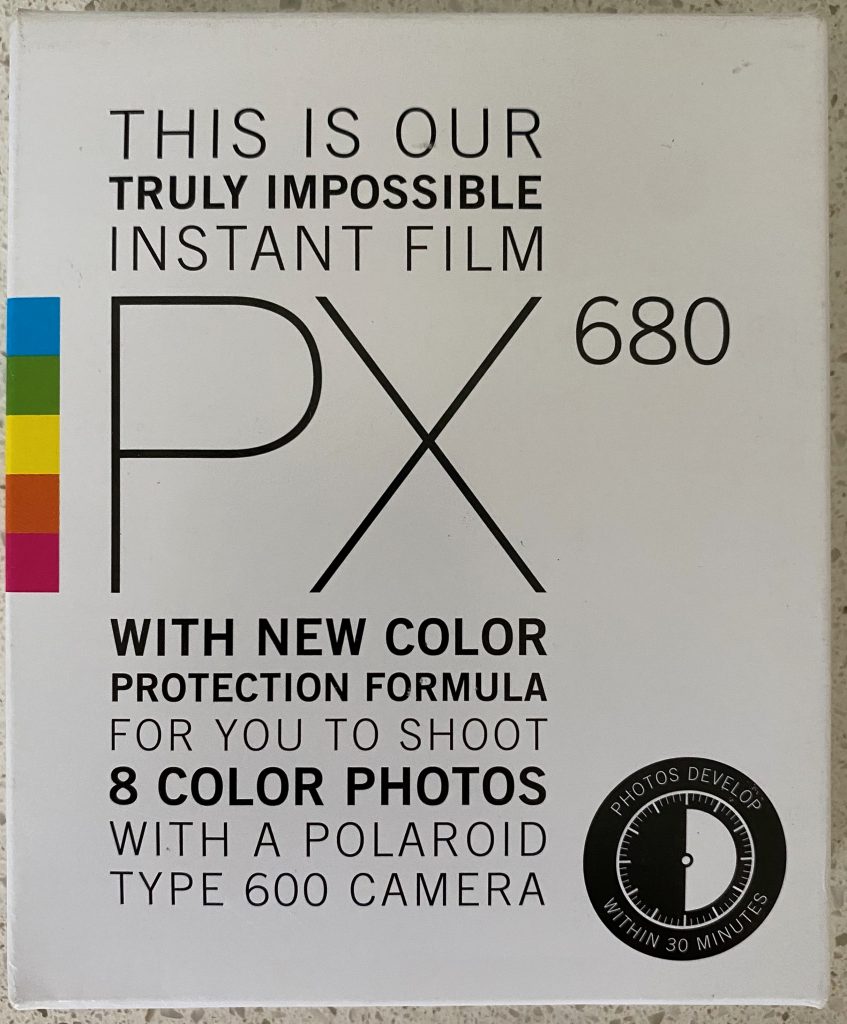
Impossible Project PX 680 film pack for Polaroid 600-type cameras ; Sgroey; Wikimedia
The story could have ended with the factory being shut down. However, it bounced back thanks to a handful of diehards. On the evening of the Enschede closure, Austrian doctor Florian Kaps, engineer André Bosman, and former employees decided to purchase the machinery in order to restart production of instant film. The project seemed so far-fetched that they named it The Impossible Project. Everything had to be reinvented: the original chemical components were no longer commercially available, so the emulsions had to be reformulated from scratch. The first black-and-white films were temperamental, unpredictable and sensitive to light, but they existed, and fans dug out their old cameras. The chemistry improved in 2015, becoming more stable. Then, in 2017, Impossible bought the brand and the name, relaunching under the Polaroid Originals label before reverting to the legendary Polaroid name. The impossible had prevailed.

Taha Berk Tekin ; Unsplash
The return of the Polaroid is by no means an isolated bout of nostalgia. It’s part of the same trend as the resurgence of vinyl and film photography: a desire for tangible objects in an increasingly abstract world. Anna Duque y González, curator of the exhibition The Polaroid Project, puts it well: ‘The Polaroid was a true social medium back when being social meant people being present together. We’d watch the image develop together, then give it to each other.’ The instant photo imposes an economy of gesture that digital technology has erased: film is expensive, so you don’t just take photos indiscriminately; every shot counts. For an entire generation, there’s also the reassurance of knowing that an image won’t end up anywhere online; no cloud backup and no embarrassing posts – just a photo that stays in the hands of those who were there. The Polaroid offers what the screen will never provide: imperfection, anticipation and a physical object.
Oleg Ivanov ; Unsplash
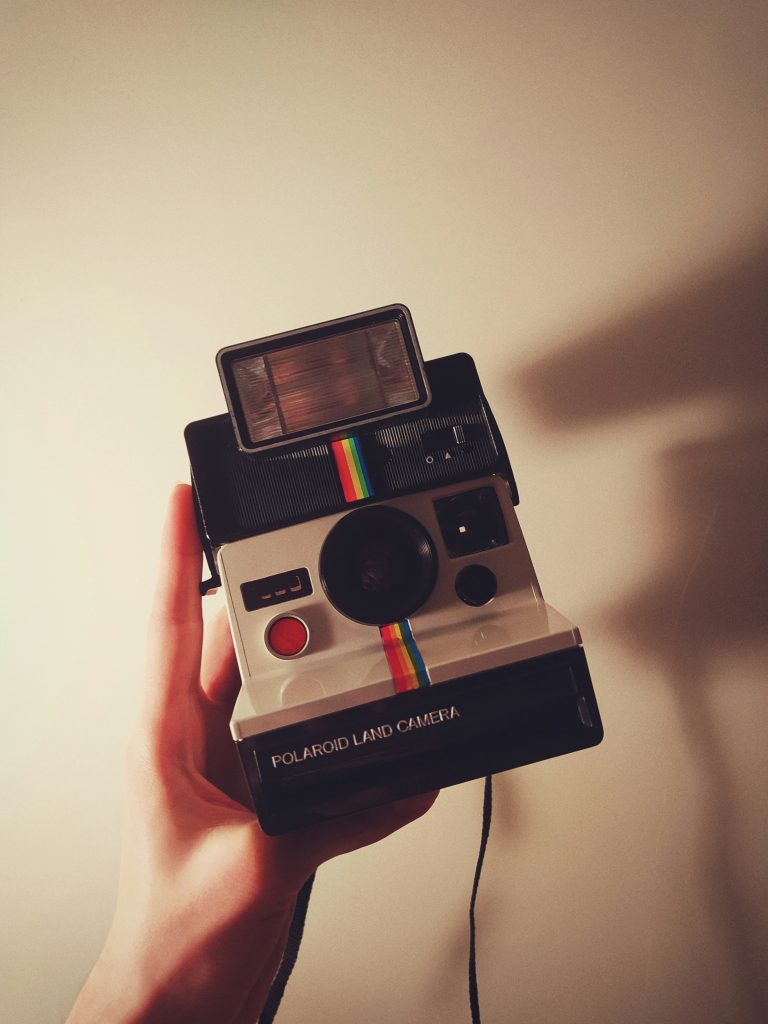
For collectors, Polaroid cameras hold a special place because they are two objects in one. First, there is the camera body: the leather-and-chrome SX-70, the 1977 OneStep and the brightly coloured 600 models from the 1980s. These are sought after for their design, mechanics and status as icons of 20^(th)-century industrial design. Then there is the image: that unique, irreproducible square which takes on a documentary and emotional value that few digital prints will ever match. Polaroid portraits from the Factory are now being auctioned, and even anonymous snaps unearthed at flea markets captivate with their grain and melancholy.
Owning a Polaroid isn’t just about having a retro camera; it’s about preserving a particular vision of photography where images were physical objects that could be held, shown to others and given as gifts. After all, what is truly beautiful never goes out of fashion.
Sources
Février, 2026
Créer avec l’existant, penser avec l’histoire
De l’architecture au design, cette édition explore comment lieux, savoir-faire et matières héritées deviennent terrains de création actuelle.
Janvier, 2026
Le luxe se réinvente.
Finis les logos clignotants, place à une sobriété raffinée, à l’immersion personnelle, à l’excellence artisanale, à la durabilité sensible.
Décembre, 2025
Héritages, gestes contemporains et plaisirs essentiels
Parce que la fête n’est jamais qu’apparence : elle reflète notre manière d’habiter le monde, de transmettre, de fabriquer des souvenirs durables.
ÉDITION #3
Upcycling et kintsugi transforment l’objet contemporain, faisant de la trace, de la réparation et de la matière un langage esthétique.
ÉDITION #3
Artisans et designers donnent une seconde vie aux matériaux anciens, entre création contemporaine, patrimoine et réemploi.
ÉDITION #3
Bunkers, wagons et kiosques renaissent grâce à la création, révélant comment l’art redonne sens aux lieux délaissés.
ÉDITION #2
Un regard transversal sur le quiet luxury à travers des lieux, des objets et des figures qui expriment l’élégance.
ÉDITION #1
Une sélection de marques, architectures, objets et escapades qui donnent corps au sens de la fête.
ÉDITION #3
Usines et gares délaissées deviennent lieux culturels ouverts, où mémoire industrielle et usages contemporains redessinent la ville.
ÉDITION #3
L’audacieuse métamorphose d’un palace parisien
ÉDITION #3
Au cœur du Marais, un lieu discret révèle comment archives, architecture et recherche font dialoguer l’œuvre de Picasso.
ÉDITION #2
Une expérience shopping unique dans un magasin emblématique.
ÉDITION #2
Voyage culinaire et architectural au cœur de la Seine
ÉDITION #2
Dans le 9e arrondissement, un établissement qui invite au quiet luxury
ÉDITION #1
Chante! vient d’ouvrir ses portes. Une invitation à vibrer !
ÉDITION #3
Icône du paysage français, la boîte jaune change de statut et s’invite dans l’univers du design.
ÉDITION #3
L’édition 2026 affirme une vision où artisanat, design et mémoire façonnent l’habitat contemporain, international actuel.
ÉDITION #3
Cent ans après 1925, l’Art déco revient dans nos villes et intérieurs avec géométrie, audace, optimisme.
ÉDITION #3
Depuis plus de deux cents ans, Royal Limoges conjugue porcelaine, savoir-faire industriel et création contemporaine.
ÉDITION #3
Des terrains de sport aux podiums, la sneaker raconte un siècle de mutations culturelles, techniques et stylistiques.
ÉDITION #2
Design, mode, artisanat : des créations où la forme et la matière se répondent avec justesse, loin de tout effet de mode.
ÉDITION #1
Décorations artisanales, calendriers ultra-luxe et pièces de collection pour s’enivrer de joie avant l’heure.
ÉDITION #3
Entre marqueterie monumentale et jungle symbolique, Anton Laborde transforme le bois en récit contemporain poétique engagé.
ÉDITION #3
À Maison & Objet, Thierry Laudren présente des meubles sculptés où fonction, matière et lenteur façonnent une présence.
ÉDITION #3
Jean Nouvel conçoit une architecture attentive aux contextes, où lumière, histoire et usages façonnent chaque projet.
ÉDITION #3
À Lyon, Sophie Morel rénove des lieux historiques en alliant respect du bâti et écriture contemporaine.
ÉDITION #3
Au Centre d’Études Picasso, l’architecte compose une architecture où lumière, géométrie et héritage dialoguent avec précision.
ÉDITION #2
Entretien avec le fondateur d’EDO (European Design Office)
ÉDITION #2
Portrait d’un visionnaire qui transforme l’art de recevoir en expérience totale.
ÉDITION #1
Personnalités, artisans et créateurs qui donnent à la fête sa profondeur humaine.
ÉDITION #3
De Bordeaux au Bassin, art, vignobles et bien-être composent une échappée élégante au cœur de la Gironde.
ÉDITION #2
Vers une région de l’Italie habitée par le temps, où paysages, culture et usages s’accordent dans une continuité rare.
ÉDITION #1
Destinations et rituels qui réinventent la fête, du soleil tropical aux marchés d’hiver.