She passed away in Tokyo on 14 August 2026, aged 97, never having put down her paintbrush. Born in Matsumoto in 1929, she transformed her childhood hallucinations into a universal language of polka dots and mirrors. From the New York avant-garde to the pumpkins of Naoshima, she transformed obsession into art and found refuge in infinity. “My life is a polka dot lost amongst thousands of other polka dots.”
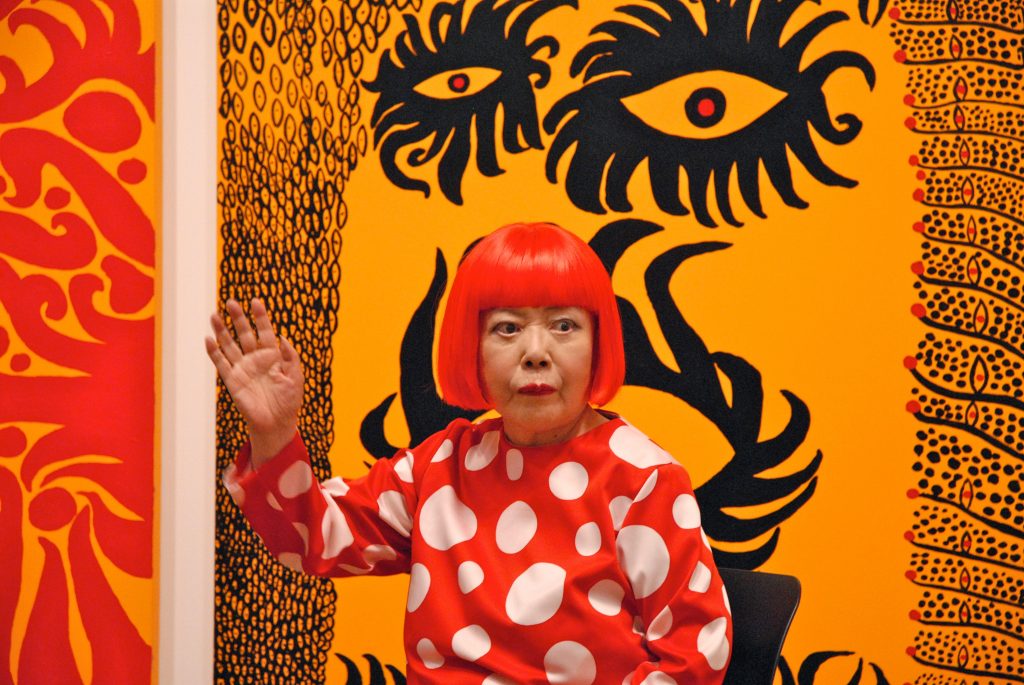
Les vagues de Yayoi Kusama à la presse au Tate Modern ; Simon Leigh ; Alamy
The youngest child in a wealthy family in Matsumoto, whose fortune came from selling seeds and running nurseries, Yayoi Kusama started drawing at the age of ten. It was at this age that the defining vision occurred: a pattern of red flowers, seen on a tablecloth, began to spread across the ceiling, the walls, the entire room and then the universe. She drew to escape these hallucinations. Her mother opposed her artistic vocation, which was a rare choice for a woman at the time, and their relationship remained strained. During the war, the teenager was conscripted to work at the Kureha textile factory, sewing parachutes and uniforms whilst continuing to sketch. At the age of sixteen, she won the Zen-Shinshū regional arts competition. The polka dot motif had already taken hold: in a self-portrait from 1950, she depicted herself as a large dot.
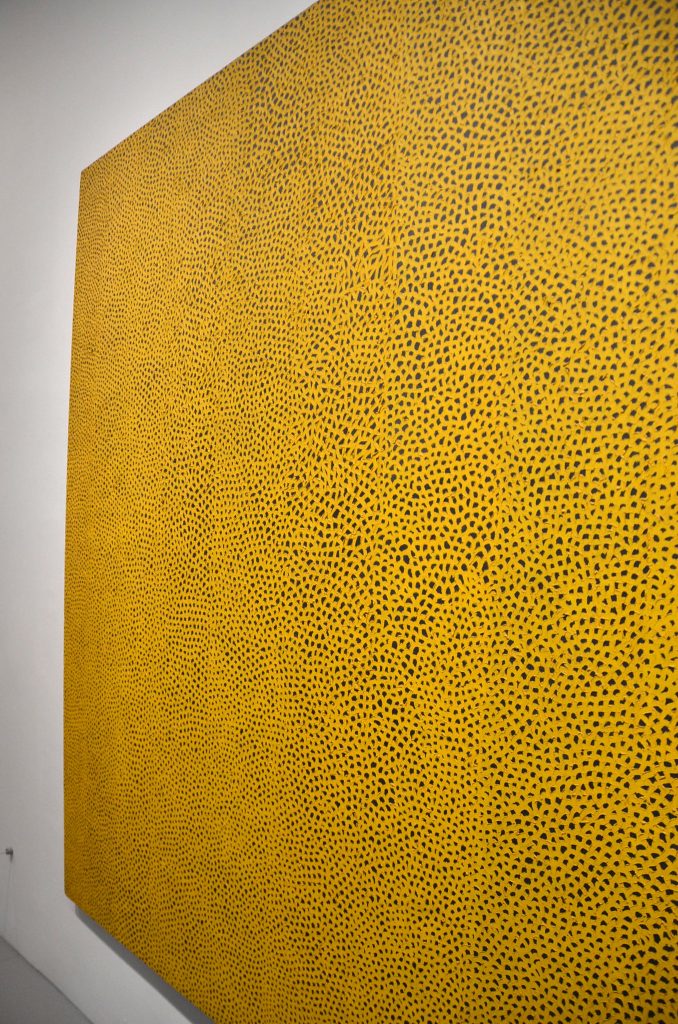
Infinity Nets Yellow ; 1960 – Oil paint on canvas – National Gallery of Art, Washington, DC; Adam Fagen
Encouraged by Georgia O’Keeffe, to whom she had once written a letter, she moved to Seattle in 1957, and then to New York the following year. Her early days were tough, marked by cold and hardship. In 1959, her Infinity Net paintings, exhibited at the Brata Gallery, revealed vast monochromes woven from thousands of repeated loops with no beginning or end. The critic and artist Donald Judd took notice of her work, purchasing one of her canvases and becoming her neighbour and friend. Cornell, Jasper Johns, Yves Klein, Claes Oldenburg and Andy Warhol were also drawn to her. She described her artistic process as ‘psychosomatic art’: reproducing what frightened her thousands of times in order to exorcise her fears. In 1960, her ‘Obliteration Manifesto’ summarised her quest for an individuality dissolved into the whole.
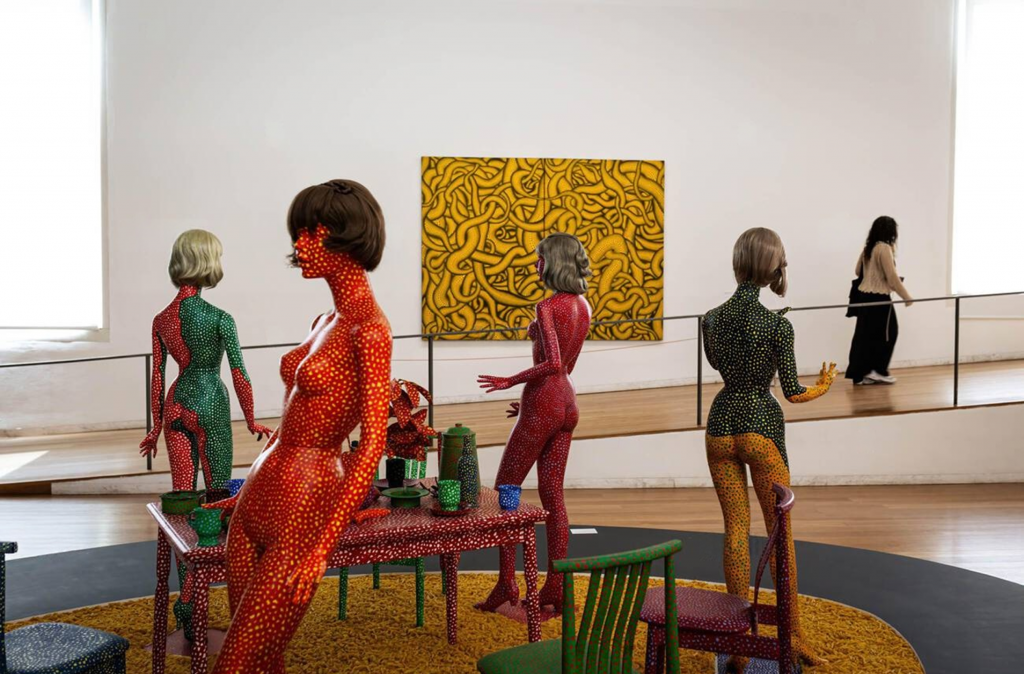
Installation view of ‘Self Obliteration’ from Yayoi Kusama’s exhibition at the Serralves Museum of Contemporary Art, Porto. Exhibition by Japanese artist Yayoi Kusama at the Serralves Museum of Contemporary Art, Porto, Portugal – SOPA Images Limited; Alamy
In the mid-1960s, Yayoi Kusama began creating performance art. During her self-obliteration performances, she painted polka dots on naked bodies, organised ‘body festivals’ and held demonstrations on Wall Street, the Brooklyn Bridge and at MoMA. Through these, she conveyed messages of pacifism, feminism and equality. She was always at the forefront of the photographs and controlled her image from start to finish. In 1966, she made an uninvited appearance at the Venice Biennale with the help of Lucio Fontana, scattering 1,500 shimmering spheres in front of the Italian pavilion. This piece, titled Narcissus Garden, was offered for sale to passers-by.
In 1968, she founded a fashion house and opened a boutique on Sixth Avenue, where her sheer dresses and group outfits caused a stir in puritanical America.

Exhausted, Yayoi Kusama returned to Japan permanently in 1973. From 1977 onwards, she chose to live at the Seiwa psychiatric hospital in Tokyo, while maintaining a studio across the road where her team worked. A period of relative seclusion followed, punctuated by naïve paintings on cardboard and her first appearance in France at the Calais Museum of Fine Arts in 1986. She still makes the daily journey between her room and her studio and continues to paint tirelessly. The paradox of her career lies therein: the artist of boundless infinity chose the confines of an institution to continue creating. ‘I still see hallucinations, even today,’ she revealed as recently as 2017, remaining lucid about the source of her work.
Pexels
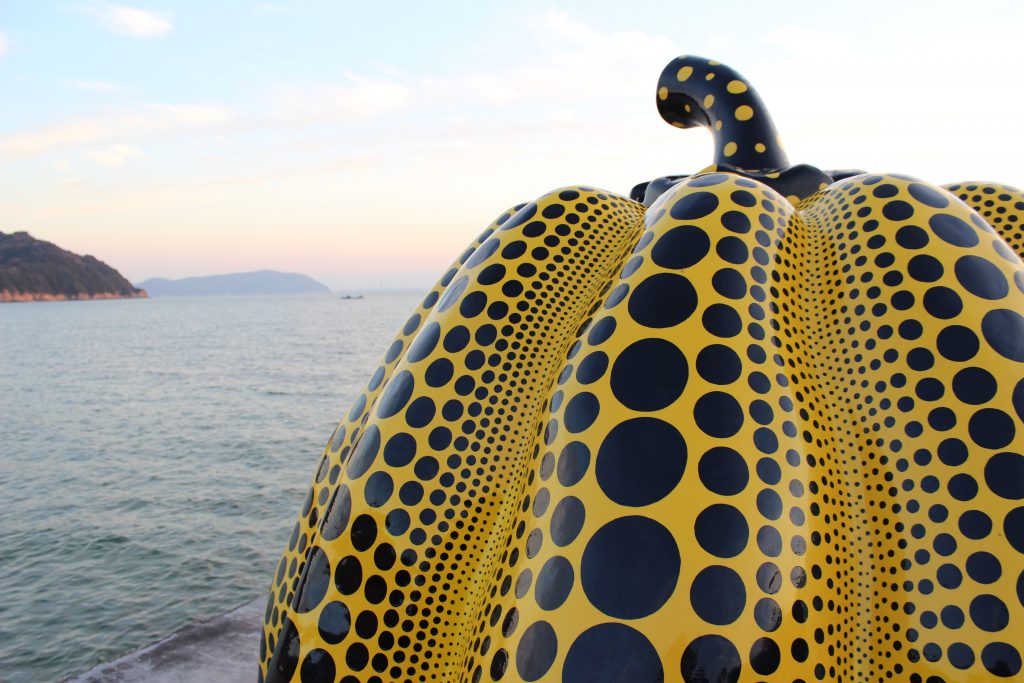
In 1993, she officially represented Japan at the Venice Biennale with a mirror room filled with pumpkins. The following year, her yellow pumpkin with black spots was installed on the island of Naoshima and became its emblem. She loved the pumpkin for its generous lack of pretension, and it functions as a self-portrait in her work. Her Infinity Mirror Rooms multiply space and light to infinity, dissolving the boundary between visitor and cosmos. In 2011, the Centre Pompidou dedicated its first French retrospective to her, featuring 150 works from 1949 to 2010. This was followed by retrospectives at the Tate Modern and the Whitney the following year. In 2014, she was named the world’s most popular artist, and in 2016 Japan awarded her the Order of Culture.
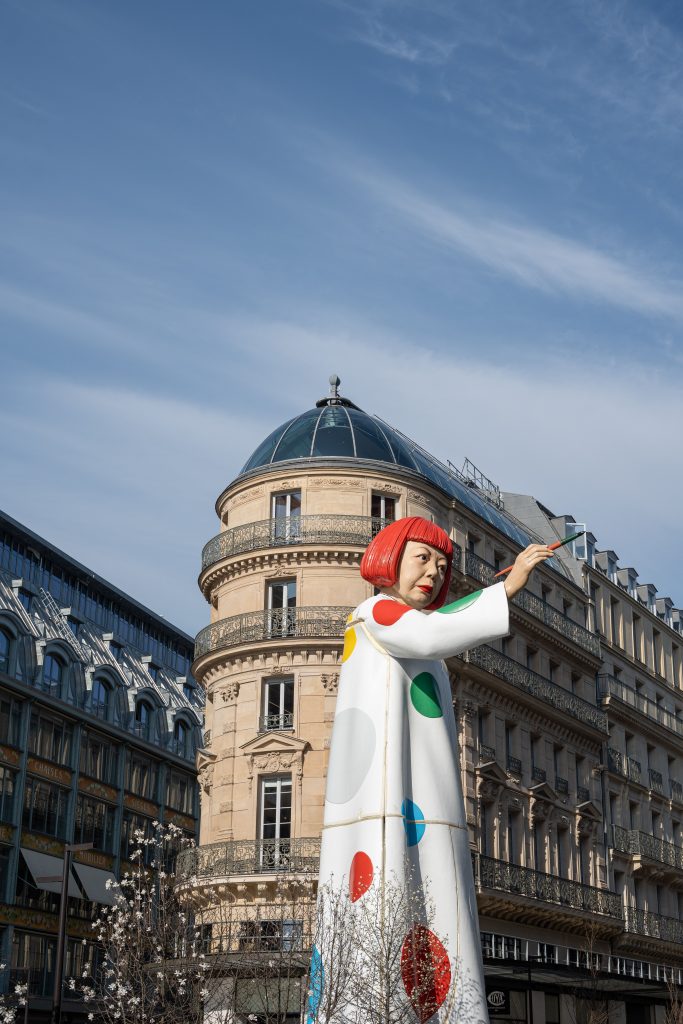
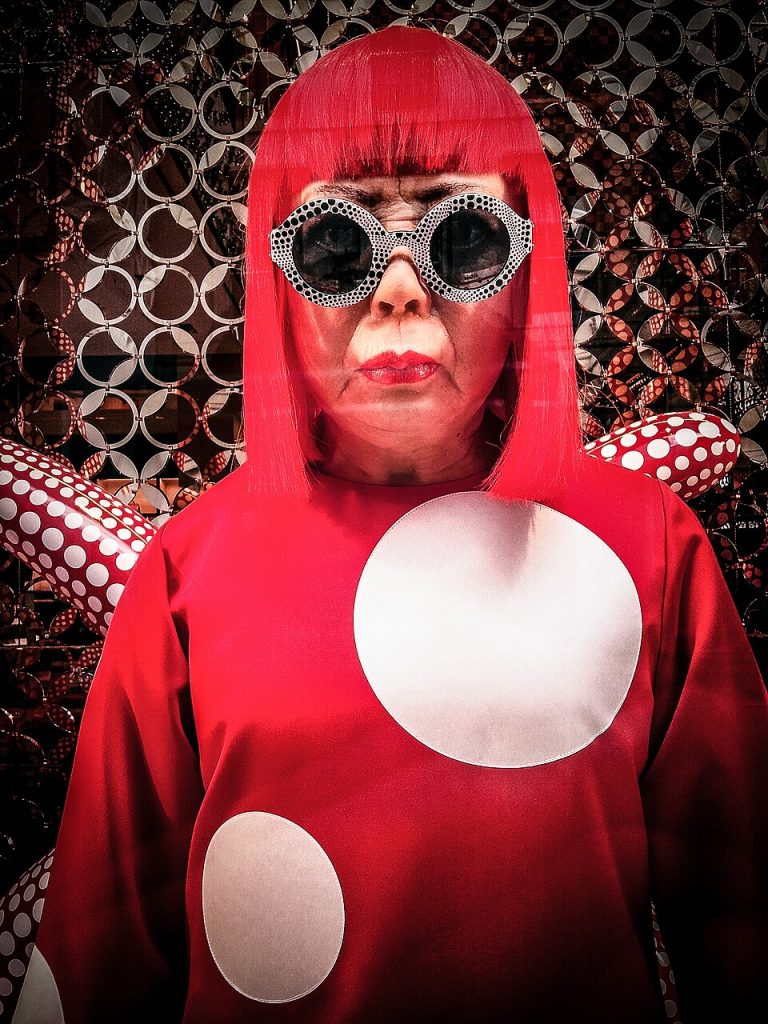
Yayoi Kusama wax model at Louis Vitton for 2012 collection unveiling ; Gary Knight; Wikimedia
In October 2017, the Yayoi Kusama Museum, the first permanent museum dedicated to the artist, opened in Shinjuku. Designed by the Kume Sekkei architectural firm, the white building has rounded corners and a pumpkin on its roof. In the world of fashion, Marc Jacobs first invited her to collaborate with Louis Vuitton in 2006, and again in 2012. Then, in 2023, there was a spectacular relaunch, with giant automatons in her likeness painting polka dots on the façades of Louis Vuitton boutiques in Paris, London and New York. She also collaborated with Lancôme and Uniqlo. True to form, she continued to paint right up until her final days. According to her studio, she pursued her exploration of ‘eternal love’ and the ‘infinite soul’ until the very end. The polka dot, born of anguish, remained her way of connecting humanity to the universe.
Février, 2026
Créer avec l’existant, penser avec l’histoire
De l’architecture au design, cette édition explore comment lieux, savoir-faire et matières héritées deviennent terrains de création actuelle.
Janvier, 2026
Le luxe se réinvente.
Finis les logos clignotants, place à une sobriété raffinée, à l’immersion personnelle, à l’excellence artisanale, à la durabilité sensible.
Décembre, 2025
Héritages, gestes contemporains et plaisirs essentiels
Parce que la fête n’est jamais qu’apparence : elle reflète notre manière d’habiter le monde, de transmettre, de fabriquer des souvenirs durables.
ÉDITION #3
Upcycling et kintsugi transforment l’objet contemporain, faisant de la trace, de la réparation et de la matière un langage esthétique.
ÉDITION #3
Artisans et designers donnent une seconde vie aux matériaux anciens, entre création contemporaine, patrimoine et réemploi.
ÉDITION #3
Bunkers, wagons et kiosques renaissent grâce à la création, révélant comment l’art redonne sens aux lieux délaissés.
ÉDITION #2
Un regard transversal sur le quiet luxury à travers des lieux, des objets et des figures qui expriment l’élégance.
ÉDITION #1
Une sélection de marques, architectures, objets et escapades qui donnent corps au sens de la fête.
ÉDITION #3
Usines et gares délaissées deviennent lieux culturels ouverts, où mémoire industrielle et usages contemporains redessinent la ville.
ÉDITION #3
L’audacieuse métamorphose d’un palace parisien
ÉDITION #3
Au cœur du Marais, un lieu discret révèle comment archives, architecture et recherche font dialoguer l’œuvre de Picasso.
ÉDITION #2
Une expérience shopping unique dans un magasin emblématique.
ÉDITION #2
Voyage culinaire et architectural au cœur de la Seine
ÉDITION #2
Dans le 9e arrondissement, un établissement qui invite au quiet luxury
ÉDITION #1
Chante! vient d’ouvrir ses portes. Une invitation à vibrer !
ÉDITION #3
Icône du paysage français, la boîte jaune change de statut et s’invite dans l’univers du design.
ÉDITION #3
L’édition 2026 affirme une vision où artisanat, design et mémoire façonnent l’habitat contemporain, international actuel.
ÉDITION #3
Cent ans après 1925, l’Art déco revient dans nos villes et intérieurs avec géométrie, audace, optimisme.
ÉDITION #3
Depuis plus de deux cents ans, Royal Limoges conjugue porcelaine, savoir-faire industriel et création contemporaine.
ÉDITION #3
Des terrains de sport aux podiums, la sneaker raconte un siècle de mutations culturelles, techniques et stylistiques.
ÉDITION #2
Design, mode, artisanat : des créations où la forme et la matière se répondent avec justesse, loin de tout effet de mode.
ÉDITION #1
Décorations artisanales, calendriers ultra-luxe et pièces de collection pour s’enivrer de joie avant l’heure.
ÉDITION #3
Entre marqueterie monumentale et jungle symbolique, Anton Laborde transforme le bois en récit contemporain poétique engagé.
ÉDITION #3
À Maison & Objet, Thierry Laudren présente des meubles sculptés où fonction, matière et lenteur façonnent une présence.
ÉDITION #3
Jean Nouvel conçoit une architecture attentive aux contextes, où lumière, histoire et usages façonnent chaque projet.
ÉDITION #3
À Lyon, Sophie Morel rénove des lieux historiques en alliant respect du bâti et écriture contemporaine.
ÉDITION #3
Au Centre d’Études Picasso, l’architecte compose une architecture où lumière, géométrie et héritage dialoguent avec précision.
ÉDITION #2
Entretien avec le fondateur d’EDO (European Design Office)
ÉDITION #2
Portrait d’un visionnaire qui transforme l’art de recevoir en expérience totale.
ÉDITION #1
Personnalités, artisans et créateurs qui donnent à la fête sa profondeur humaine.
ÉDITION #3
De Bordeaux au Bassin, art, vignobles et bien-être composent une échappée élégante au cœur de la Gironde.
ÉDITION #2
Vers une région de l’Italie habitée par le temps, où paysages, culture et usages s’accordent dans une continuité rare.
ÉDITION #1
Destinations et rituels qui réinventent la fête, du soleil tropical aux marchés d’hiver.