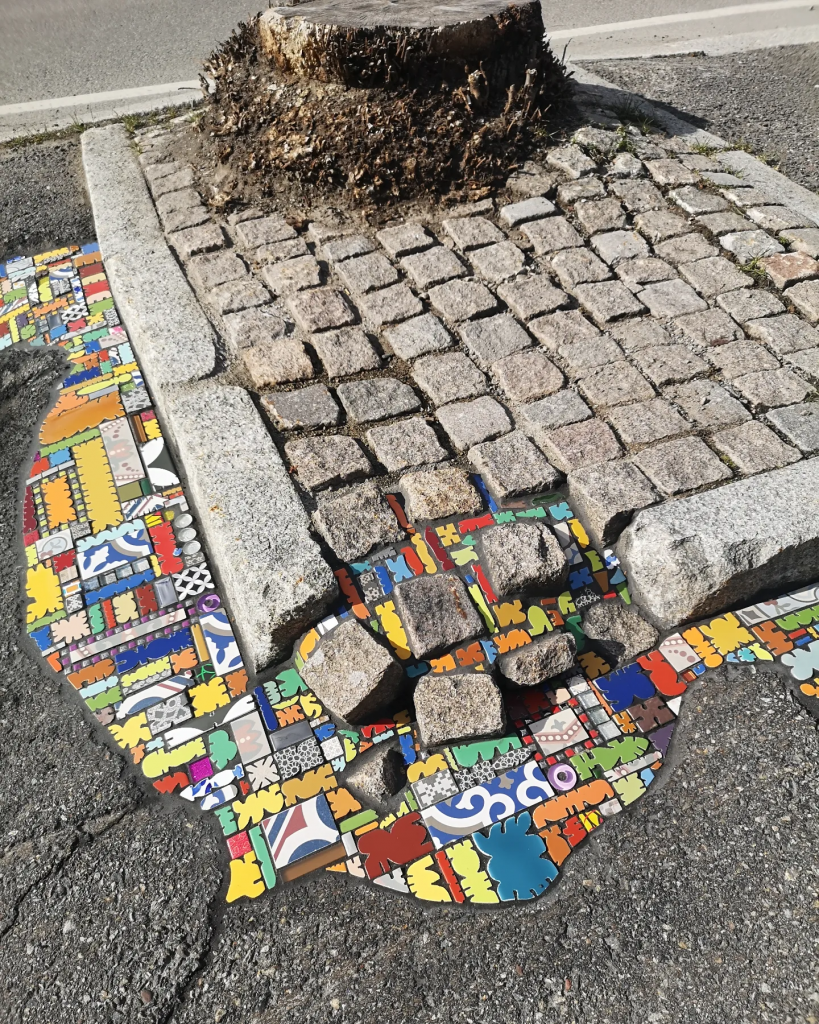
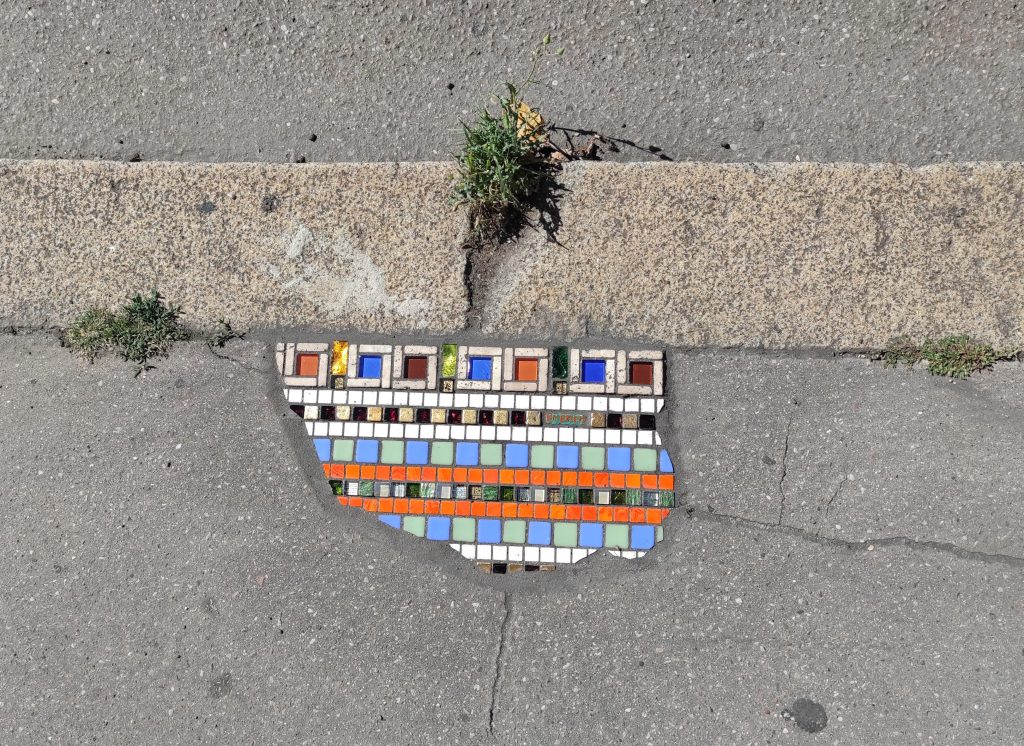
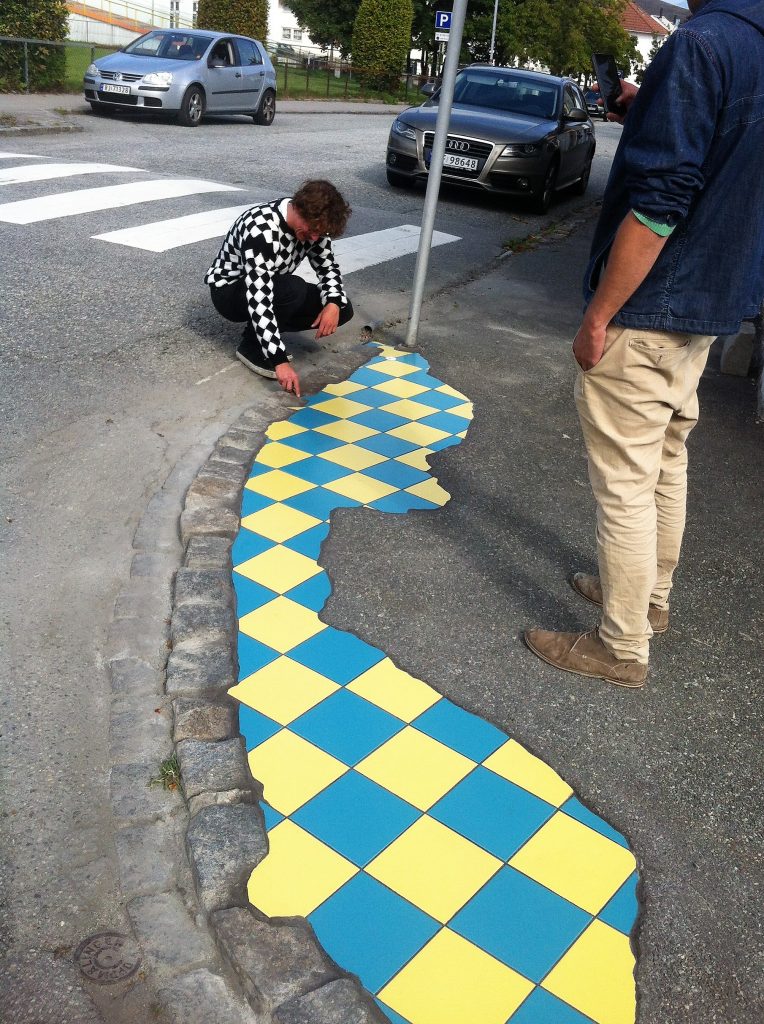
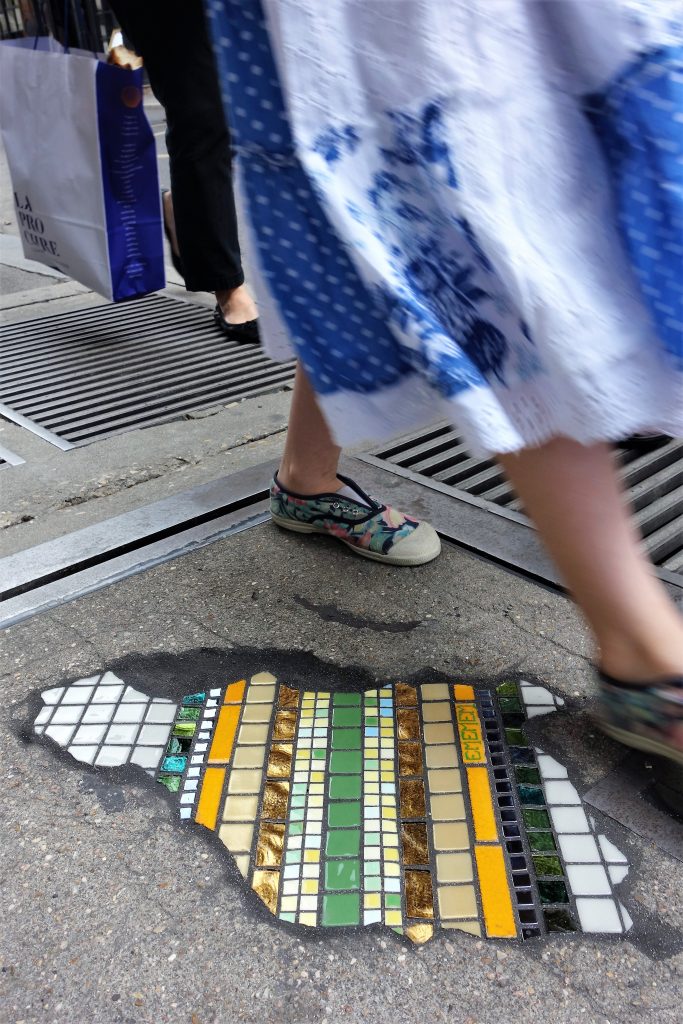
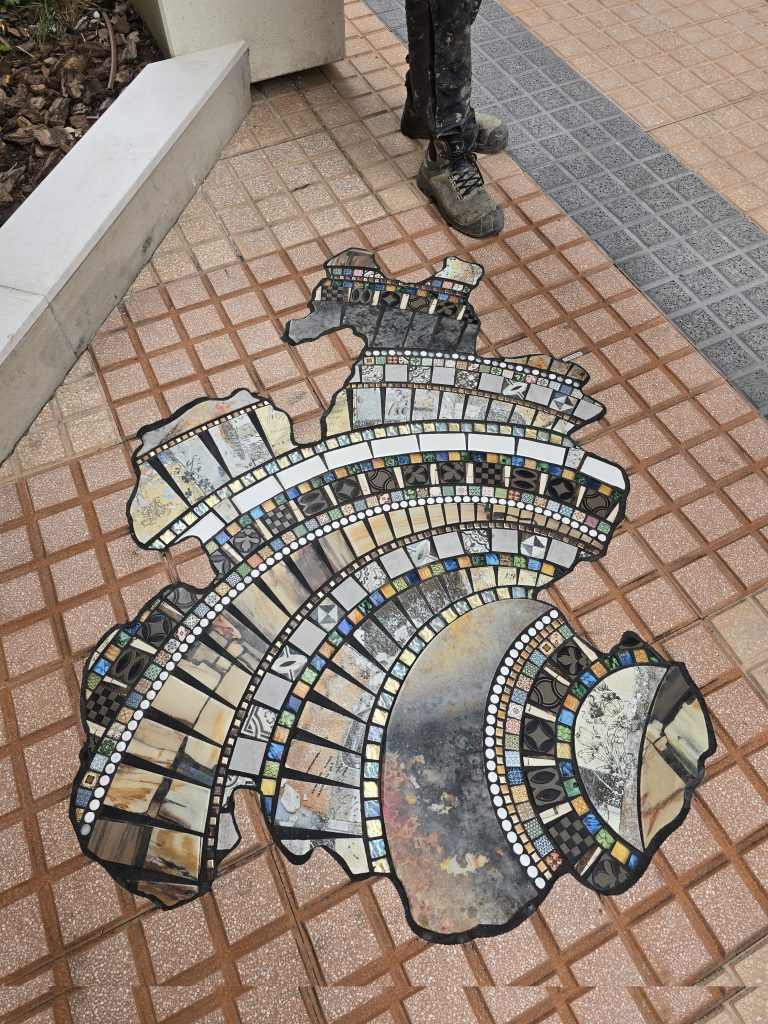
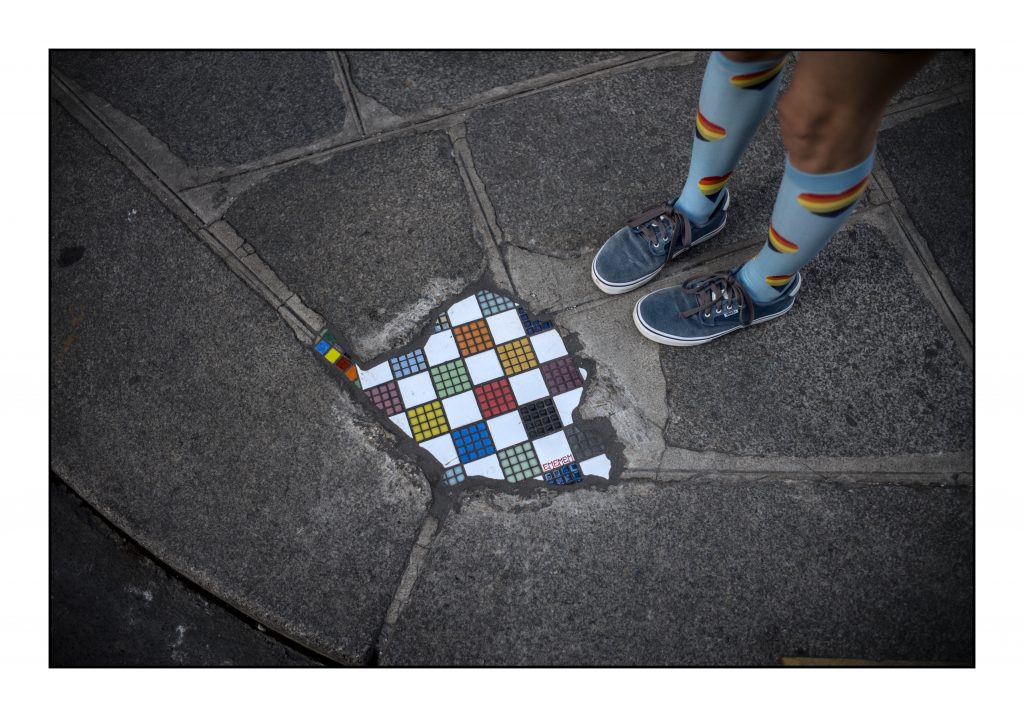
From a broken pavement in Lyon, Ememem has turned the city’s wounds into raw material. Pavement poet, surgeon of the tarmac, the artist fills cracks and potholes with vivid ceramic mosaics. The practice carries a name Ememem coined, flacking, now part of the street art vocabulary. It is as much repair as it is poetry. “Cracks are like wrinkles. They tell the story of time passing, of tensions, transformations, and the invisible histories of a city.”
Madamedekeravel ; Wikimedia
It all began almost as a game. One day Ememem stood before a crack and had the idea of filling it, the way one might repair a precious scar. “I was fascinated by the possibility of intervening directly in the city without adding anything unnecessary,” the artist recalls. The first flacking appeared in 2016, in front of the Gallo-Roman Museum in Lyon. What confirmed it was people’s reactions. “I understood that this visual language had a universal resonance.” To make the technique official, Ememem coined the word flacking, now commonly used to describe this new way of repairing holes. These pavement dressings belong to the lineage of street art and contemporary art, while echoing the Japanese kintsugi, the tradition that mends broken objects by highlighting their golden fractures rather than hiding them.
Ememem
Ememem’s world is one of poetic repair. The artist works with wounds, absences and forgotten spaces, using traditional materials, ceramics and mosaics, to create unexpected encounters between fragility and colour, between decay and wonder. Against the grey of the asphalt, the polychrome compositions burst out, the outlines surprise, the unusual materials divert the imagery of ancient mosaic. “I do not believe there is a clear boundary between art and urban repair. I enjoy working precisely within that ambiguity,” Ememem explains. Each intervention genuinely mends an urban wound while introducing a poetic element that serves no practical function. The work emerges from that meeting point, between the practical gesture and the artistic one. Resilience runs through everything: a simple question about how a wound can be turned into a strength.
Ememem
For Ememem, public space is a place of collective memory. Every street, wall and paving stone holds traces of those who have passed through it. When intervening, the artist does not erase that memory but tries to engage with it. “What interests me is transforming a sign of deterioration into something that invites attention,” Ememem says. Far from flaws, cracks become testimonies. They are evidence that a place has been lived in, crossed, continuously evolving. The artist hopes for a fresh way of seeing cities: not as perfect objects that must remain immaculate, but as living organisms. Imperfections do not necessarily need to be erased. They can become opportunities for creativity, dialogue and beauty, a more attentive, human and sensitive way of looking at the urban environment.
Ememem
The process always begins with observation. Ememem walks a great deal, looking for a crack with a particular personality, an interesting shape, a story waiting to be told. “The place suggests the intervention, not the other way around,” the artist notes. Once the site is found, Ememem studies its shape and imagines how to enter into dialogue with it. Then come the ceramic pieces, shaped in the studio, followed by a return to the location to install them. It is a constant back and forth between craftsmanship, reflection and direct intervention in public space. In the studio, Ememem also creates replicas of these pavement dressings, exhibited in galleries and international contemporary art fairs. The works seem to surface from beneath the asphalt, as if they had always been there, buried under our conventions. Were they there before? Who made them?

Alexandre Dulaunoy ; Wikimedia
What Ememem seeks above all is the element of surprise. “I would like people, even for a brief moment, to interrupt their routine and look differently at their surroundings,” the artist says. If one intervention brings a smile, sparks curiosity or slows someone’s pace, it has already fulfilled its purpose. Ememem hopes passers-by will remember the place rather than the artwork. “If, after seeing one of my interventions, someone begins to pay closer attention to their city, then the work continues to live long after I have left.” What keeps the artist going comes down to a single word: curiosity. Every city offers new situations, new stories, new wounds to interpret. As long as there are cracks to observe and people to surprise, Ememem will remain eager to explore.
Février, 2026
Créer avec l’existant, penser avec l’histoire
De l’architecture au design, cette édition explore comment lieux, savoir-faire et matières héritées deviennent terrains de création actuelle.
Janvier, 2026
Le luxe se réinvente.
Finis les logos clignotants, place à une sobriété raffinée, à l’immersion personnelle, à l’excellence artisanale, à la durabilité sensible.
Décembre, 2025
Héritages, gestes contemporains et plaisirs essentiels
Parce que la fête n’est jamais qu’apparence : elle reflète notre manière d’habiter le monde, de transmettre, de fabriquer des souvenirs durables.
ÉDITION #3
Upcycling et kintsugi transforment l’objet contemporain, faisant de la trace, de la réparation et de la matière un langage esthétique.
ÉDITION #3
Artisans et designers donnent une seconde vie aux matériaux anciens, entre création contemporaine, patrimoine et réemploi.
ÉDITION #3
Bunkers, wagons et kiosques renaissent grâce à la création, révélant comment l’art redonne sens aux lieux délaissés.
ÉDITION #2
Un regard transversal sur le quiet luxury à travers des lieux, des objets et des figures qui expriment l’élégance.
ÉDITION #1
Une sélection de marques, architectures, objets et escapades qui donnent corps au sens de la fête.
ÉDITION #3
Usines et gares délaissées deviennent lieux culturels ouverts, où mémoire industrielle et usages contemporains redessinent la ville.
ÉDITION #3
L’audacieuse métamorphose d’un palace parisien
ÉDITION #3
Au cœur du Marais, un lieu discret révèle comment archives, architecture et recherche font dialoguer l’œuvre de Picasso.
ÉDITION #2
Une expérience shopping unique dans un magasin emblématique.
ÉDITION #2
Voyage culinaire et architectural au cœur de la Seine
ÉDITION #2
Dans le 9e arrondissement, un établissement qui invite au quiet luxury
ÉDITION #1
Chante! vient d’ouvrir ses portes. Une invitation à vibrer !
ÉDITION #3
Icône du paysage français, la boîte jaune change de statut et s’invite dans l’univers du design.
ÉDITION #3
L’édition 2026 affirme une vision où artisanat, design et mémoire façonnent l’habitat contemporain, international actuel.
ÉDITION #3
Cent ans après 1925, l’Art déco revient dans nos villes et intérieurs avec géométrie, audace, optimisme.
ÉDITION #3
Depuis plus de deux cents ans, Royal Limoges conjugue porcelaine, savoir-faire industriel et création contemporaine.
ÉDITION #3
Des terrains de sport aux podiums, la sneaker raconte un siècle de mutations culturelles, techniques et stylistiques.
ÉDITION #2
Design, mode, artisanat : des créations où la forme et la matière se répondent avec justesse, loin de tout effet de mode.
ÉDITION #1
Décorations artisanales, calendriers ultra-luxe et pièces de collection pour s’enivrer de joie avant l’heure.
ÉDITION #3
Entre marqueterie monumentale et jungle symbolique, Anton Laborde transforme le bois en récit contemporain poétique engagé.
ÉDITION #3
À Maison & Objet, Thierry Laudren présente des meubles sculptés où fonction, matière et lenteur façonnent une présence.
ÉDITION #3
Jean Nouvel conçoit une architecture attentive aux contextes, où lumière, histoire et usages façonnent chaque projet.
ÉDITION #3
À Lyon, Sophie Morel rénove des lieux historiques en alliant respect du bâti et écriture contemporaine.
ÉDITION #3
Au Centre d’Études Picasso, l’architecte compose une architecture où lumière, géométrie et héritage dialoguent avec précision.
ÉDITION #2
Entretien avec le fondateur d’EDO (European Design Office)
ÉDITION #2
Portrait d’un visionnaire qui transforme l’art de recevoir en expérience totale.
ÉDITION #1
Personnalités, artisans et créateurs qui donnent à la fête sa profondeur humaine.
ÉDITION #3
De Bordeaux au Bassin, art, vignobles et bien-être composent une échappée élégante au cœur de la Gironde.
ÉDITION #2
Vers une région de l’Italie habitée par le temps, où paysages, culture et usages s’accordent dans une continuité rare.
ÉDITION #1
Destinations et rituels qui réinventent la fête, du soleil tropical aux marchés d’hiver.