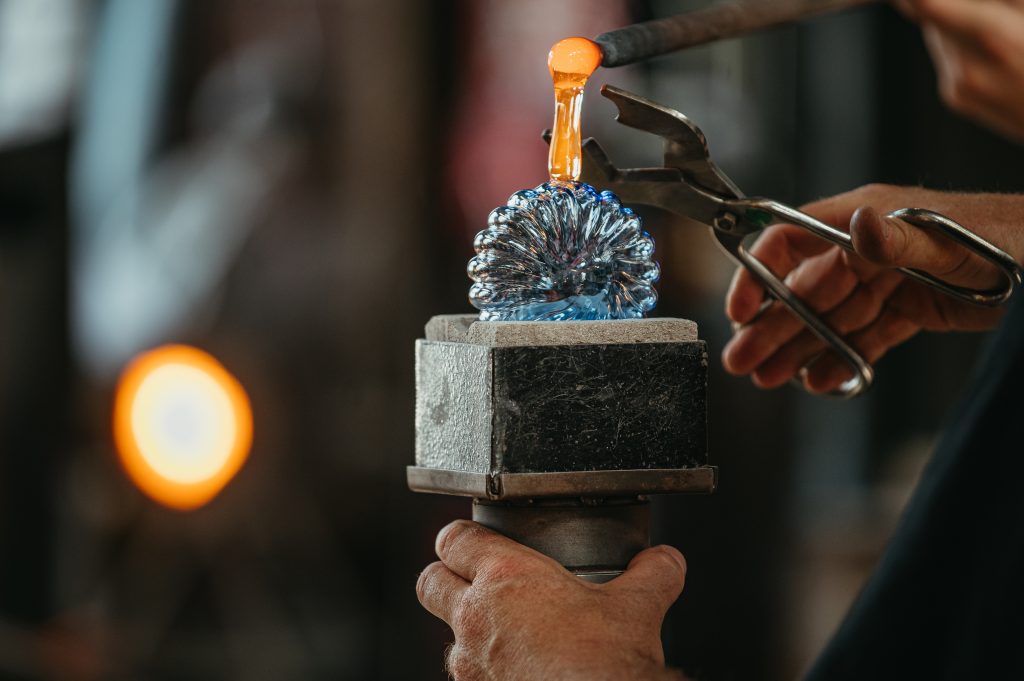
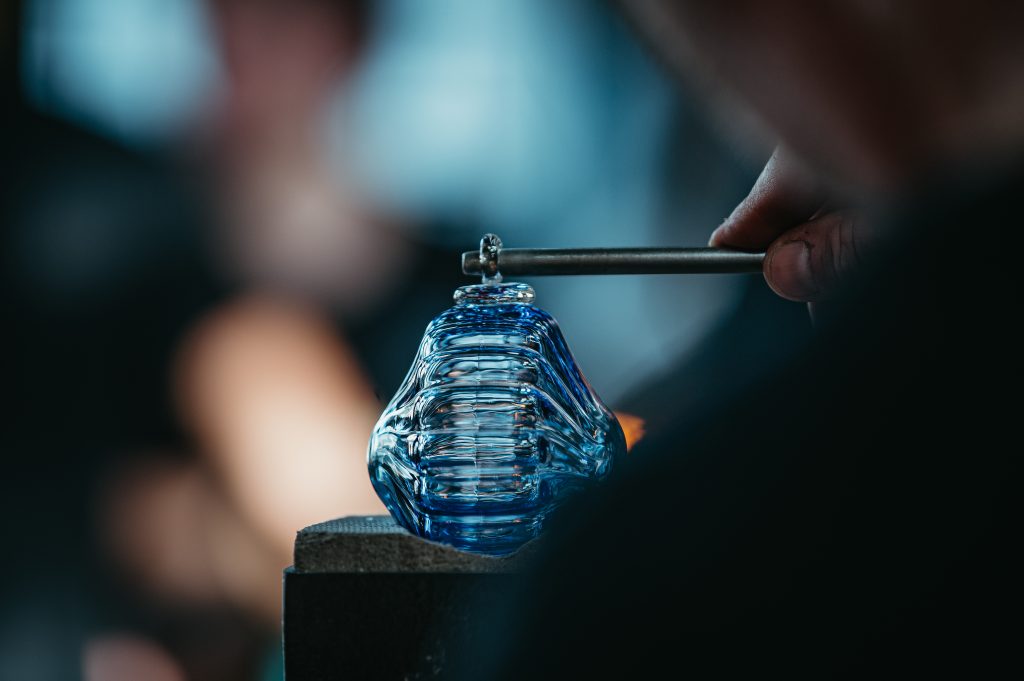
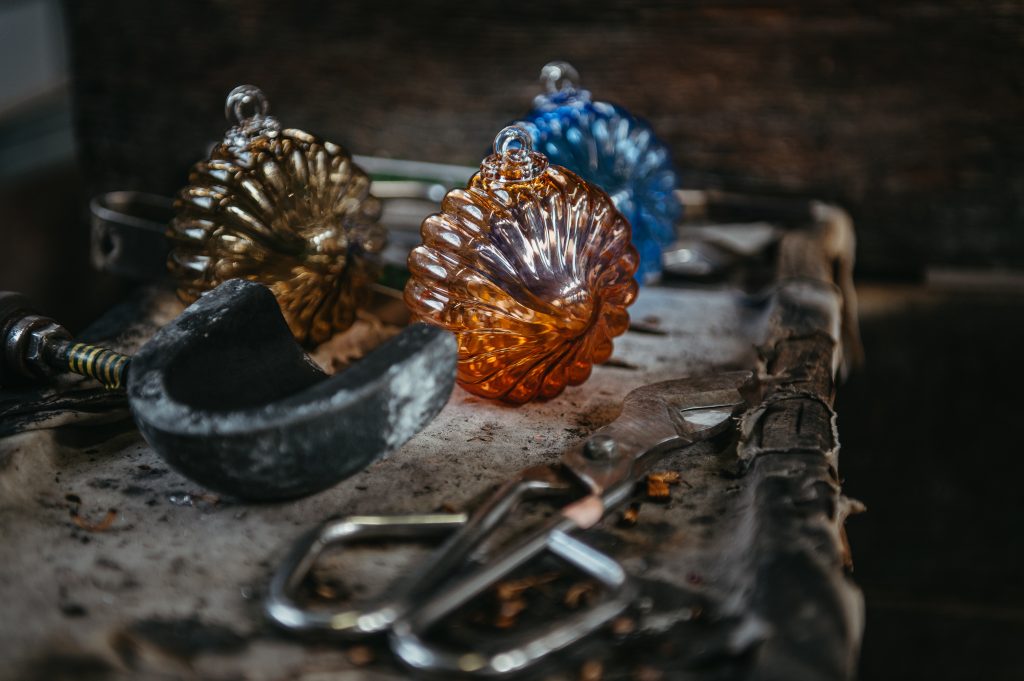
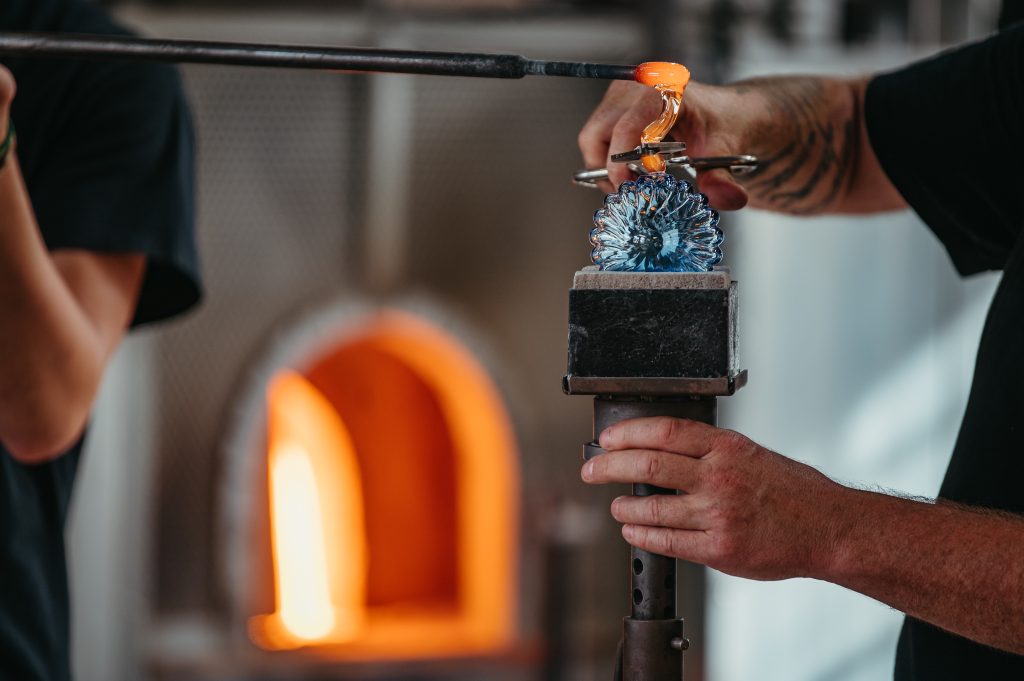
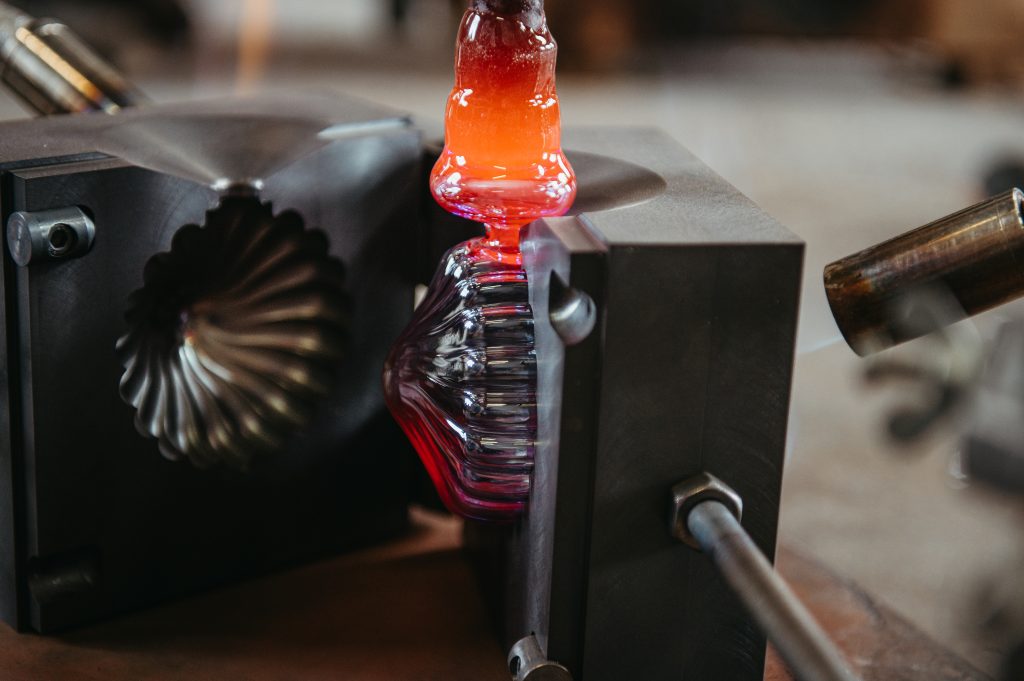
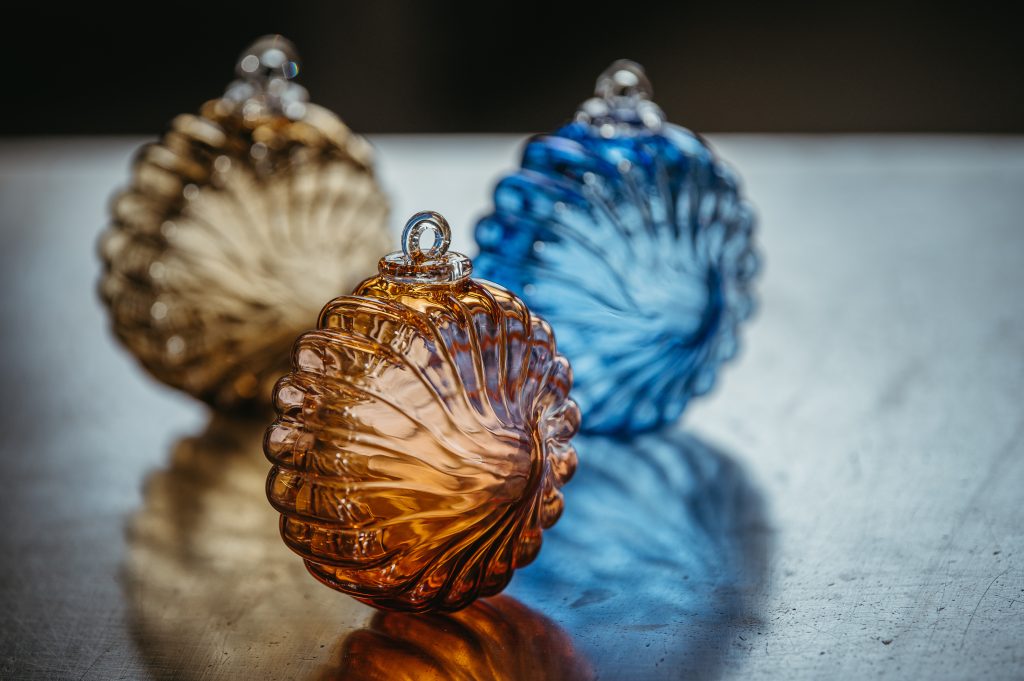
Small enough to rest in the palm of your hand, Alma is a flower-shaped glass ornament with nineteen petals through which light passes from one side to the other. Designed by the duo Marie & Alexandre, formed by Marie Cornil and Alexandre Willaume, this Christmas bauble joins the collection of the International Centre for Glass Art (CIAV) in Meisenthal in 2026. There, glassmakers shape each piece by mouth-blowing molten glass into a mould. The designers describe Alma as “a kind of contemporary amulet to which one might entrust a wish, a secret or a hope”.
Photo: Meisenthal Centre International d’Art Verrier ; ©Laurent Beckrich
Meisenthal Centre International d’Art Verrier ; ©Laurent Beckrich
The project began with a collection of symbols. Four-leaf clovers, horseshoes, dreamcatchers, protective eyes, stones and flowers to which different cultures attribute protective powers: Marie Cornil and Alexandre Willaume compiled an extensive inventory of good-luck charms, from familiar symbols to more personal talismans.
It was the latter that captured their interest most. A piece of jewellery, a garment or a tool passed down from a distant relative may have little monetary value, yet over time it gathers memories and takes on a significance of its own. People often develop small rituals around such objects.
Having first met at the 2018 Design Parade at Villa Noailles, the two designers have always approached object design through an exploration of materials, techniques and craftsmanship. At Meisenthal, their starting point was a local tradition: the glass Christmas baubles produced by the CIAV are treasured and passed down through families in the Pays de Bitche and far beyond. Creating a bauble that could hold a wish felt like a natural extension of this tradition.

Meisenthal Centre International d’Art Verrier ; ©Laurent Beckrich
Five sources of inspiration informed the design: the traditional Provençal birth box, offered as a protective keepsake; lily of the valley, associated with good luck; the protective eye; the sun, with its many symbolic associations; and the Japanese Kokeshi doll, which also carries a wealth of symbolic meaning.
The duo brought these different traditions together in a single form, guided by a handful of very deliberate design choices. Nineteen petals run around the perimeter, outlining a flower on the verge of blooming. Curved lines repeat across both sides of the ornament, echoing one another through the glass so that the eye can take in both faces at once. Their overlapping patterns create a rosette whose reflections shift with the viewing angle. A full, regular curve completes the design, giving the bauble its inviting, palm-sized shape.
Meisenthal Centre International d’Art Verrier ; ©Laurent Beckrich
From the first sketches and technical drawings to the making of the mould and the development of prototypes, Alma went through every stage of the design process before reaching its final form. Molten glass, gathered on the end of a blowpipe, takes on the impression of the petals inside the mould as the glassblower blows into it, one piece at a time.
The setting is as important as the craft itself. At Meisenthal, the Glass Museum traces more than three centuries of local glassmaking history, while the CIAV’s mould library preserves historic moulds that are still fit for use. These provide a starting point for designers looking to create new objects. Marie & Alexandre found a place where tradition provides a foundation for experimentation, and where glassmakers, custodians of generations-old techniques, bring their expertise to bear on the ideas of contemporary designers.
In nearby Goetzenbruck, the production of decorative glass baubles began in 1858, laying the foundations for a glassmaking tradition that the CIAV continues to uphold today
Meisenthal Centre International d’Art Verrier ; ©Laurent Beckrich
The moment finally arrives when the first pieces emerge from the workshop. The designers recall feeling a mixture of apprehension and excitement, followed by an immediate urge to pick up the object and experience its shape for themselves.
“There is a world of difference between drawing an object, imagining what it will be like and finally holding it in your hands,” they explain.
Alma felt familiar to them from the outset, yet handling it revealed a more organic, more tactile presence than they had anticipated. Measuring 8.5 centimetres in diameter, it fits comfortably in the palm. In its transparent version, the glass allows light to travel from one side to the other, while the overlapping curves form a rosette that shifts with the slightest movement. Hung from a Christmas tree branch, it scatters the reflections of an open flower around it.
Meisenthal Centre International d’Art Verrier ; ©Laurent Beckrich
Meisenthal’s Christmas baubles are part of a family ritual, brought out year after year, carefully put away and sometimes passed on to another generation. Marie & Alexandre wanted Alma to carry this tradition forward by giving it the role of a confidante: a gift to give or to keep for oneself, an object to which everyone can entrust their own wishes and intentions.
The designers are keen to distance it from anything mystical or esoteric. They see it instead as a sincere, protective object, one that can rekindle the imagination surrounding good-luck charms while remaining both universal and rooted in the place where it is made.
They have even written a short poem for Alma, four lines to whisper to it in the hope of awakening its benevolent spirit. Ultimately, as they put it, Alma is “a good-luck charm whose only powers are those that each person chooses to give it”.
Février, 2026
Créer avec l’existant, penser avec l’histoire
De l’architecture au design, cette édition explore comment lieux, savoir-faire et matières héritées deviennent terrains de création actuelle.
Janvier, 2026
Le luxe se réinvente.
Finis les logos clignotants, place à une sobriété raffinée, à l’immersion personnelle, à l’excellence artisanale, à la durabilité sensible.
Décembre, 2025
Héritages, gestes contemporains et plaisirs essentiels
Parce que la fête n’est jamais qu’apparence : elle reflète notre manière d’habiter le monde, de transmettre, de fabriquer des souvenirs durables.
ÉDITION #3
Upcycling et kintsugi transforment l’objet contemporain, faisant de la trace, de la réparation et de la matière un langage esthétique.
ÉDITION #3
Artisans et designers donnent une seconde vie aux matériaux anciens, entre création contemporaine, patrimoine et réemploi.
ÉDITION #3
Bunkers, wagons et kiosques renaissent grâce à la création, révélant comment l’art redonne sens aux lieux délaissés.
ÉDITION #2
Un regard transversal sur le quiet luxury à travers des lieux, des objets et des figures qui expriment l’élégance.
ÉDITION #1
Une sélection de marques, architectures, objets et escapades qui donnent corps au sens de la fête.
ÉDITION #3
Usines et gares délaissées deviennent lieux culturels ouverts, où mémoire industrielle et usages contemporains redessinent la ville.
ÉDITION #3
L’audacieuse métamorphose d’un palace parisien
ÉDITION #3
Au cœur du Marais, un lieu discret révèle comment archives, architecture et recherche font dialoguer l’œuvre de Picasso.
ÉDITION #2
Une expérience shopping unique dans un magasin emblématique.
ÉDITION #2
Voyage culinaire et architectural au cœur de la Seine
ÉDITION #2
Dans le 9e arrondissement, un établissement qui invite au quiet luxury
ÉDITION #1
Chante! vient d’ouvrir ses portes. Une invitation à vibrer !
ÉDITION #3
Icône du paysage français, la boîte jaune change de statut et s’invite dans l’univers du design.
ÉDITION #3
L’édition 2026 affirme une vision où artisanat, design et mémoire façonnent l’habitat contemporain, international actuel.
ÉDITION #3
Cent ans après 1925, l’Art déco revient dans nos villes et intérieurs avec géométrie, audace, optimisme.
ÉDITION #3
Depuis plus de deux cents ans, Royal Limoges conjugue porcelaine, savoir-faire industriel et création contemporaine.
ÉDITION #3
Des terrains de sport aux podiums, la sneaker raconte un siècle de mutations culturelles, techniques et stylistiques.
ÉDITION #2
Design, mode, artisanat : des créations où la forme et la matière se répondent avec justesse, loin de tout effet de mode.
ÉDITION #1
Décorations artisanales, calendriers ultra-luxe et pièces de collection pour s’enivrer de joie avant l’heure.
ÉDITION #3
Entre marqueterie monumentale et jungle symbolique, Anton Laborde transforme le bois en récit contemporain poétique engagé.
ÉDITION #3
À Maison & Objet, Thierry Laudren présente des meubles sculptés où fonction, matière et lenteur façonnent une présence.
ÉDITION #3
Jean Nouvel conçoit une architecture attentive aux contextes, où lumière, histoire et usages façonnent chaque projet.
ÉDITION #3
À Lyon, Sophie Morel rénove des lieux historiques en alliant respect du bâti et écriture contemporaine.
ÉDITION #3
Au Centre d’Études Picasso, l’architecte compose une architecture où lumière, géométrie et héritage dialoguent avec précision.
ÉDITION #2
Entretien avec le fondateur d’EDO (European Design Office)
ÉDITION #2
Portrait d’un visionnaire qui transforme l’art de recevoir en expérience totale.
ÉDITION #1
Personnalités, artisans et créateurs qui donnent à la fête sa profondeur humaine.
ÉDITION #3
De Bordeaux au Bassin, art, vignobles et bien-être composent une échappée élégante au cœur de la Gironde.
ÉDITION #2
Vers une région de l’Italie habitée par le temps, où paysages, culture et usages s’accordent dans une continuité rare.
ÉDITION #1
Destinations et rituels qui réinventent la fête, du soleil tropical aux marchés d’hiver.