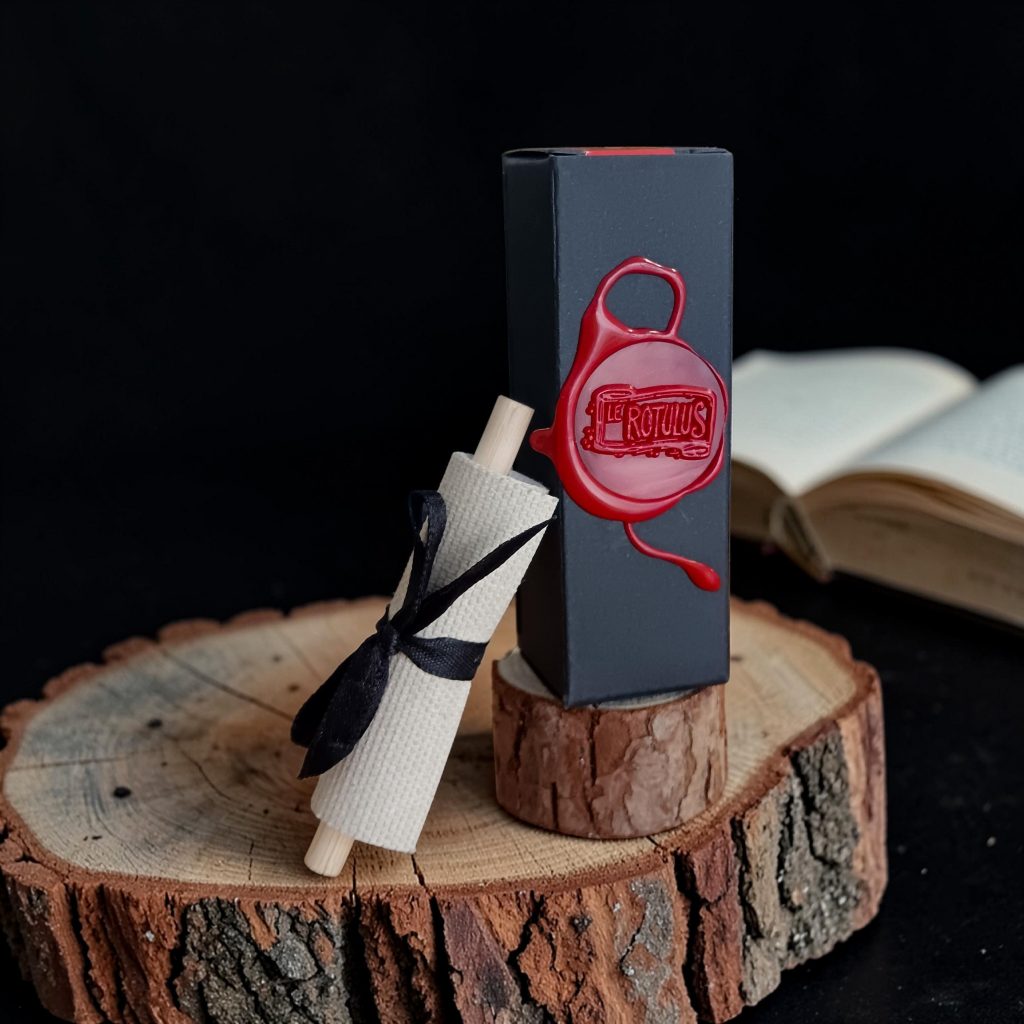
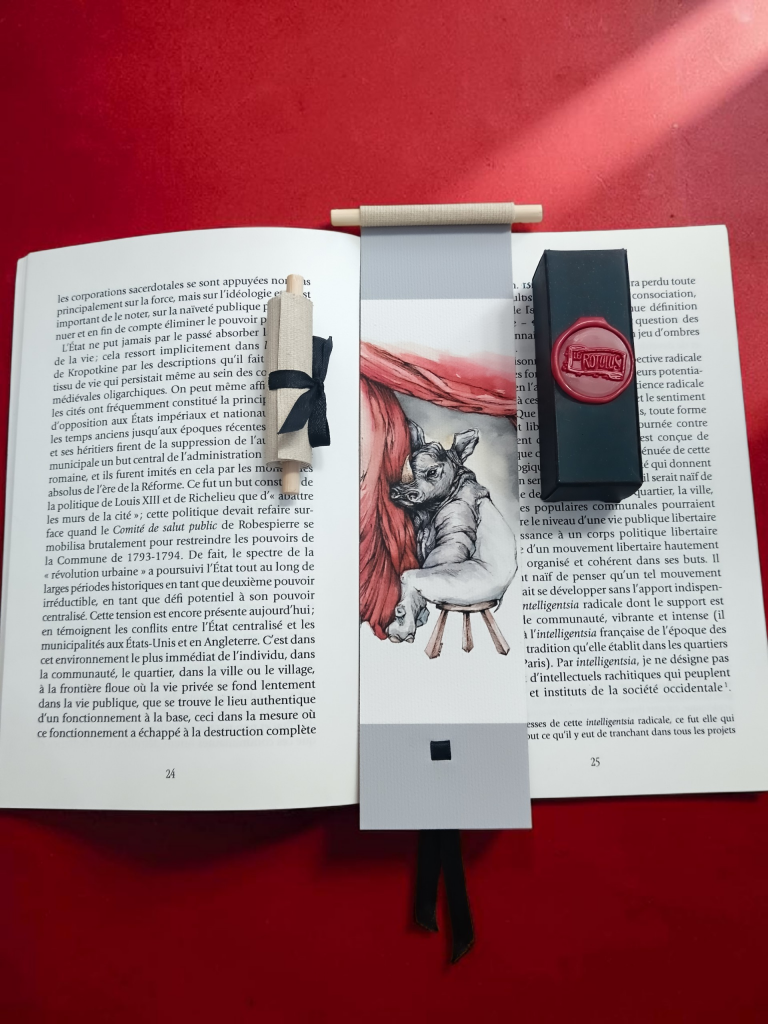
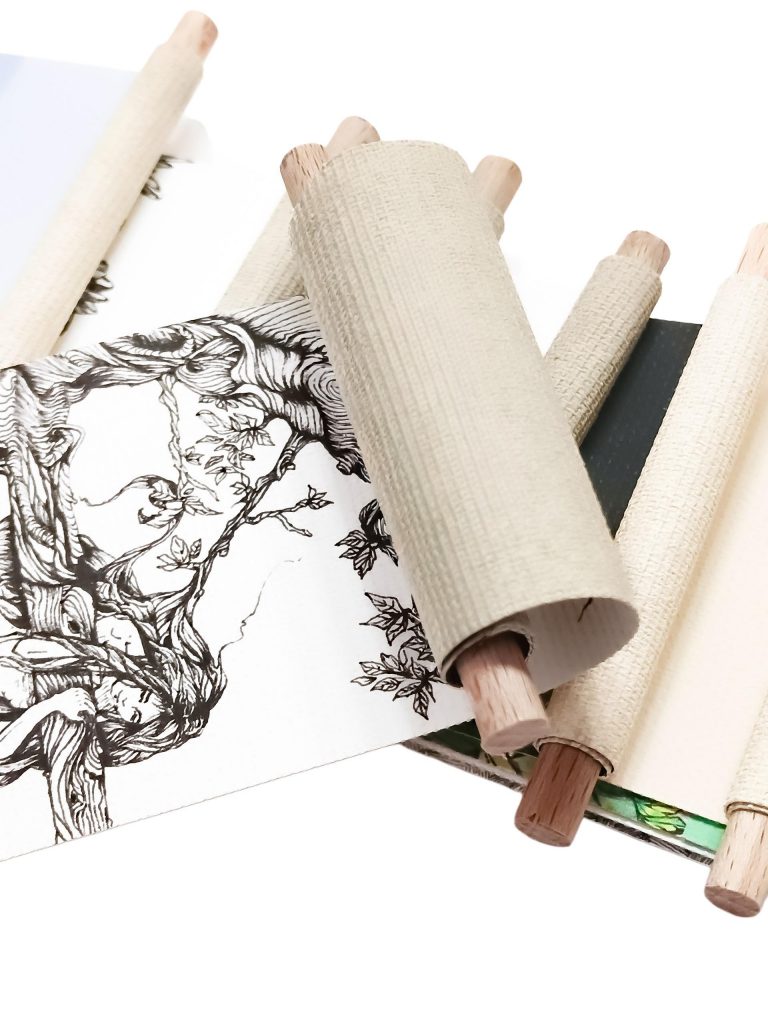
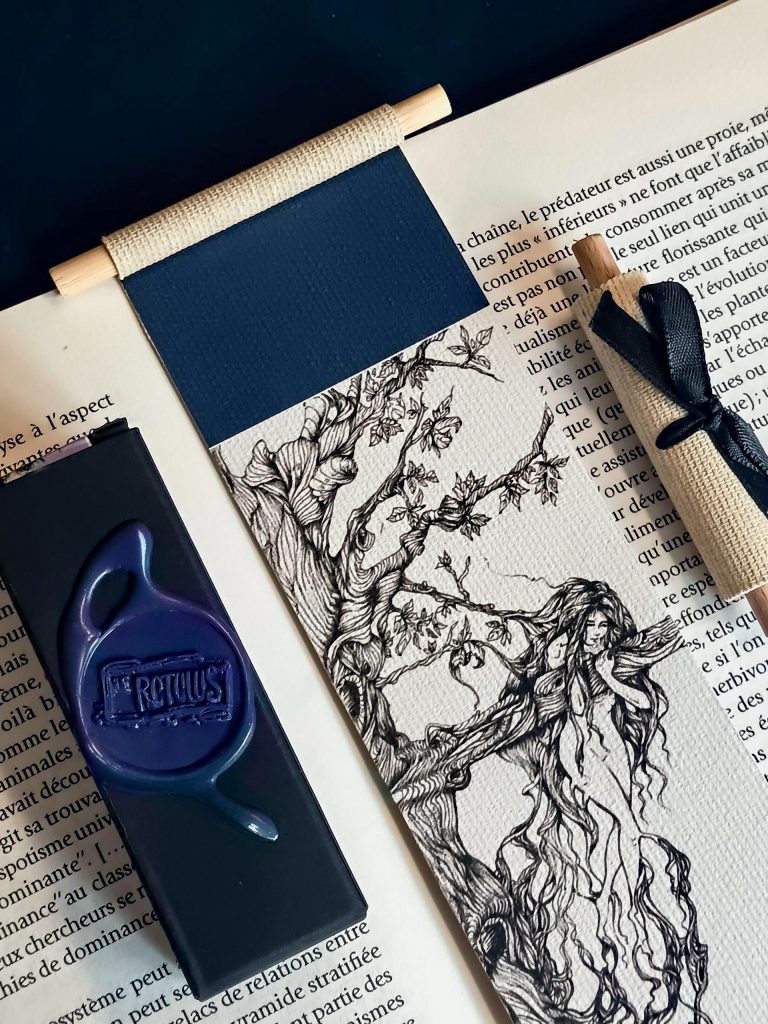
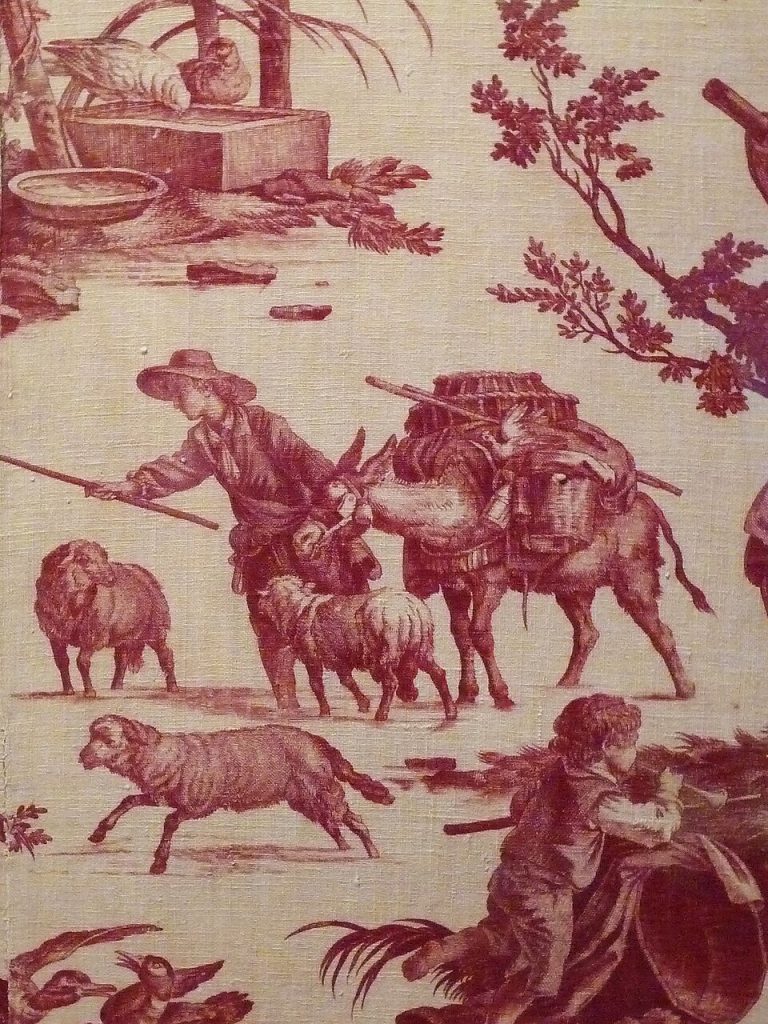
This small scroll, attached to a wooden rod, holds the page in place without slipping and can be unrolled at will, much like a pocket-sized painting. Designed and crafted in Strasbourg by artist ZalmO, this artistic bookmark draws inspiration from ancient parchment scrolls, turning reading into a cherished ritual. Hand-drawn illustrations adorn this playful nod to our age of scrolling, offering book lovers a poetic and sustainable object.
ZalmO ; Le Rotulus
The Rotulus does more than simply mark a page; it enhances the reading experience. Taking the form of a miniature illustrated scroll, it fastens at the top of the page with a wooden rod. Unlike a traditional bookmark, which slips to the back of the book, this one stays in place, marking the line where you left off. Readers unroll it, contemplate it and tuck it away as they turn the pages, then bring it out again. Although the object measures just a few centimetres, it packs a real visual punch. ZalmO sees it as an accessory that slows down the act of reading, encouraging readers to take the time to unroll it and link an image to their reading, thus transforming a pause into a moment suspended in time. Both practical and decorative, it accompanies the book while also standing out in its own right, whether placed on a shelf or framed on the wall.
ZalmO ; Le Rotulus
The name alone speaks volumes about the intention. Before the codex-style book that we are familiar with today, texts were carried on scrolls. The volume was unrolled horizontally and the rotulus vertically. ZalmO borrows this ancient term to link two gestures separated by millennia. Unrolling parchment and scrolling down a screen stem from the same movement. “Yesterday we unrolled parchment; today we scroll,” she summarises. This act of unrolling spans the ages, reminding us that humanity has been scrolling through world news since the dawn of time. The Rotulus plays on this parallel with a touch of mischief: it restores permanence and meaning to an automatic habit, inviting us to reconnect with the gesture of scrolling through words and images with our fingertips — whether across the web or a painted canvas — and changing our relationship with the object and the moment.
ZalmO ; Le Rotulus
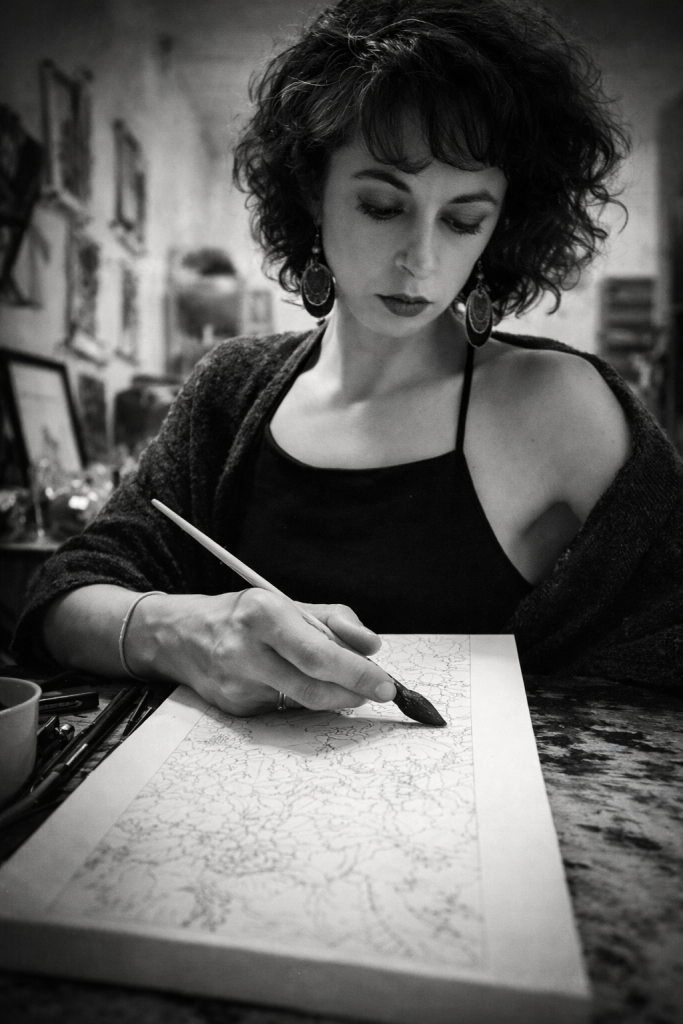
Discreet by nature, she signs her illustrations with her artist’s name: ZalmO. Her career spans various disciplines: she trained as a visual artist, studied literature, and worked in the performing arts for nearly fifteen years. A few years ago, drawing returned to the forefront, spurred on by lockdown and the birth of her son. Passionate about literature and the history of the book, she sought a way to create a dialogue between gesture, narrative, and the object. She works with a fine-tipped pen and watercolours, focusing first on the line and then on the colour. Her motifs originate from images that she envisages: a hand, which was her first subject of study; a bear, which is a legacy of her Pyrenean roots; a pregnant woman, which is a result of her experience of motherhood; and a rook, which has escaped from her medieval readings. These figures are brought together in thematic worlds ranging from nature to gastronomy.

ZalmO ; Le Rotulus
Each Rotulus is based on an original ZalmO drawing. The illustration is then sent to a French printer who reproduces it on canvas as faithfully as possible. The frame is made of wood and the ribbon is made of satin. The entire piece is tear-proof, water-repellent, and crease-resistant, and is designed to withstand many reading sessions. ZalmO assembles each piece by hand, making every item unique. Design, printing and assembly are all carried out in her Strasbourg workshop. The small wooden stem that secures the bookmark to the book is a fine example of micro-design and is protected by an INPI design registration. Even the packaging is wax-sealed and designed to make gift-giving a pleasure.

ZalmO ; Le Rotulus
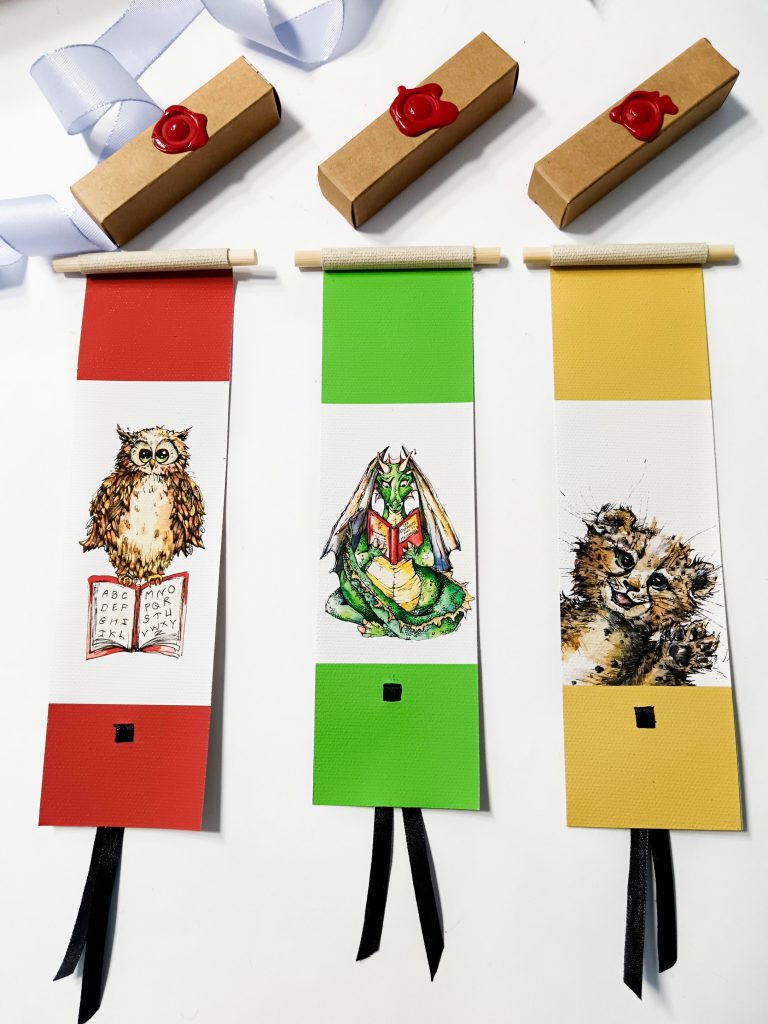
The online shop features the full range of designs, which are regularly updated. Each Rotulus has a name and belongs to a specific theme, so you can find one that speaks to the recipient or matches their favourite read: ‘Rhinocéros’ for theatre lovers and ‘Polar’ for thrill-seekers. The price remains the same at €15, whether you buy online, at a trade fair or in-store. A Junior collection completes the range, featuring Mon Dragon, Le Guépard, and Le Hibou Chou Caillou Pou. ZalmO designed it for her seven-year-old son, whose tastes inspired the designs. Children enjoy the items, which bring a touch of awareness to the act of reading. According to feedback from parents, they also enhance reading time by adding an element of passing on knowledge. Some enthusiasts, initially drawn in by the illustrations, buy several to hang in their homes, turning them into decorative and collectable items in their own right.
ZalmO ; Le Rotulus
Le Rotulus particularly appeals to booksellers and retailers beyond individual customers, who are drawn in by its novelty, human appeal and the idea of a renewed reading experience. There is also a sense of solidarity between artists and cultural figures who are keen to restore meaning to their profession. Businesses and local authorities are also taking an interest, seeking meaningful, handcrafted, French-made gifts for works councils, conferences, and business trips. ZalmO accepts bespoke orders, ranging from variations on an existing design to original creations to be printed. A word to the wise…
The complete collection, which is regularly updated, is available in the online shop. In Strasbourg, ZalmO works and exhibits all year round at the Wyrd gallery, shop and studio in the heart of the Krutenau district. The artist responds to enquiries herself via her website and on Instagram.
Février, 2026
Créer avec l’existant, penser avec l’histoire
De l’architecture au design, cette édition explore comment lieux, savoir-faire et matières héritées deviennent terrains de création actuelle.
Janvier, 2026
Le luxe se réinvente.
Finis les logos clignotants, place à une sobriété raffinée, à l’immersion personnelle, à l’excellence artisanale, à la durabilité sensible.
Décembre, 2025
Héritages, gestes contemporains et plaisirs essentiels
Parce que la fête n’est jamais qu’apparence : elle reflète notre manière d’habiter le monde, de transmettre, de fabriquer des souvenirs durables.
ÉDITION #3
Upcycling et kintsugi transforment l’objet contemporain, faisant de la trace, de la réparation et de la matière un langage esthétique.
ÉDITION #3
Artisans et designers donnent une seconde vie aux matériaux anciens, entre création contemporaine, patrimoine et réemploi.
ÉDITION #3
Bunkers, wagons et kiosques renaissent grâce à la création, révélant comment l’art redonne sens aux lieux délaissés.
ÉDITION #2
Un regard transversal sur le quiet luxury à travers des lieux, des objets et des figures qui expriment l’élégance.
ÉDITION #1
Une sélection de marques, architectures, objets et escapades qui donnent corps au sens de la fête.
ÉDITION #3
Usines et gares délaissées deviennent lieux culturels ouverts, où mémoire industrielle et usages contemporains redessinent la ville.
ÉDITION #3
L’audacieuse métamorphose d’un palace parisien
ÉDITION #3
Au cœur du Marais, un lieu discret révèle comment archives, architecture et recherche font dialoguer l’œuvre de Picasso.
ÉDITION #2
Une expérience shopping unique dans un magasin emblématique.
ÉDITION #2
Voyage culinaire et architectural au cœur de la Seine
ÉDITION #2
Dans le 9e arrondissement, un établissement qui invite au quiet luxury
ÉDITION #1
Chante! vient d’ouvrir ses portes. Une invitation à vibrer !
ÉDITION #3
Icône du paysage français, la boîte jaune change de statut et s’invite dans l’univers du design.
ÉDITION #3
L’édition 2026 affirme une vision où artisanat, design et mémoire façonnent l’habitat contemporain, international actuel.
ÉDITION #3
Cent ans après 1925, l’Art déco revient dans nos villes et intérieurs avec géométrie, audace, optimisme.
ÉDITION #3
Depuis plus de deux cents ans, Royal Limoges conjugue porcelaine, savoir-faire industriel et création contemporaine.
ÉDITION #3
Des terrains de sport aux podiums, la sneaker raconte un siècle de mutations culturelles, techniques et stylistiques.
ÉDITION #2
Design, mode, artisanat : des créations où la forme et la matière se répondent avec justesse, loin de tout effet de mode.
ÉDITION #1
Décorations artisanales, calendriers ultra-luxe et pièces de collection pour s’enivrer de joie avant l’heure.
ÉDITION #3
Entre marqueterie monumentale et jungle symbolique, Anton Laborde transforme le bois en récit contemporain poétique engagé.
ÉDITION #3
À Maison & Objet, Thierry Laudren présente des meubles sculptés où fonction, matière et lenteur façonnent une présence.
ÉDITION #3
Jean Nouvel conçoit une architecture attentive aux contextes, où lumière, histoire et usages façonnent chaque projet.
ÉDITION #3
À Lyon, Sophie Morel rénove des lieux historiques en alliant respect du bâti et écriture contemporaine.
ÉDITION #3
Au Centre d’Études Picasso, l’architecte compose une architecture où lumière, géométrie et héritage dialoguent avec précision.
ÉDITION #2
Entretien avec le fondateur d’EDO (European Design Office)
ÉDITION #2
Portrait d’un visionnaire qui transforme l’art de recevoir en expérience totale.
ÉDITION #1
Personnalités, artisans et créateurs qui donnent à la fête sa profondeur humaine.
ÉDITION #3
De Bordeaux au Bassin, art, vignobles et bien-être composent une échappée élégante au cœur de la Gironde.
ÉDITION #2
Vers une région de l’Italie habitée par le temps, où paysages, culture et usages s’accordent dans une continuité rare.
ÉDITION #1
Destinations et rituels qui réinventent la fête, du soleil tropical aux marchés d’hiver.