The remarkable journey of luxury wallpaper

Long confined to the role of a decorative backdrop, wallpaper is now enjoying renewed recognition. In today’s most exacting interior projects, it no longer merely covers a wall: it structures space, engages with architecture and anchors interiors within a long lineage of gestures, techniques and visual cultures.

The story of luxury wallpaper is that of a mural art in its own right -one that predates industrialisation and has been shaped by cultural exchange, technical innovation and shifting tastes over centuries.

Origins: an imperial wall art

Lin Amd – Pexels

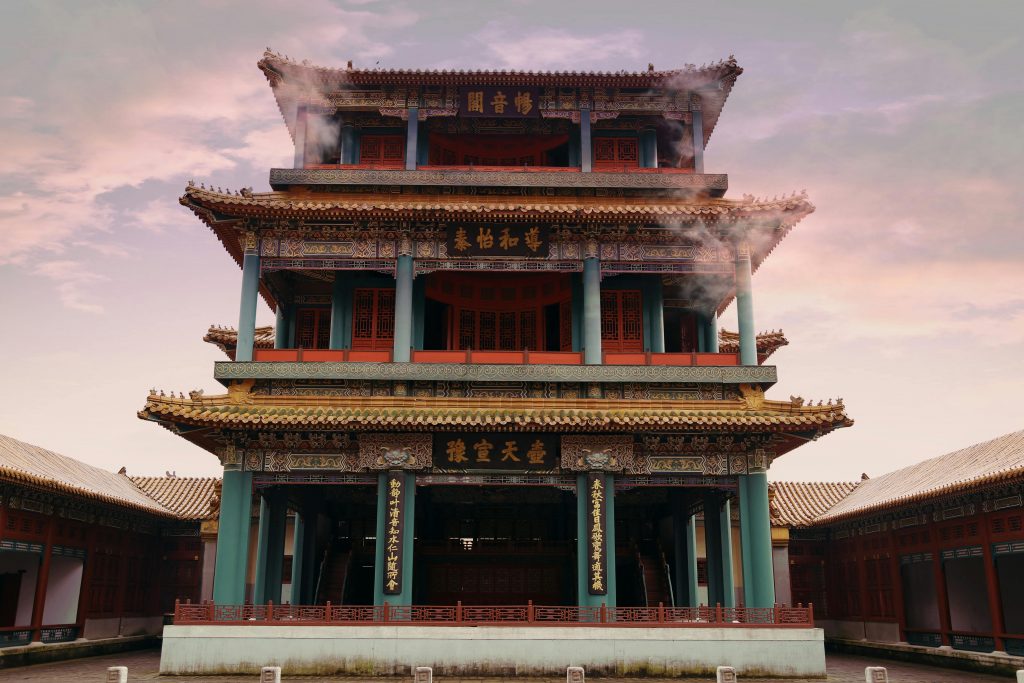
The history of wallpaper begins in China before the year 1000. From the 8th century onward, large sheets of paper or fabric were hand-painted to adorn the walls of palaces and aristocratic residences. Unlike later European production, these early wall coverings were not conceived as repeating patterns but as expansive pictorial scenes, designed to envelop the space.

Their chromatic precision and attention to detail established an enduring standard for luxury wall decoration. Ironically, these Chinese wallpapers — produced largely for export — were rarely used domestically. Imported into Europe from the 16th century through trade in silks, lacquers and porcelain, they quickly became prized by Western elites. Their technical sophistication and narrative power profoundly influenced European makers, who sought to decipher their secrets.

Europe discovers wallpaper

Pxhere (détails)

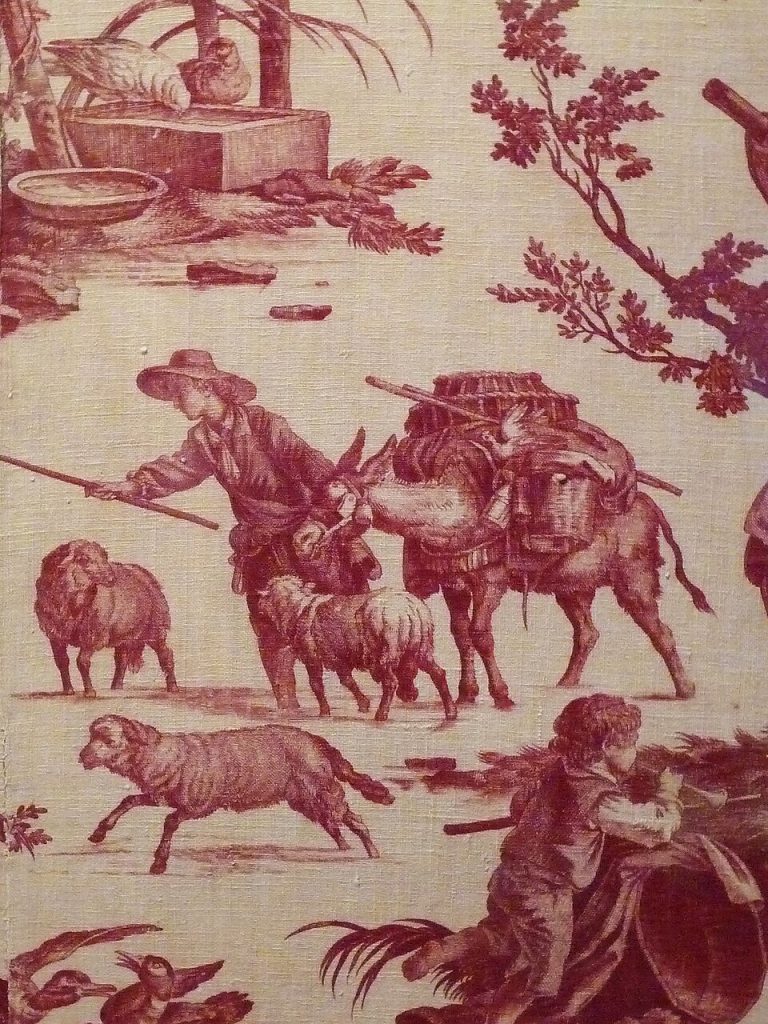
By the 16th century, Europe had begun developing its own solutions. In France, dominos appeared as early as 1514: paper sheets printed with wooden blocks for outlines, then coloured by hand. These versatile objects were used not only on walls, but also on furniture, boxes and book bindings -hybrid artefacts at the crossroads of graphic craft and interior decoration.

A decisive shift occurred in early 18th-century England, when manufacturers began gluing sheets together into continuous rolls before printing. This innovation gave birth to wallpaper as we know it today: a continuous surface designed to cover entire walls. Block printing soon enabled increasingly complex polychrome motifs, often inspired by contemporary textile patterns.

The textile illusion: the golden age of flocked wallpaper

Brian Ramirez – Pexels

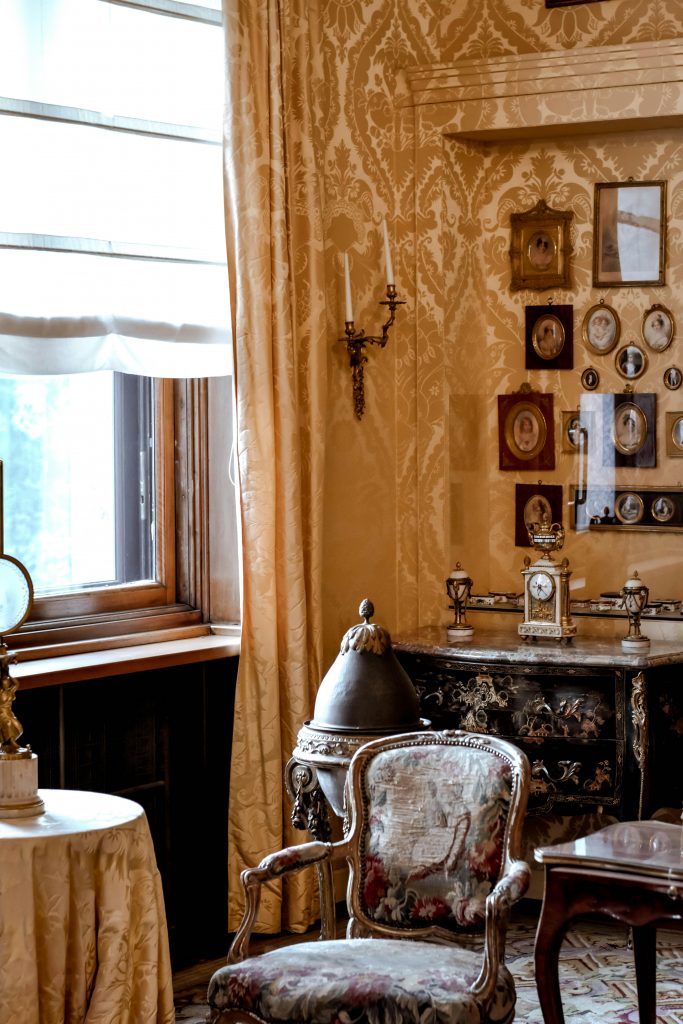
One of the era’s most significant innovations was flocked wallpaper. In 1634, in London, Jerome Lanier developed a method of applying coloured wool powder onto varnished motifs, creating a remarkably convincing imitation of velvet and silk damasks.

These wallpapers were an immediate success. Less costly than textiles yet durable — and conveniently moth-resistant thanks to the turpentine used in the adhesive — they became widespread. By the 18th century, few English homes lacked at least one room decorated with flocked wallpaper. The wall became tactile, almost textile in nature, and wallpaper emerged as a credible alternative to tapestries.

The 18th century: wallpaper as a statement

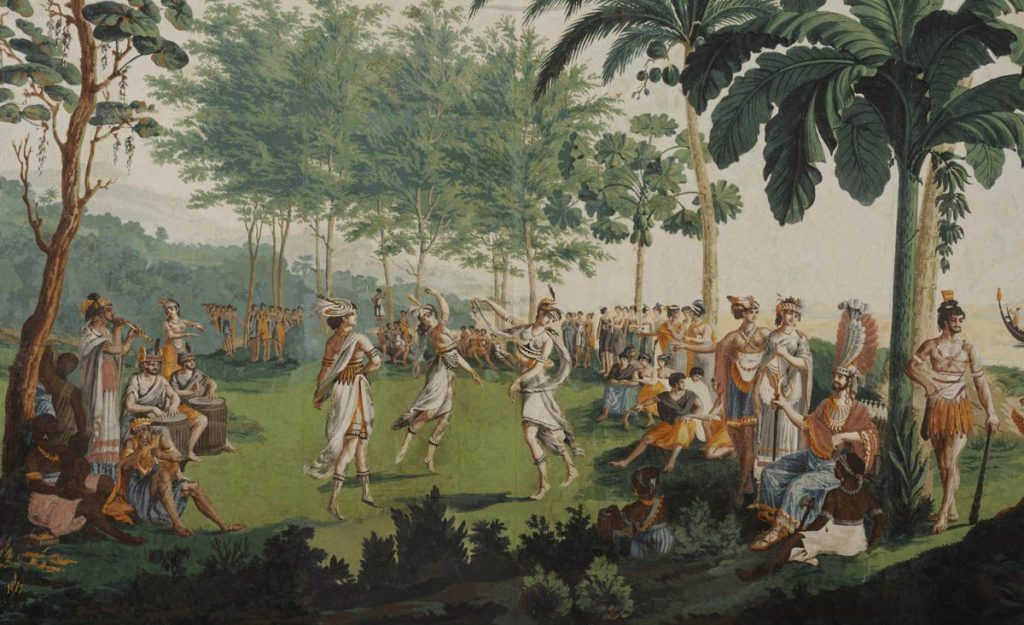
DUFOUR (manufacture) ; CHARVET Jean-Gabriel (dessinateur) – Les sauvages de la mer du Pacifique ; les voyages du capitaine COOK (titre d’usage) ; Paysages indiens (titre d’usage) – Wikimedia

In France, excellence found its embodiment in the factory of Jean-Baptiste Réveillon, founded around 1750. As the first royal wallpaper manufactory, it elevated the medium to new heights through refined backgrounds, masterful colour palettes and complex printing techniques. Wallpaper was no longer a substitute; it became a deliberate aesthetic choice.

This ambition culminated in the rise of panoramic wallpapers. At the beginning of the 19th century, Joseph Dufour produced Les Sauvages de la mer du Pacifique (1804), a monumental composition printed across vast strips. These immersive decors transformed salons and staircases into narrative landscapes. Wallpaper ceased to be a pattern — it became a story.

Industrialisation and controlled democratisation

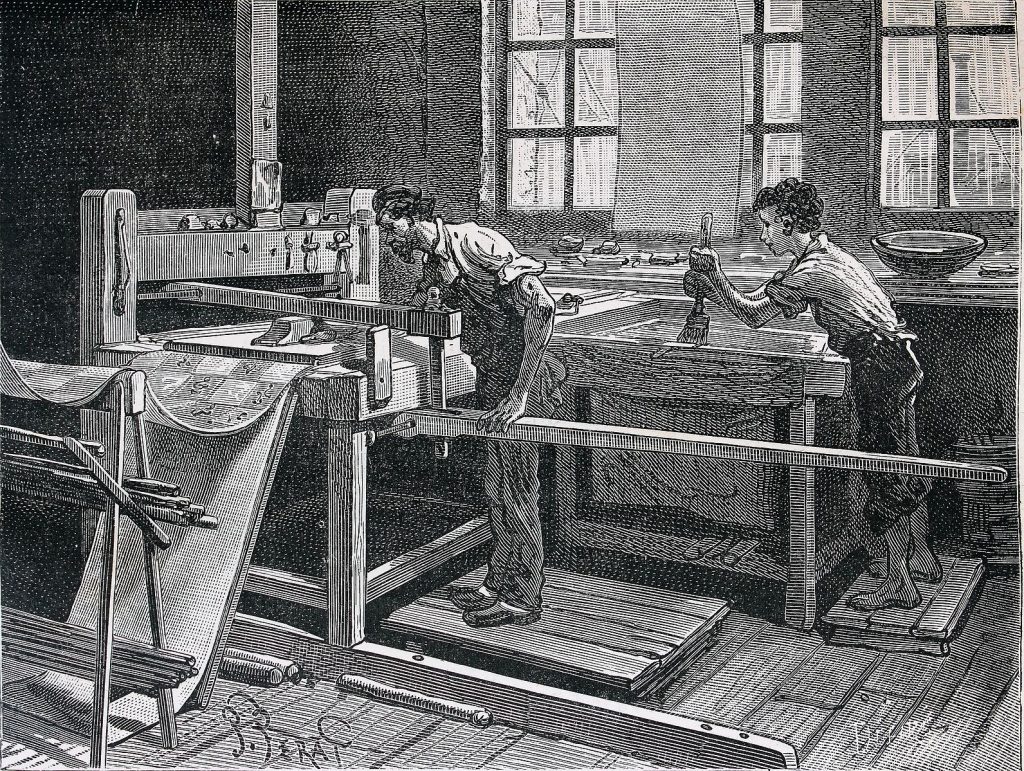
Les merveilles de l’industrie ou, Description des principales industries modernes / par Louis Figuier. – Paris : Furne, Jouvet, [1873-1877]. – Tome II – Fondo Antiguo de la Biblioteca de la Universidad de Sevilla – Wikipedia

The 19th century brought major technical breakthroughs. The invention of continuous paper around 1830 enabled mechanised production. Printing machines — first manual, then steam-powered — multiplied rapidly. In 1839, Potters & Ross patented the first roller-printing machine; by 1841, C.H. & E. Potter had refined the process. British production soared from one million rolls in 1834 to nearly nine million by 1860, while prices fell sharply.

Yet industrialisation did not erase luxury. On the contrary, manufacturers competed through innovation: embossing, gilding, satin finishes and trompe-l’œil effects. Wallpaper imitated marble, Cordovan leather, Lyon silks and winter-garden foliage. It became a tool of architectural illusion, capable of reshaping spatial perception.

Wall, surface and illusion: aesthetic debates

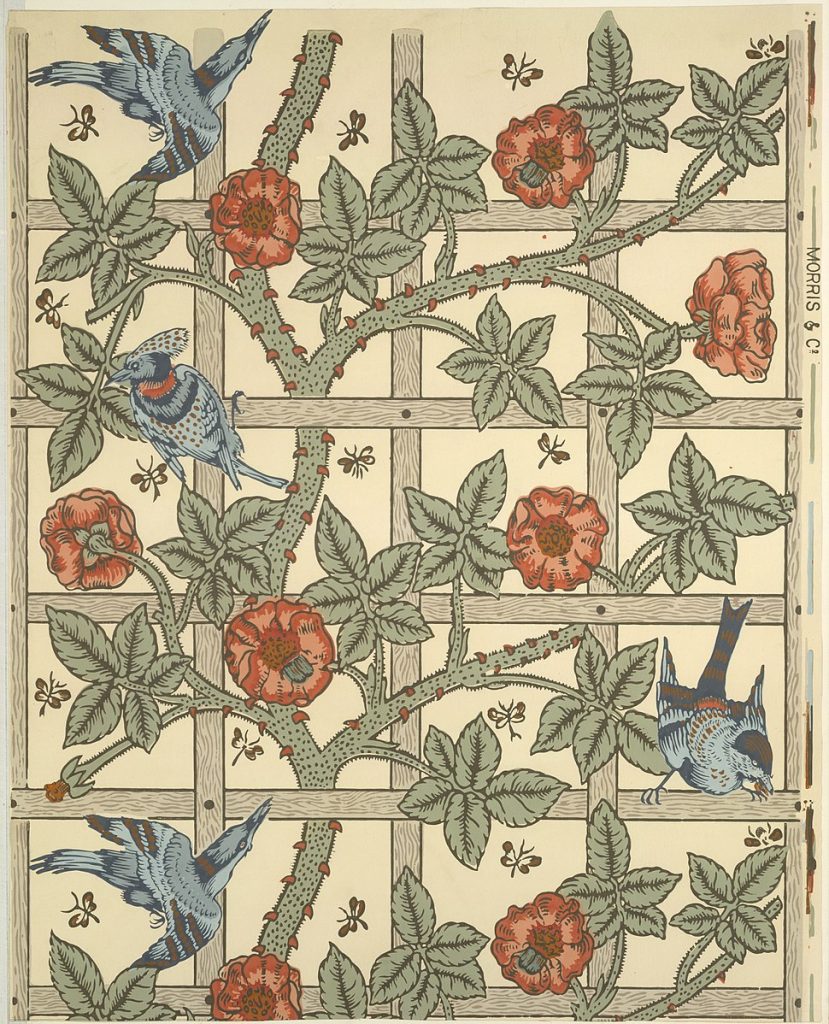
Trellis, papier peint, William Morris, Birds designed by Philip Webb, Morris & Company (MET, 23.163.4h) – Wikimedia

This decorative abundance also sparked debate. In the mid-19th century, figures such as architect A.W.N. Pugin criticised the excessive naturalism of Victorian motifs, arguing that they contradicted the inherent flatness of the wall. Owen Jones advocated a return to abstraction, symmetry and disciplined ornament.

It was William Morris who forged the most enduring synthesis. Designing over fifty patterns, Morris observed nature directly, distilling it into stylised organic forms that were neither illusionistic nor purely geometric. Trellis (1864) and Willow Bough (1885) exemplify this approach. Wallpaper became the bearer of an ideal: accessible art rooted in everyday life.

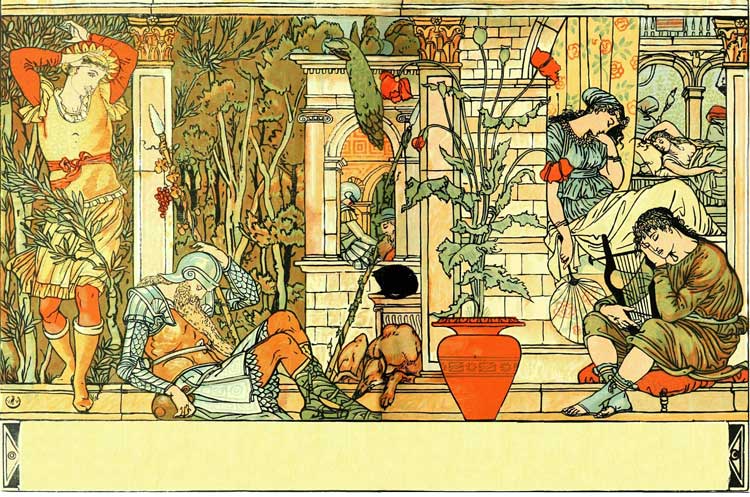
Walter Crane, The Sleeping Beauty, le château endormi – Picryl

From domestic decor to specialised uses

Walter Crane, The Sleeping Beauty, le château endormi – Picryl

By the late 19th century, wallpaper adapted to increasingly specialised interiors. The frieze–filler–dado system structured walls into functional layers, balancing durability and visual rhythm. Wallpapers designed specifically for children’s rooms emerged. In 1879, Walter Crane created Sleeping Beauty, a washable, arsenic-free wallpaper intended to support children’s well-being and imagination.

The 20th century: modernity, decline and revival

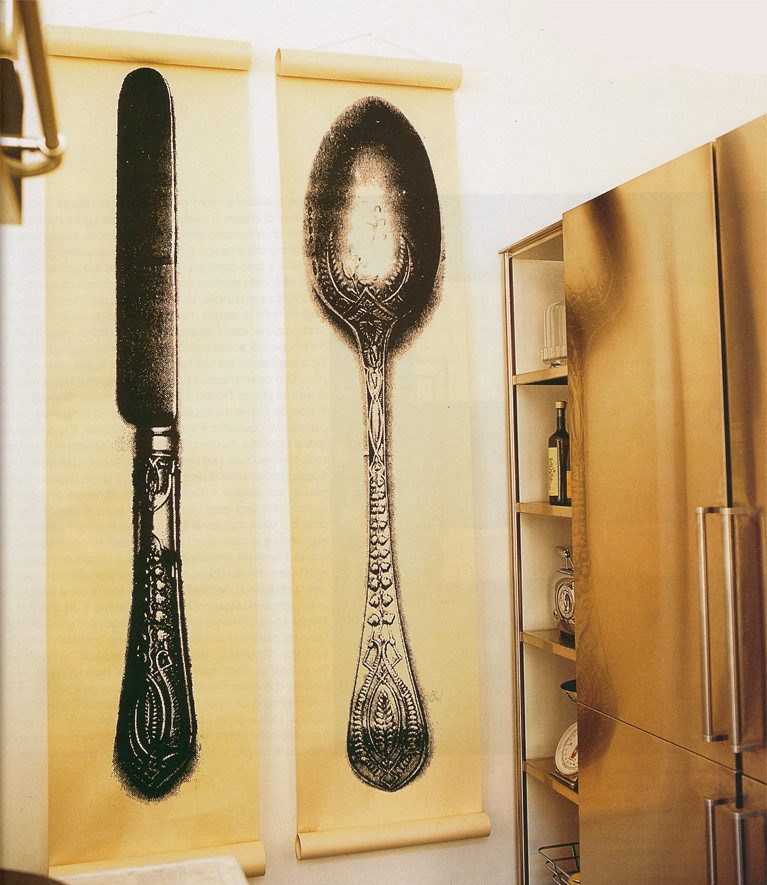
Flickr – Tracy Kendall Wallpaper

Throughout the 20th century, wallpaper mirrored artistic movements of its time. Jazz-age graphics, Cubism, Orientalism and Egyptomania flourished in the 1920s and 1930s. Production peaked at nearly 100 million rolls in 1939. Post-war modernism favoured abstraction, followed by the bold colours of Pop and Op Art in the 1960s.

Technical innovations multiplied: pre-pasted wallpapers (1961), metallic finishes, washable vinyls. The oil crisis of 1973 weakened the industry, and paint emerged as a competitor. Wallpaper briefly lost its prestige.

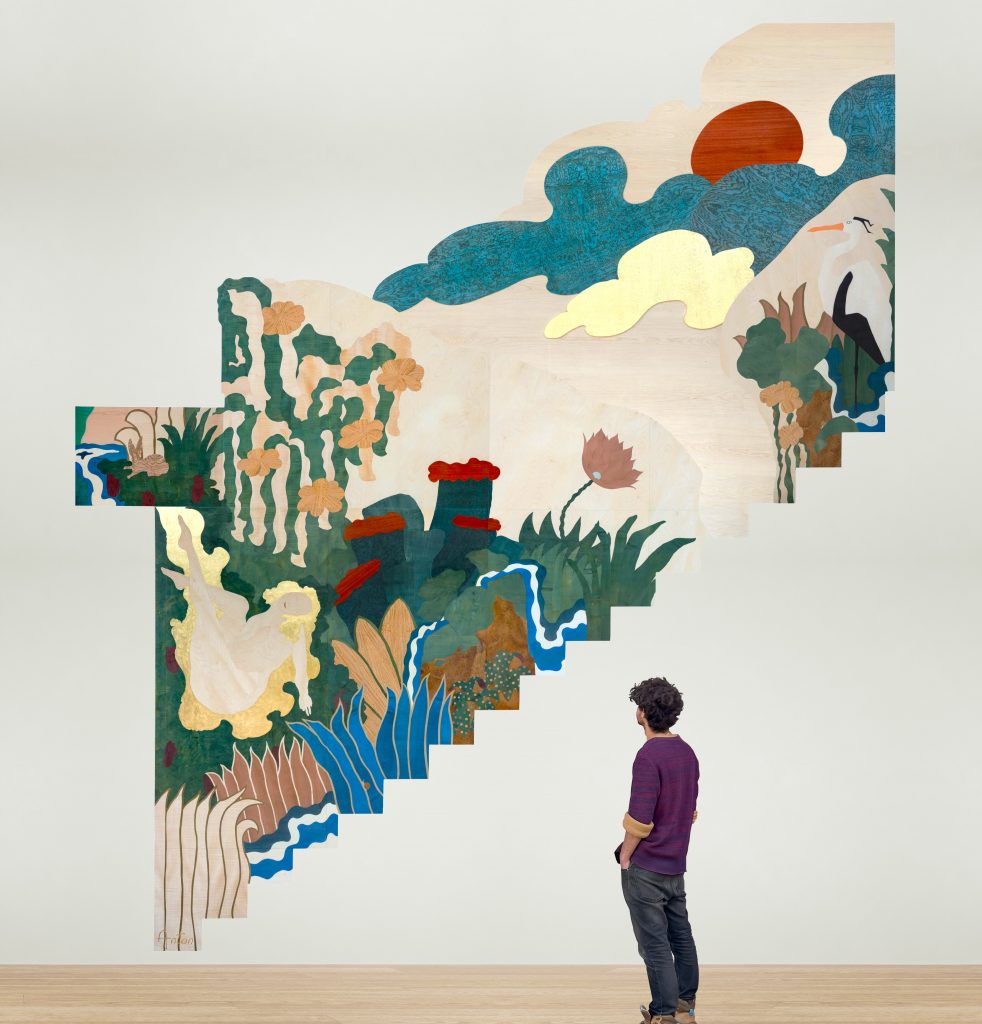
From the 2000s onward, however, a renaissance took place. High-definition digital printing, contemporary screen printing and limited editions reconnected wallpaper with artistic expression. Designers such as Deborah Bowness, Tracy Kendall and Timorous Beasties approached the wall as installation rather than surface.

Luxury wallpaper today: an architectural material

Photo de Mehmet Turgut Kirkgoz – Pexels

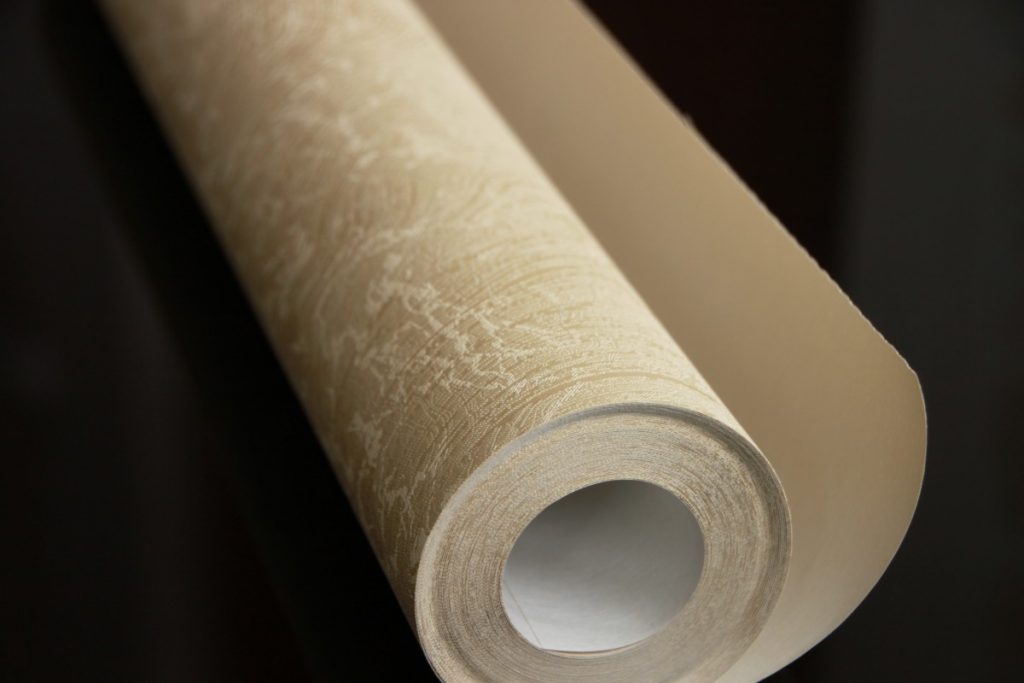
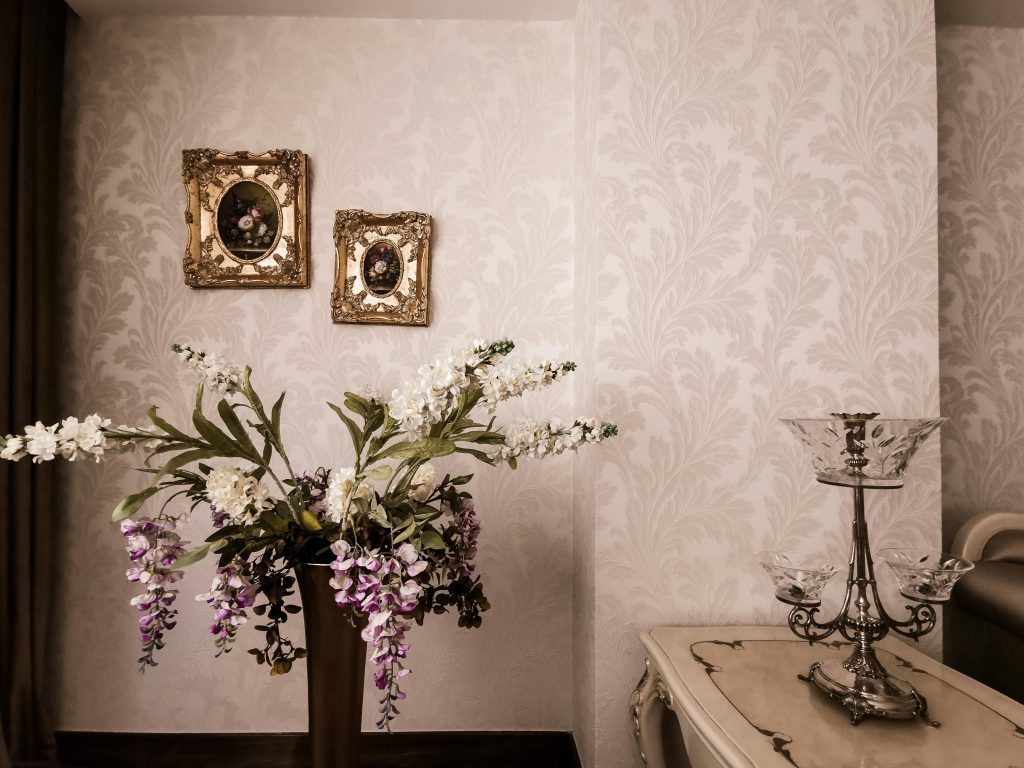
Today, luxury wallpaper is fully recognised as an architectural material. Premium non-woven substrates, complex textures, material effects and the integration of resin beads or metallic primers combine technical performance with visual richness. Durable, washable and stable, wallpaper conceals imperfections while enabling bold yet reversible interventions.

For architects, it has become a powerful storytelling tool — capable of giving spaces immediate identity and interacting with light, volume and use.

Manufacturers and publishers: a living heritage

French houses such as Élitis, Isidore Leroy, Casamance, Papiers de Paris, Ananbô and Le Grand Siècle uphold this tradition, blending innovation with craftsmanship. Internationally, Cole & Son, Osborne & Little, Designers Guild and Little Greene embody a British lineage where wallpaper remains inseparable from domestic culture.

Luxury wallpaper is neither relic nor ornament. It is a living memory, a sensitive surface that continues to evolve without losing its emotional resonance. For contemporary designers, it offers a rare field of expression — where history, technique and vision converge.


French luxury wallpaper manufacturers

Élitis

French publisher of high-end wallpapers, textures and panoramas, offering varied collections (plain, textured, patterned and hand-painted motifs) designed for residential or contract environments. Its wall coverings frequently incorporate materials and effects sought after in demanding projects.

Isidore Leroy

Historic French company specialising in traditional and panoramic wallpapers, renowned for its refined patterns and artisanal heritage.

Casamance

French brand offering wallpapers, wall coverings and decorative textiles with a timeless and sophisticated aesthetic, combining meticulous detail with stylistic diversity.

Papiers de Paris

French specialist in reproductions of exceptional historical and panoramic decorations, often produced under museum licences and featuring large-scale heritage-inspired compositions.

Le Grand Siècle

French publisher reviving 18th- and 19th-century decorative schemes from museum collections. Its panoramic wallpapers and motifs reinterpret a rich decorative heritage for contemporary interiors.

Ananbô

High-end studio specialising in murals and panoramic wallpapers, created from original designs or inspired by historical landscapes and motifs. Particularly suited to exceptional projects, hotels and prestigious residences.

International companies

Cole & Son (United Kingdom)

Iconic English luxury wallpaper house founded in 1875, renowned for its heritage patterns, graphic identity and artistic collaborations.

Osborne & Little

British manufacturer celebrated for bold wallpapers and innovative textures, blending contemporary trends with reinterpreted classic designs.

Little Greene (United Kingdom)

British manufacturer of premium wallpapers and paints, drawing on historical archives to reinterpret patterns for both classic and contemporary interiors.

Continue exploring

The story of a bold French company: from Q de Bouteille to QDB Éditions
Gastronomy and craftsmanship: the anatomy of the perfect bite
Michelin Guide : How a tyre manufacturer became the ultimate judge of the world’s best cuisine
The iconic French mailbox becomes a design object
Maison&Objet 2026: a return to heritage and essence
Art Deco: a century-old movement that’s more relavant than ever

Février, 2026

Édition 3 : Patrimoine et création

Créer avec l’existant, penser avec l’histoire

De l’architecture au design, cette édition explore comment lieux, savoir-faire et matières héritées deviennent terrains de création actuelle.

Janvier, 2026

Édition 2 : Quiet luxury

Le luxe se réinvente.

Finis les logos clignotants, place à une sobriété raffinée, à l’immersion personnelle, à l’excellence artisanale, à la durabilité sensible.

Décembre, 2025

Édition 1 : Le sens de la fête

Héritages, gestes contemporains et plaisirs essentiels

Parce que la fête n’est jamais qu’apparence : elle reflète notre manière d’habiter le monde, de transmettre, de fabriquer des souvenirs durables.

ÉDITION #3

Révéler la beauté

Upcycling et kintsugi transforment l’objet contemporain, faisant de la trace, de la réparation et de la matière un langage esthétique.

ÉDITION #3

Les nouveaux artisans du patrimoine

Artisans et designers donnent une seconde vie aux matériaux anciens, entre création contemporaine, patrimoine et réemploi.

ÉDITION #3

L'art à la rescousse des friches et lieux oubliés

Bunkers, wagons et kiosques renaissent grâce à la création, révélant comment l’art redonne sens aux lieux délaissés.

ÉDITION #2

Le murmure du beau

Un regard transversal sur le quiet luxury à travers des lieux, des objets et des figures qui expriment l’élégance.

ÉDITION #1

Lieux, maisons et matières en éclats

Une sélection de marques, architectures, objets et escapades qui donnent corps au sens de la fête.

ÉDITION #3

La création au secours des bâtiments promis à l’oubli

Usines et gares délaissées deviennent lieux culturels ouverts, où mémoire industrielle et usages contemporains redessinent la ville.

ÉDITION #3

Hôtel Normandy Le Chantier

L’audacieuse métamorphose d’un palace parisien

ÉDITION #3

Dans les coulisses du Centre d'Études Picasso à Paris

Au cœur du Marais, un lieu discret révèle comment archives, architecture et recherche font dialoguer l’œuvre de Picasso.

ÉDITION #2

Shopping iconique dans un décor Tudor

Une expérience shopping unique dans un magasin emblématique.

ÉDITION #2

Gastronomie et architecture

Voyage culinaire et architectural au cœur de la Seine

ÉDITION #2

L'art de l'hospitalité parisienne

Dans le 9e arrondissement, un établissement qui invite au quiet luxury

ÉDITION #1

Chante!

Chante! vient d’ouvrir ses portes. Une invitation à vibrer !

ÉDITION #3

La boîte aux lettres française devenue objet de design

Icône du paysage français, la boîte jaune change de statut et s’invite dans l’univers du design.

ÉDITION #3

Retour sur Maison&Objet 2026 : retour aux sources et à l’essentiel

L’édition 2026 affirme une vision où artisanat, design et mémoire façonnent l’habitat contemporain, international actuel.

ÉDITION #3

Art Deco: un mouvement centenaire, plus actuel que jamais

Cent ans après 1925, l’Art déco revient dans nos villes et intérieurs avec géométrie, audace, optimisme.

ÉDITION #3

Royal Limoges, deux siècles d’histoire au présent

Depuis plus de deux cents ans, Royal Limoges conjugue porcelaine, savoir-faire industriel et création contemporaine.

ÉDITION #3

Du terrain à la rue et au catwalk : les sneakers à travers les époques

Des terrains de sport aux podiums, la sneaker raconte un siècle de mutations culturelles, techniques et stylistiques.

ÉDITION #2

La formidable aventure du papier peint de luxe

Design, mode, artisanat : des créations où la forme et la matière se répondent avec justesse, loin de tout effet de mode.

ÉDITION #1

Icônes, détails, rituels

Décorations artisanales, calendriers ultra-luxe et pièces de collection pour s’enivrer de joie avant l’heure.

ÉDITION #3

Anton Laborde

Entre marqueterie monumentale et jungle symbolique, Anton Laborde transforme le bois en récit contemporain poétique engagé.

ÉDITION #3

Thierry Laudren

À Maison & Objet, Thierry Laudren présente des meubles sculptés où fonction, matière et lenteur façonnent une présence.

ÉDITION #3

Jean Nouvel

Jean Nouvel conçoit une architecture attentive aux contextes, où lumière, histoire et usages façonnent chaque projet.

ÉDITION #3

Sophie Morel

À Lyon, Sophie Morel rénove des lieux historiques en alliant respect du bâti et écriture contemporaine.

ÉDITION #3

Pascal Grasso

Au Centre d’Études Picasso, l’architecte compose une architecture où lumière, géométrie et héritage dialoguent avec précision.

ÉDITION #2

Alexandre Danan

Entretien avec le fondateur d’EDO (European Design Office)

ÉDITION #2

Aziz Temimi

Portrait d’un visionnaire qui transforme l’art de recevoir en expérience totale.

ÉDITION #1

Visages, gestes, inspirations

Personnalités, artisans et créateurs qui donnent à la fête sa profondeur humaine.

ÉDITION #3

Chemins de traverse : parenthèse d’exception en Bordelais

De Bordeaux au Bassin, art, vignobles et bien-être composent une échappée élégante au cœur de la Gironde.

ÉDITION #2

Voyage en Toscane

Vers une région de l’Italie habitée par le temps, où paysages, culture et usages s’accordent dans une continuité rare.

ÉDITION #1

Horizons, saisons, traditions

Destinations et rituels qui réinventent la fête, du soleil tropical aux marchés d’hiver.

Dates, adresses, invitations

Expositions, événements et repères culturels pour vivre pleinement la saison des fêtes.