When walls become narrative, material and architecture
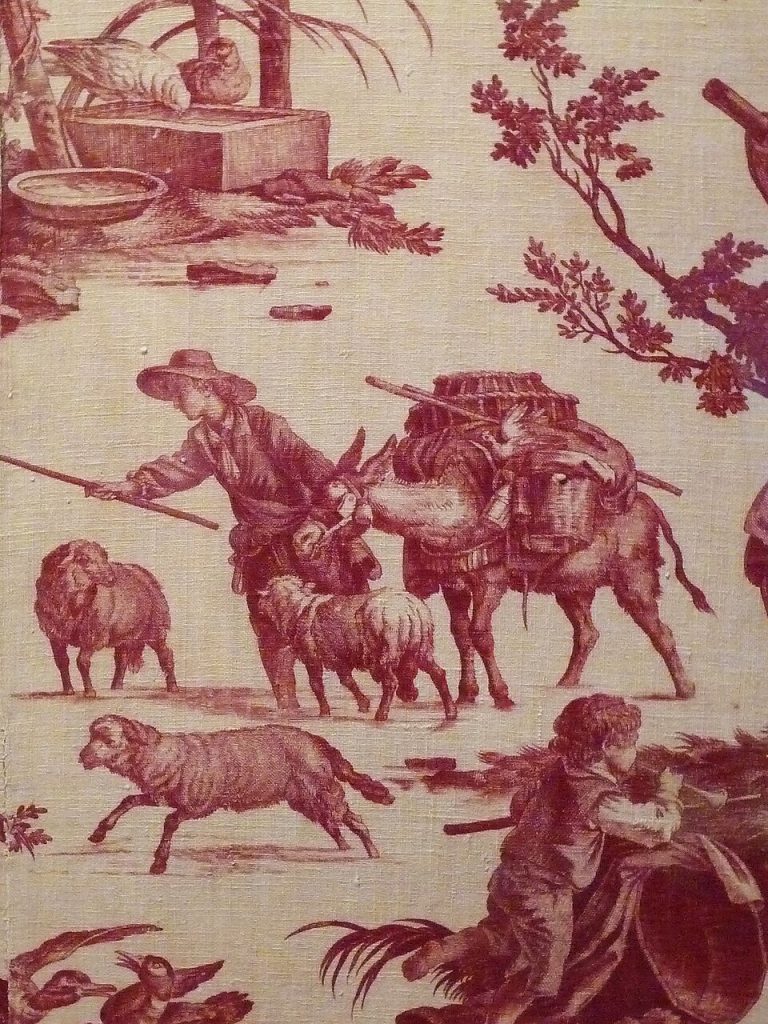
Les occupations de la ferme, Jouy-en-Josas, manufacture Oberkampf, dessinateur Jean-Baptiste Huet, vers 1785-1792, toile de coton imprimée à la plaque de cuivre. Ji-Elle – Wikimedia
Long confined to the role of a decorative backdrop, wallpaper is now enjoying renewed recognition. In today’s most exacting interior projects, it no longer merely covers a wall: it structures space, engages with architecture and anchors interiors within a long lineage of gestures, techniques and visual cultures.
The story of luxury wallpaper is that of a mural art in its own right -one that predates industrialisation and has been shaped by cultural exchange, technical innovation and shifting tastes over centuries.
Les occupations de la ferme, Jouy-en-Josas, manufacture Oberkampf, dessinateur Jean-Baptiste Huet, vers 1785-1792, toile de coton imprimée à la plaque de cuivre. Ji-Elle – Wikimedia
Lin Amd – Pexels
Lin Amd – Pexels
The history of wallpaper begins in China before the year 1000. From the 8th century onward, large sheets of paper or fabric were hand-painted to adorn the walls of palaces and aristocratic residences. Unlike later European production, these early wall coverings were not conceived as repeating patterns but as expansive pictorial scenes, designed to envelop the space.
Their chromatic precision and attention to detail established an enduring standard for luxury wall decoration. Ironically, these Chinese wallpapers — produced largely for export — were rarely used domestically. Imported into Europe from the 16th century through trade in silks, lacquers and porcelain, they quickly became prized by Western elites. Their technical sophistication and narrative power profoundly influenced European makers, who sought to decipher their secrets.
Pxhere (détails)
By the 16th century, Europe had begun developing its own solutions. In France, dominos appeared as early as 1514: paper sheets printed with wooden blocks for outlines, then coloured by hand. These versatile objects were used not only on walls, but also on furniture, boxes and book bindings -hybrid artefacts at the crossroads of graphic craft and interior decoration.
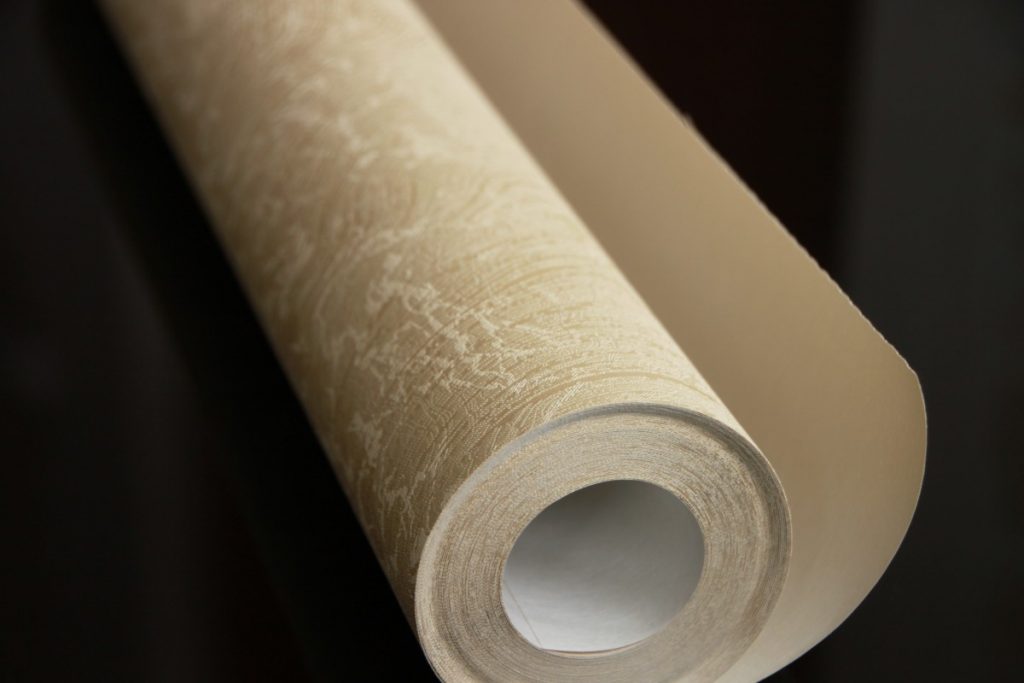
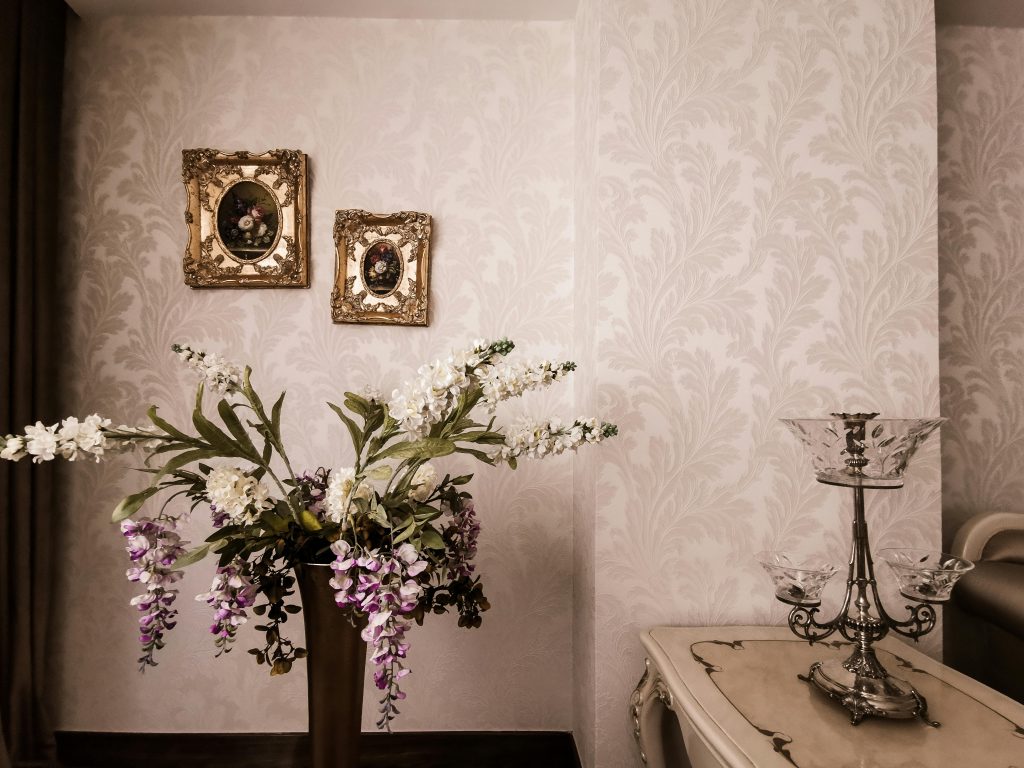
A decisive shift occurred in early 18th-century England, when manufacturers began gluing sheets together into continuous rolls before printing. This innovation gave birth to wallpaper as we know it today: a continuous surface designed to cover entire walls. Block printing soon enabled increasingly complex polychrome motifs, often inspired by contemporary textile patterns.
Pxhere (détails)
Brian Ramirez – Pexels
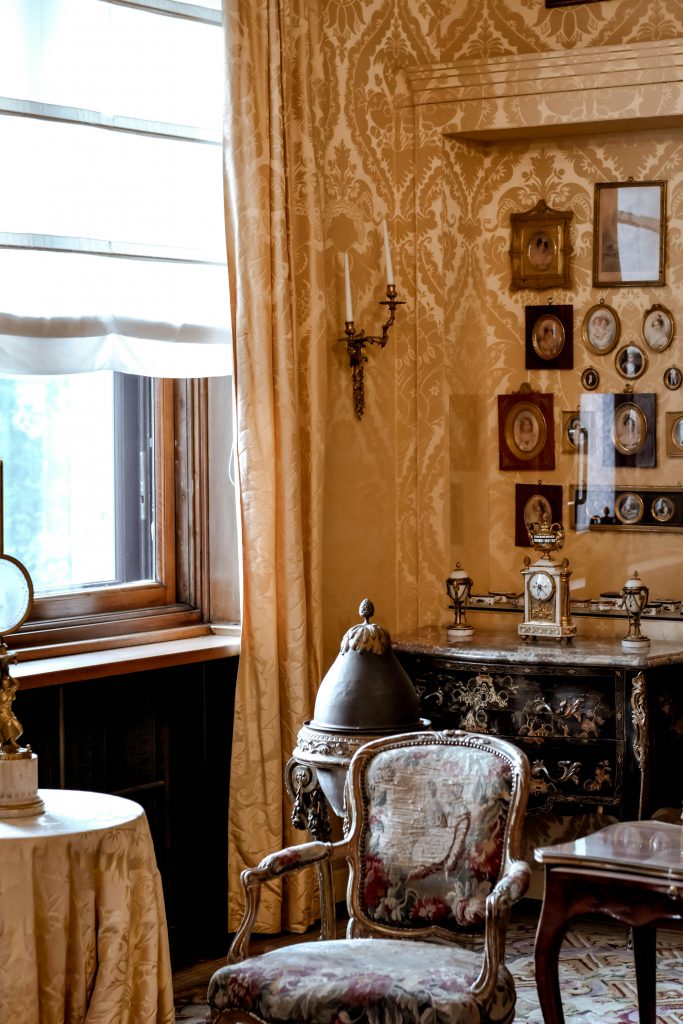
One of the era’s most significant innovations was flocked wallpaper. In 1634, in London, Jerome Lanier developed a method of applying coloured wool powder onto varnished motifs, creating a remarkably convincing imitation of velvet and silk damasks.
These wallpapers were an immediate success. Less costly than textiles yet durable — and conveniently moth-resistant thanks to the turpentine used in the adhesive — they became widespread. By the 18th century, few English homes lacked at least one room decorated with flocked wallpaper. The wall became tactile, almost textile in nature, and wallpaper emerged as a credible alternative to tapestries.
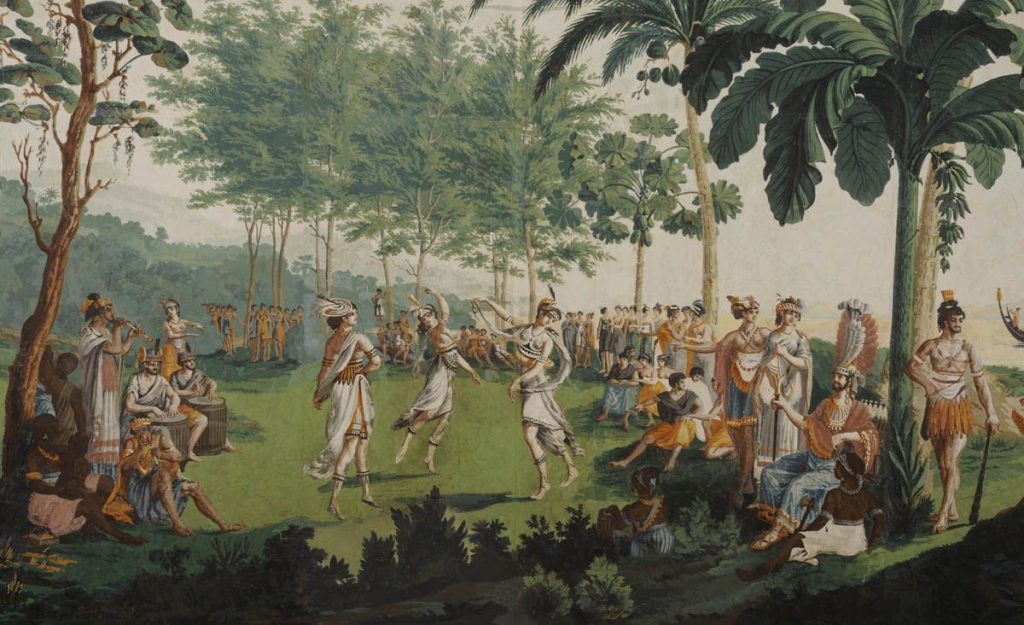
DUFOUR (manufacture) ; CHARVET Jean-Gabriel (dessinateur) – Les sauvages de la mer du Pacifique ; les voyages du capitaine COOK (titre d’usage) ; Paysages indiens (titre d’usage) – Wikimedia
In France, excellence found its embodiment in the factory of Jean-Baptiste Réveillon, founded around 1750. As the first royal wallpaper manufactory, it elevated the medium to new heights through refined backgrounds, masterful colour palettes and complex printing techniques. Wallpaper was no longer a substitute; it became a deliberate aesthetic choice.
This ambition culminated in the rise of panoramic wallpapers. At the beginning of the 19th century, Joseph Dufour produced Les Sauvages de la mer du Pacifique (1804), a monumental composition printed across vast strips. These immersive decors transformed salons and staircases into narrative landscapes. Wallpaper ceased to be a pattern — it became a story.
DUFOUR (manufacture) ; CHARVET Jean-Gabriel (dessinateur) – Les sauvages de la mer du Pacifique ; les voyages du capitaine COOK (titre d’usage) ; Paysages indiens (titre d’usage) – Wikimedia
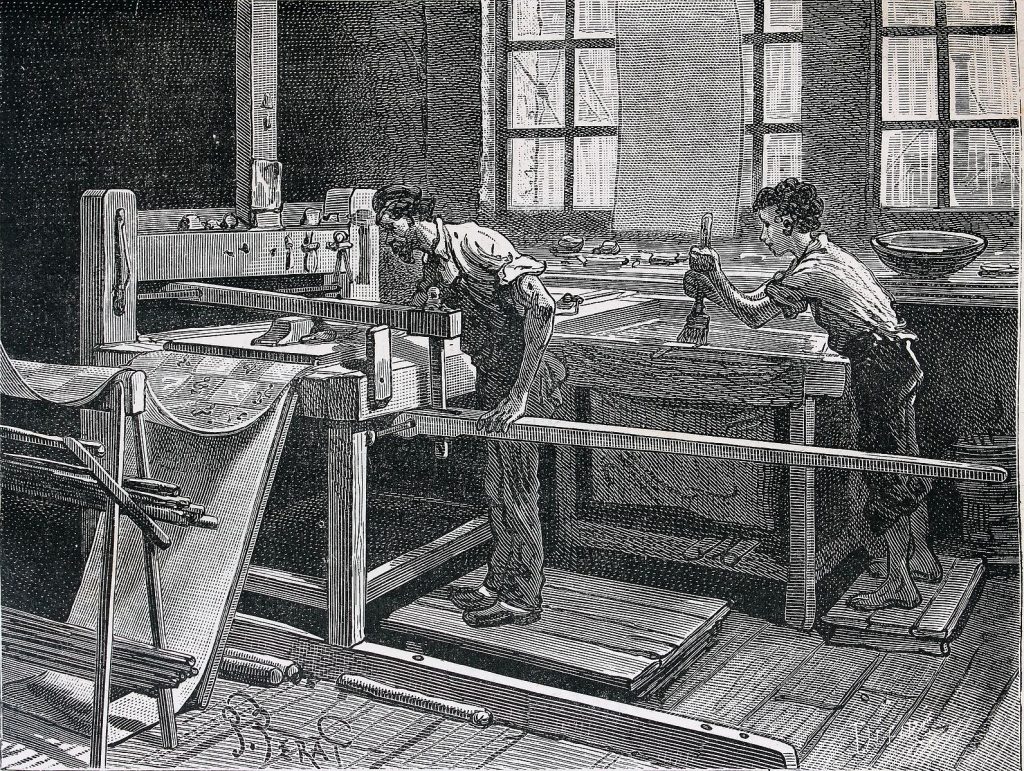
Les merveilles de l’industrie ou, Description des principales industries modernes / par Louis Figuier. – Paris : Furne, Jouvet, [1873-1877]. – Tome II – Fondo Antiguo de la Biblioteca de la Universidad de Sevilla – Wikipedia
The 19th century brought major technical breakthroughs. The invention of continuous paper around 1830 enabled mechanised production. Printing machines — first manual, then steam-powered — multiplied rapidly. In 1839, Potters & Ross patented the first roller-printing machine; by 1841, C.H. & E. Potter had refined the process. British production soared from one million rolls in 1834 to nearly nine million by 1860, while prices fell sharply.
Yet industrialisation did not erase luxury. On the contrary, manufacturers competed through innovation: embossing, gilding, satin finishes and trompe-l’œil effects. Wallpaper imitated marble, Cordovan leather, Lyon silks and winter-garden foliage. It became a tool of architectural illusion, capable of reshaping spatial perception.
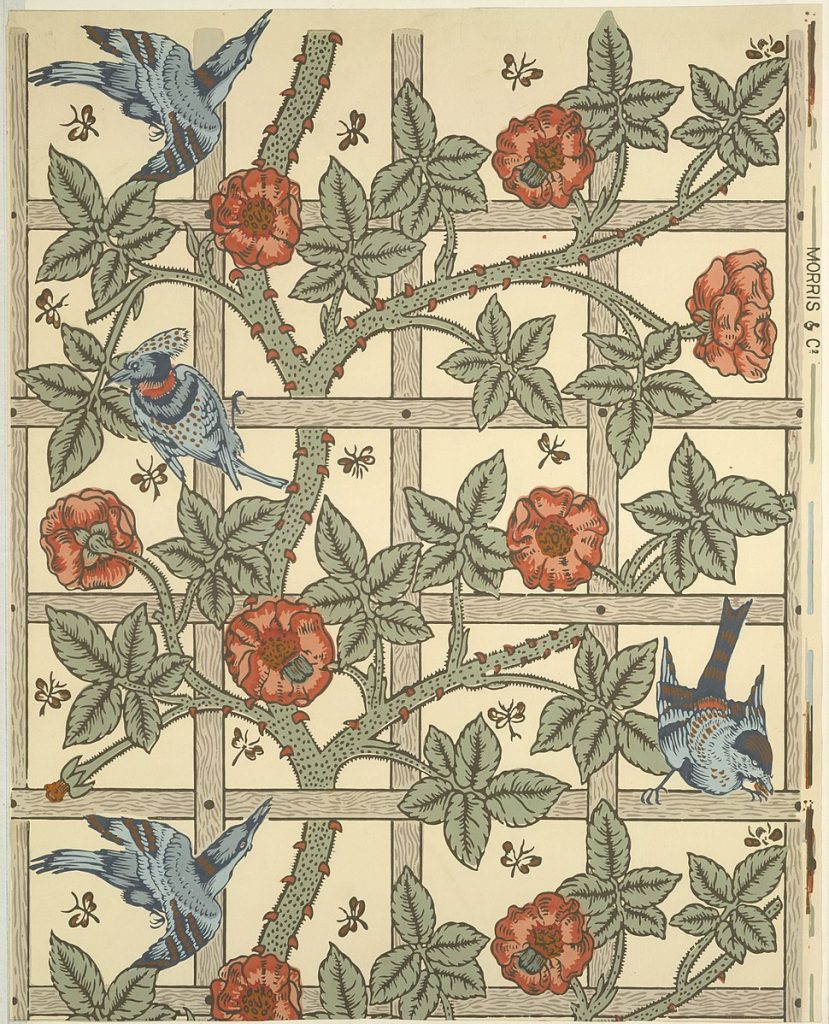
Trellis, papier peint, William Morris, Birds designed by Philip Webb, Morris & Company (MET, 23.163.4h) – Wikimedia
This decorative abundance also sparked debate. In the mid-19th century, figures such as architect A.W.N. Pugin criticised the excessive naturalism of Victorian motifs, arguing that they contradicted the inherent flatness of the wall. Owen Jones advocated a return to abstraction, symmetry and disciplined ornament.
It was William Morris who forged the most enduring synthesis. Designing over fifty patterns, Morris observed nature directly, distilling it into stylised organic forms that were neither illusionistic nor purely geometric. Trellis (1864) and Willow Bough (1885) exemplify this approach. Wallpaper became the bearer of an ideal: accessible art rooted in everyday life.
Trellis, papier peint, William Morris, Birds designed by Philip Webb, Morris & Company (MET, 23.163.4h) – Wikimedia
Walter Crane, The Sleeping Beauty, le château endormi – Picryl
By the late 19th century, wallpaper adapted to increasingly specialised interiors. The frieze–filler–dado system structured walls into functional layers, balancing durability and visual rhythm. Wallpapers designed specifically for children’s rooms emerged. In 1879, Walter Crane created Sleeping Beauty, a washable, arsenic-free wallpaper intended to support children’s well-being and imagination.
Flickr – Tracy Kendall Wallpaper
Throughout the 20th century, wallpaper mirrored artistic movements of its time. Jazz-age graphics, Cubism, Orientalism and Egyptomania flourished in the 1920s and 1930s. Production peaked at nearly 100 million rolls in 1939. Post-war modernism favoured abstraction, followed by the bold colours of Pop and Op Art in the 1960s.
Technical innovations multiplied: pre-pasted wallpapers (1961), metallic finishes, washable vinyls. The oil crisis of 1973 weakened the industry, and paint emerged as a competitor. Wallpaper briefly lost its prestige.
From the 2000s onward, however, a renaissance took place. High-definition digital printing, contemporary screen printing and limited editions reconnected wallpaper with artistic expression. Designers such as Deborah Bowness, Tracy Kendall and Timorous Beasties approached the wall as installation rather than surface.
Flickr – Tracy Kendall Wallpaper
Photo de Mehmet Turgut Kirkgoz – Pexels
Today, luxury wallpaper is fully recognised as an architectural material. Premium non-woven substrates, complex textures, material effects and the integration of resin beads or metallic primers combine technical performance with visual richness. Durable, washable and stable, wallpaper conceals imperfections while enabling bold yet reversible interventions.
For architects, it has become a powerful storytelling tool — capable of giving spaces immediate identity and interacting with light, volume and use.
French houses such as Élitis, Isidore Leroy, Casamance, Papiers de Paris, Ananbô and Le Grand Siècle uphold this tradition, blending innovation with craftsmanship. Internationally, Cole & Son, Osborne & Little, Designers Guild and Little Greene embody a British lineage where wallpaper remains inseparable from domestic culture.
Luxury wallpaper is neither relic nor ornament. It is a living memory, a sensitive surface that continues to evolve without losing its emotional resonance. For contemporary designers, it offers a rare field of expression — where history, technique and vision converge.


French publisher of high-end wallpapers, textures and panoramas, offering varied collections (plain, textured, patterned and hand-painted motifs) designed for residential or contract environments. Its wall coverings frequently incorporate materials and effects sought after in demanding projects.

Historic French company specialising in traditional and panoramic wallpapers, renowned for its refined patterns and artisanal heritage.
French brand offering wallpapers, wall coverings and decorative textiles with a timeless and sophisticated aesthetic, combining meticulous detail with stylistic diversity.
French specialist in reproductions of exceptional historical and panoramic decorations, often produced under museum licences and featuring large-scale heritage-inspired compositions.
French publisher reviving 18th- and 19th-century decorative schemes from museum collections. Its panoramic wallpapers and motifs reinterpret a rich decorative heritage for contemporary interiors.
High-end studio specialising in murals and panoramic wallpapers, created from original designs or inspired by historical landscapes and motifs. Particularly suited to exceptional projects, hotels and prestigious residences.
Iconic English luxury wallpaper house founded in 1875, renowned for its heritage patterns, graphic identity and artistic collaborations.
British manufacturer celebrated for bold wallpapers and innovative textures, blending contemporary trends with reinterpreted classic designs.
British manufacturer of premium wallpapers and paints, drawing on historical archives to reinterpret patterns for both classic and contemporary interiors.
Luxury wallpaper is neither a relic nor a mere decorative accessory. It is a living memory — a sensitive material that has withstood time without losing its emotional power. For contemporary architects, it offers a unique surface of expression: a place where history, technique and vision converge.
contact@wearekollectors.com
5 rue du Helder 75009 PARIS
Site by FORGITWEB
January, 2026
Luxury is reinventing itself.
No more flashing logos, place to a refined sobriety, personal immersion, artisanal excellence, sensitive sustainability.
December, 2025
heritage, contemporary practices and essential pleasures
Because celebration is more than just appearances:
it reflects how we live the world, pass on traditions and create lasting memories.
ISSUE #2
Design, fashion, craftsmanship: creations where form and material respond with precision, far from any fashionable effect.
ISSUE #1
Handcrafted decorations, ultra-luxurious calendars and collectibles to fill you with joy before the season begins.
ISSUE #2
The architect of light and shadow
Interview with the founder of EDO (European Design Office)
ISSUE #2
The alchemist of discreet hospitality
Portrait of a visionary who transforms the art of hospitality into a total experience.
ISSUE #1
Antonio Gaudi and Paul Tissier
Personalities, artisans and creators who give the celebration its human depth.
Inscrivez-vous pour avoir accès à l’ensemble du site WeAreKollectors.